

The Work of Maurits Cornelis M'C' Escher PowerPoint PPT Presentation
1 / 24
Title: The Work of Maurits Cornelis M'C' Escher
1
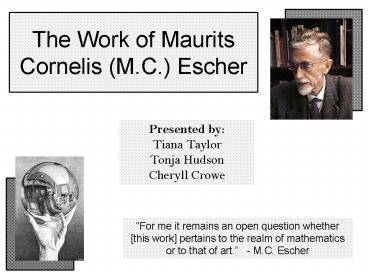
The Work of Maurits Cornelis (M.C.) Escher
Presented by Tiana Taylor Tonja Hudson Cheryll
Crowe
For me it remains an open question whether
this work pertains to the realm of mathematics
or to that of art. - M.C. Escher
2
Small Group Discussion - Guiding Questions
1) Give examples of how Eschers work can be
utilized at the following levels elementary,
middle / high school, beyond. 2) Do you believe
Eschers work is more in the realm of mathematics
or art? 3) How can technology be used to create
Escher-inspired art? Other technology/software? 4)
Knowing there are other artists/mathematicians
with Eschers vision, how can you use this
information in constructing lessons in
mathematics?
3
Topics touched by Escher
- Tessellations
- Isometric drawings
- Transformations
- Impossible figures
- Non-Euclidean geometry
- Symmetry
- Polygons
- Limiting Idea
- Infinity
- Polyhedra
- Spherical geometry
4
History of M.C. Escher
- Maurits Cornelis Escher was born in Holland in
1898. - Poor student who had to repeat two grades
- Architecture to Graphic Arts to professional work
- Inspired by Italian architecture
- Two categories
- Geometry of Space
- Tessellations
- Polyhedra
- Hyperbolic Space
- Logic of Space
- Visual Paradoxes
- Impossible Drawings
- MC Escher died in 1972 and Snakes was his last
contribution to the world of art and mathematics.
Snakes (1969)
5
Artist and/or Mathematician
- The ideas that are basic to my works often
bear witness to my amazement and wonder at the
laws of nature which operate in the world around
us. He who wonders discovers that this is in
itself a wonder. By keenly confronting the
enigmas that surround us, and by considering and
analyzing the observations that I had made, I
ended up in the domain of mathematics. Although I
am absolutely without training or knowledge in
the exact sciences, I often seem to have more in
common with mathematicians than with my fellow
artists. M. C. Escher
6
Escher at the Elementary Level (K-5)
7
NCTM StandardsPre-K Grade 2 Connections
- Recognize 2D and 3D shapes
- Investigate and predict results of putting
together and taking apart shapes - Recognize and apply slides, flips, and turns
- Recognize and represent shapes from different
perspectives
8
NCTM StandardsGrade 3-5 Connections
- Investigate, describe, and reason about the
results of combining and transforming shapes - Explore congruence and similarity
- Predict and describe results of sliding,
flipping, and turning 2D shapes - Identify and describe line and rotational
symmetry - Recognize geometric ideas and relationships and
apply them in everyday life
9
Escher-Inspired Lego Designs
M.C. Escher "Relativity"
http//imp-world.narod.ru/art/lego/
10
Escher-Inspired Lego Designs cont.
M.C. Escher "Waterfall"
http//imp-world.narod.ru/art/lego/
11
Escher for the Middle and High School (6-12)
12
NCTM StandardsGrade 6-8 Connections
- Examine the congruence, similarity, and line or
rotational symmetry of objects using
transformations - Recognize and apply geometric ideas and
relationships in areas outside the mathematics
classroom, such as art and everyday life
13
NCTM StandardsGrade 9-12 Connections
- Analyze properties and determine attributes of 2D
and 3D objects - Explore relationships among classes of 2D and 3D
geometric objects - Understand and represent translations,
reflections, rotations, and dilations of objects
in the plane - Draw and construct representation of 2D and 3D
geometric objects using a variety of tools
14
Creating Eschers Impossible Figures Using
Computer Software
Impossible Puzzle 1.10 creates
impossible figures from triangles
http//imp-world.narod.ru/programs/index.html
15
Creating Eschers Impossible FiguresUsing
Computer Software
Impossible Constructor 1.25 creates
impossible figures from cubes
http//imp-world.narod.ru/programs/index.html
16
Escher and Beyond
17
Escher and the Droste Effect
- Did Escher leave the center blank on purpose?
- Is it possible to render this image via computer
programming? - Hendrik Lendstra Bart de Smit
- http//www.msri.org/people/members/sara/articles/s
iamescher.pdf - http//escherdroste.math.leidenuniv.nl/index.php?m
enuintro
18
Beyond Escher
- Victor Acevedo
- 1977 Escher inspired pilgrimage to Alhambra in
Granada
Synapse - Cuboctahedronic Periphery
19
Beyond Escher
- Dr. Helaman Ferguson
- Sculpture
- celebrates the remarkable achievements of
mathematics as an abstract art form
Thirteenth Eigenfunction on the Helge Koch
fractal snowflake curve
20
Beyond Escher
- Dr. Robert Fathauer
- In 1993 founded Tessellations
- Researcher for NASAs Jet Propulsion Laboratory
- Fractal Iteration
Fractal Knots No. 1
21
Beyond Escher
- Dr. S. Jan Abas
- School of Computer Science at the University of
Wales - Islamic Geometric Patterns his heritage
Islamic Pattern in
Hyperbolic Space
22
Small Group Discussion - Guiding Questions
1) Give examples of how Eschers work can be
utilized at the following levels elementary,
middle / high school, beyond. 2) Do you believe
Eschers work is more in the realm of mathematics
or art? 3) How can technology be used to create
Escher-inspired art? Other technology/software? 4)
Knowing there are other artists/mathematicians
with Eschers vision, how can you use this
information in constructing lessons in
mathematics?
23
References
Abas, S. J. (2001). Islamic geometrical patterns
for the teaching of mathematics of symmetry
Special issue of Symmetry Culture and Science.
Symmetry in Ethnomathematics, 12(1-2), 53-65.
Budapest, Hungary International
Symmetry Foundation. Abas, S. J. (2000).
Symmetry 2000. Retrieved November 10, 2007,
from http//www.bangor.ac.uk/mas009/pcont.htm A
lexeev, V. (n.d.). Programs. Retrieved November
6, 2007, from http//imp-world.narod.ru/programs
/index.html Alexeev, V. (n.d.). Impossible world
Legos. Retrieved November 6, 2007 from
http//imp-world.narod.ru/art/lego/ Art-Baarn,
C. (n.d.). Escher and the droste effect.
Retrieved November 10, 2007, from
http//escherdroste.math.leidenuniv.nl/index.php
?menuintro De Smit, B. Lenstra Jr., H. W.
(2003). The mathematical structure of
Eschers print gallery, Notices of the AMS,
50(4). Fathauer, R. (n.d.) The iteration
(fractal) art of Robert Fathauer. Retrieved
November 10, 2007, from http//members.cox.net/te
ssellations/IterationArt.html Ferguson, H.
(2003). Helaman Ferguson Sculpture. Retrieved
November 10, 2007, from http//www.helasculpt.com
/index.html Gershon E. (2007). Escher for real.
Retrieved November 6, 2007, from
http//www.cs.technion.ac.il/gershon/EscherFor
Real/Penrose.gif Impossible Staircase (n.d.)
Retrieved November 6, 2007, from
http//www.timhunkin.com/ page_pictures/a119_f3
.jpg
24
References
Mathematics Behind the Art of M.C. Escher (n.d.).
Retrieved November 6, 2007, from
http//www.math.nus.edu.sg/aslaksen/gem-project
s/maa/0203-2-03-Escher/ main3.html M.C. Escher
Company B.V. (2007). The official M.C. Escher
website. Retrieved November 6, 2007, from
http//www.mcescher.com/ NNDB (2007). M.C.
Escher. Retrieved November 6, 2007, from
http//www.nndb.com/people/308/000030218/ Platoni
c Realms (2007). The Mathematical Art of M.C.
Escher. Retrieved November 10, 2007, from
http//www.mathacademy.com/pr/minitext/escher/inde
x.asp Robinson, S. (2002). M.C. Escher More
mathematics than meets the eye. SIAM News,
35(8).
Recommended

