

The Central Dogma of Molecular Biology PowerPoint PPT Presentation
1 / 37
Title: The Central Dogma of Molecular Biology
1
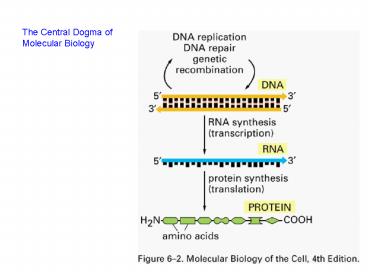
The Central Dogma of Molecular Biology
2
Lecture 2 RNA
- What is it?
- Different types of RNA?
- What is its structure?
- What is its function?
- Terminology (structure) intron, exon, 5
regulatory region, ribosomal RNA, transfer RNA,
messenger RNA, polyadenylation, capping,
transcription, transcription factors, splicing,
alternative transcripts
3
(No Transcript)
4
Structural Elements in DNA Determine Transcription
Exon - sequence that codes for all or part of a
protein Intron - noncoding sequence of DNA that
is removed or spliced out from mRNA 5
regulatory region - region of DNA that drives
gene expression contains promoter
region Terminator - signals end of transcript
5
The Chemical Structure of RNA
Ribose is the sugar
Instead of thymine, RNA contains the pyrimidine
base, Uracil
6
Nucleotide arrangement follow the same rules as
in DNA
7
.except that RNA is single stranded.
RNA can adopt various types of secondary
structure due to base-pairing within the molecule.
8
How is DNA transcribed into RNA?
- One strand of DNA is used as a template for RNA
synthesis - The RNA transcript has a sequence that is
complementary to the DNA strand used as template
- Synthesis of the RNA chain proceeds one
nucleotide at a time, similar to DNA synthesis
- Differences
- RNA strand does not remain hydrogen-bonded to
DNA rather, it is quickly released as a single
strand
- RNA transcripts are much shorter than DNA
molecules since they are copied from a limited
region of the DNA sequence
9
DNA Transcription Requires RNA Polymerase
- DNA helix is unwound as RNA polymerase moves
along DNA - RNA polymerase links ribonucleotides in 5 to 3
direction
- When termination site is reached, RNA is released
10
Several hundred RNA transcripts can be
synthesized from the same DNA sequence 1000/hr!
11
Principal Types of RNAs Produced in Cells TYPE
OF RNA FUNCTION mRNAs messenger RNAs, code for
proteins rRNAs ribosomal RNAs, form the basic
structure of the ribosome and catalyze protein
synthesis tRNAs transfer RNAs, central to
protein synthesis as adaptors between mRNA and
amino acids snRNAs small nuclear RNAs, function
in a variety of nuclear processes, including
the splicing of pre-mRNA snoRNAs small nucleolar
RNAs, used to process and chemically modify
rRNAs Other noncoding function in diverse
cellular processes, including RNAs telomere
synthesis, X-chromosome inactivation, and the
transport of proteins into the ER
12
Three RNA Polymerases in Eucaryotic Cells TYPE
OF POLYMERASE GENES TRANSCRIBED RNA polymerase
I 5.8S, 18S, and 28S rRNA genes RNA polymerase
II all protein-coding genes, plus snoRNA
genes and some snRNA genes RNA polymerase III
tRNA genes, 5S rRNA genes, some snRNA
genes and genes for other small RNAs
13
Messenger RNA (mRNA)
14
It takes a lot of work to begin the process of
transcription...
- RNA Polymerase II requires the help of several
general transcription factors - These are other proteins that
- Position the polymerase correctly
- Help unwind DNA
- Help the polymerase move along DNA strand
Named as TFII for transcription factor for
polymerase II
15
It takes a lot of work to begin the process of
transcription...
- TATA box A-T-rich sequence upstream from
transcription start site - TFIID binds to TATA box via TATA-binding protein
(TBP) - Binding of TFIID causes DNA to bend and distort
16
- Other TFs bind to form a complex
- RNA Pol II is also modified (phosphorylated) on
its tail to stabilize its interaction and
movement along DNA - Once transcription is initiated, TFs fall away
to initiate another round of transcription
17
It gets more complicated....
Transcription also requires activators,
mediators, and chromatin-modifying proteins
Hahn, S. Structure and mechanism of the RNA
polymerase II transcription machinery. Nat.
Struct. Mol. Biol 11(5)394-403
18
Examples of Transcriptional Activators/Repressors
Lac repressor p53 NF?b C/EBP ATF/c-jun STAT
Steroid hormone receptors estrogen (ER),
glucocorticoid (GR), retinoic acid
(RXR) CREB Homeodomain proteins PDX-1, OCT-1,
Pit-1
19
Ruff et al Breast Cancer Res. 2000 2(5)
353359 Estrogen receptor transcription and
transactivation Structure-function relationship
in DNA- and ligand-binding domains of estrogen
receptors
Panne et al EMBO J. 2004 23(22)
43844393. Crystal structure of ATF-2/c-Jun and
IRF-3 bound to the interferon-ß enhancer
20
- Functions of Transcriptional Activators
- Regulate the expression of genes involved in
apoptosis, cell proliferation, differentiation,
development, response to external stimuli - Association of TFs with cellular functions
these factors are biomarkers of these functions
Biomarker Molecular Imaging Probe!!
21
Articles to read
Takahashi et al 2007 Functional imaging of
estrogen receptors with radiolabeled-GAP-EDL in
rabbit endometriosis model. Acad Radiol. 14(9)
1050-1057
Lindout BI et al 2007 Live cell imaging of
repetitive DNA sequences via GFP-tagged
polydactyl zinc finger proteins. Nucleic Acids
Res 35(16)e107
22
After transcription, mRNA has to be modified
prior to export from the nucleus 5
Capping Splicing 3 PolyA
23
Remember RNA Pol II has a Tail...
24
The RNA Factory
The phosphorylated tail of RNA Pol II acts as a
central docking site for the factors needed for
mRNA processing. This ensures that the mRNA is
modified during transcription.
25
mRNA 5 Capping is Required for Export
- An enzyme complex adds a methylguanosine cap
to the 5 end of the mRNA as it emerges from the
transcriptional complex - This modification distinguishes mRNA from other
RNAs and assists in export from the nucleus
26
RNA Splicing Removes Intron Sequences From
Nascent RNA
5
3
Exon 1
Exon 2
Exon 3
Introns
Splicing
Exon 1
Exon 2
Exon 3
27
RNA Splicing The Simple View
28
RNA Splicing The Realistic View
- RNA splicing is performed by RNA molecules -
snRNA (small nuclear RNA) - snRNA is contained in a complex of 7 proteins -
complex is called snRNP (ribonucleoprotein) - Assembly of snRNPs spliceosome
29
RNA Splicing The Realistic View
Splicing is a series of RNA-RNA rearrangements
that result in breaking sequences, proofreading,
and re-annealing
30
Why Splice??
RNA splicing can generate a number of different
mRNAs that can get translated into a number of
different proteins. Therefore, 1 gene can give
rise to several mRNAs and several different
proteins.
31
The 3 end of mRNA is polyadenylated
- As RNA exits RNA Pol II, two proteins on the
tail are waiting - When the sequence AUAAA emerges, both CPSF and
CstF bind to it - Shortly afterwards, RNA is cleaved and released
from the polymerase complex
32
- Poly-A-polymerase binds to the 3 end and
synthesizes a stretch of approx 200 A residues - Poly-A binding proteins bind to the poly-A
sequence - The addition of a poly-A tail to mRNA help to
stabilize the mRNA for export - Regions of mRNA that are not polyadenylated are
degraded
33
FINALLY...after 5 capping, splicing and 3
polyadenylation...the mRNA is ready to leave the
nucleus Several protiens are bound to the mRNA to
ensure proper transport out of the nucleus Export
occurs at the nuclear pore complex
34
And now....a preview of the next lecture....
35
Ribsomal RNA (rRNA) are incorporated into
Ribosomes
There are 3 sizes of rRNA in the ribosome
36
Transfer RNAs (tRNAs) are Adaptor Molecules in
Protein Synthesis
37
Paper for Discussion
Imaging cerebral gene transcripts in live
animals Liu CH, Kim YR, Ren JQ, Eichler F, Rosen
BR, Liu PK J. Neurosci. 27(3) 713-722, 2007
- Discussion points
- What is the model?
- What is the imaging modality? Why was this
modality chosen? - What is the probe? How was it designed?
- Could they image transcription?
Recommended

