

D Hard Diffraction in Run I and Prospects for Run II PowerPoint PPT Presentation
1 / 34
Title: D Hard Diffraction in Run I and Prospects for Run II
1
DØ Hard Diffraction in Run I and Prospects for
Run II
- Andrew Brandt
- DØ / University of Texas, Arlington
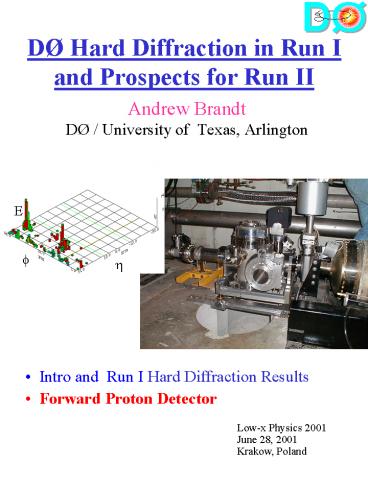
- Intro and Run I Hard Diffraction Results
- Forward Proton Detector
Low-x Physics 2001 June 28, 2001 Krakow, Poland
2
Event Topologies
p p ? p p
p p ? p (p) X
p p ? p (p) j j
p p ? p p j j
3
Event Characteristics
4
Hard Color-Singlet Exchange
f
Count tracks and EM Calorimeter Towers in h lt
1.0
Dh
jet
jet
h
(ET gt 30 GeV, ?s 1800 GeV)
Measure fraction of events due to color-singlet
exchange
Measured fraction (1) rises with initial quark
content Consistent with a soft color
rearrangement model preferring initial quark
states Inconsistent with two-gluon, photon, or
U(1) models
Phys. Lett. B 440 189 (1998)
5
1800 and 630 GeV Multiplicities
?s 1800 GeV
?s 630 GeV
6
SD Event Characteristics
7
POMPYT Monte Carlo
p p ? p (or p) j j
Model pomeron exchange POMPYT26
(Bruni Ingelman) based on PYTHIA
define pomeron as beam particle
P
p
Structure Functions 1) Hard Gluon
xG(x) x(1-x) 2) Flat Gluon (flat in x) 3)
Quark xG(x) x(1-x) 4) Soft Gluon xG(x)
(1-x)5
p
p
? 1 - xp (momentum loss of proton)
P
8
hep-ex/9912061
9
Single Diffractive ? Distributions
? distribution for forward and central jets using
(0,0) bin
Dp p
central
?s 1800 GeV forward
central
?s 630 GeV forward
? ? 0.2 for ?s 630 GeV
10
Double Gaps at 1800 GeVJet h lt 1.0, ETgt15 GeV
Gap Region 2.5lthlt5.2
Demand gap on one side, measure multiplicity on
opposite side
DØ Preliminary
11
Double Gaps at 630 GeVJet h lt 1.0, ETgt12 GeV
Gap Region 2.5lthlt5.2
Demand gap on one side, measure multiplicity on
opposite side
DØ Preliminary
12
Diffractive W
nL0
?s 1800 GeV
ncal
ncal
nL0
Peak at (0,0) indicates diffractive W with a
signal on the 1 level
13
Gap Summary
- Pioneered central gaps between jets, 3 papers,
3 Ph. Ds - Observed and measured forward gaps in jet
events - at ?s 630 and 1800 GeV. Rates much smaller
than - expected from naïve Ingelman-Schlein model.
- Require a different normalization and
significant - soft component to describe data. Large
fraction - of proton momentum frequently involved in
collision. - Observed jet events with forward/backward gaps
- at ?s 630 and 1800 GeV
- Observed W and Z boson events with gaps
- Finalizing papers and attempting to combine
results
14
A Few New Interesting Things
- Gap fractions at 630 are higher than
- 1800 for Central Gaps and Hard SD,
- but comparable for Double Gaps
- Double gap events with 15 GeV jets
- are about as rare as top events
- Diffractive Ws and Zs have similar
- gap fractions
15
FPD Layout
Roman Pot
Bellows
p
Detector
P1UP
P2OUT
Q4
D
S
Q3
S
Q2
Q4
Q3
Q2
D1
P1DN
P2IN
D2
A1
A2
23
33
59
57
33
23
0
Z(m)
Series of 18 Roman Pots forms 9
independent momentum spectrometers allowing
measurement of proton momentum and angle.
1 Dipole Spectrometer ( p ) x gt xmin 8
Quadrupole Spectrometers (p or p, up or
down, left or right) t gt tmin
16
Physics Topics with the FPD
1) Diffractive jet production 2) Hard double
pomeron exchange 3) Diffractive heavy flavor
production 4) Diffractive W/Z boson
production 5) New physics 6) Inclusive double
pomeron 7) High-t elastic scattering 8)
Total cross section 9) Inclusive single
diffraction FPD allows DØ to maximize Run II
physics
17
Data Taking
- No special conditions required
- Read out Roman Pot detectors for all events
- (cant miss )
- A few dedicated global triggers for diffractive
- jets, double pomeron, and elastic events
- Use fiber tracker trigger board -- select
- x , t ranges at L1, readout DØ standard
- Reject fakes from multiple interactions
- (Ex. SD dijet) using L0 timing, silicon
- tracker, longitudinal momentum conservation,
- and scintillation timing
- Obtain large samples (for 1 fb-1)
- 1K diffractive W bosons
- 3K hard double pomeron
- 500K diffractive dijets
with minimal impact on standard DØ
physics program
18
Run II Event Displays
Hard Diffractive Candidate
Hard Double Pomeron Candidate
19
Diffractive Variables
pBeam
pF
P
Pomeron Exchange
Non-diffractive
For TeV
For
GeV
GeV
(Note
)
GeV
20
Acceptance
x
Quadrupole ( p or )
450 400 350 280 200
MX(GeV)
Geometric (f) Acceptance
x
Dipole ( only)
GeV2
450 400 350 280 200
MX(GeV)
GeV2
Dipole acceptance better at low t, large
x Cross section dominated by low t
x 0 0.02 0.04 1.4 1.4 1.3 2
35 95
21
Quadrupole Dipole Spectrometers
The combination of quadrupole and dipole
spectrometers gives 1) Detection of protons
and anti-protons a) tagged double pomeron
events b) elastics for alignment,
calibration, luminosity monitoring
c) halo rejection from early time hits
2) Acceptance for low and high t 3)
Over-constrained tracks for
understanding detectors and backgrounds
22
FPD Commissioning
23
Roman Pot Castle Design
Worm gear assembly
50 l/s ion pump
Detector
Beam
Step motor
- Constructed from 316L Stainless Steel
- Parts are degreased and vacuum degassed
- Plan to achieve 10-11 Torr
- Will use Fermilab style controls
- Bakeout castle, then insert fiber detectors
24
Roman Pot
25
The Detector
4 Fiber bundle fits well the pixel size of H6568
16 Ch. MAPMT 7 PMTs/detector (most of the cost)
U
U
26
Detector Construction
- Being completed at UTA
- Four fibers are aligned together in the frame to
make a channel - X frame also includes trigger scintillating rod
- Bicron optical epoxy is used to secure the fibers
into the frame once completely assembled - After curing, channels are mapped to appropriate
location in cookie, PMT calibration fibers are
included, lengths are measured and final gluing
with optical epoxy is done
27
Jan. 12, 2001 Commissioning meeting
- Beyond the Engineering Run
- FPD Installation and Commissioning
- All of the castles should be installed and tested
by March 1st, 2001. ? - All the tunnel electronics will be installed and
cables will all be laid. ? - The dipole spectrometer will be instrumented with
full detectors and phototubes. ? - The vertical spectrometers and one horizontal
spectrometer will be instrumented with
pseudodetectors (trigger scintillators only) to
study halo. ? - Still looking for funds to purchased the
phototubes for the other castles. ? - We hope to be ready to take data with a Phase I
(10 pot) FPD in late summer. ?
28
Castles Installed
29
Pot Motion LVDT vs. Encoder
30
Hit Reconstruction
- This event (from Engineering Run data)
- represents a hit in our detector at the location
- xd 5.6 mm
- yd 3.8 mm
31
Run II HSD Improvements
- Measure ?, t over large kinematic range
- Integrated FPD trigger allows large data samples
- Higher ET jets allow smaller systematic errors
- Comparing measurements of HSD with track tag vs.
gap - tag yields new insight into process
- Can calibrate calorimeter ? measurement without
MC
32
June-August Run Plan
- Dedicated FPD shifts with pots inserted
- close to beam (2 full detectors, 8 with
- only trigger scintillators)
- Start with stand-alone DAQ/trigger in
- small control room then integrate into
- DØ
- Full system tests
- Debugging, data-taking, algorithm
- development, pot insertion procedure,
- documentation, etc.
33
Long Range Plan
- Install 8 more detectors (total of 10) during
- September shutdown
- Begin data taking with full DØ detector
- and trigger list in October
- Demonstrate working system, usefulness
- of horizontal plane, and secure funding
- for remaining MAPMT in 2002
- Early papers
- NIM
- Elastic t-distribution
- Single diffraction distributions
- Diffractive jet production
- Double tagged double pomeron exchange
34
Conclusion
- Tremendous progress in installation and
- commissioning
- Entering a new phase of FPD
- 1) Installation almost complete
- 2) We have funding!
- Emphasis shifts to software and operations
- Trigger hardware and firmware a MAJOR
- concern
- Starting to think about physics a little!
Recommended

