

Configuration and the RankineHugoniot type condition PowerPoint PPT Presentation
1 / 5
Title: Configuration and the RankineHugoniot type condition
1
Minimal surfaces in the Heisenberg group
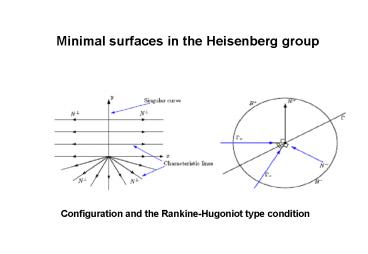
- Configuration and the Rankine-Hugoniot type
condition
2
- The research team consisting of Dr. Jih-Hsin
Cheng and Dr. Jenn-Fang Hwang at IMAS has
collaborated with Professor Paul Yang of
Princeton University and Professor Andrea
Malchiodi of SISSA on the study of minimal
surfaces in the Heisenberg group. This is a
degenerate elliptic and degenerate hyperbolic
equation. They proved a Bernstein-type theorem.
They also proved the existence of minimizers and
pointed out a condition for characteristic lines
to meet along a singular curve. It is a
Rankine-Hugoniot type jump condition. As a
consequence, a C2-smooth solution from the PDE
viewpoint may not be a minimizer.
3
Quantitative Analysis of Boltzmann Equation
4
Quantitative Analysis of Boltzmann Equation
- Tai-Ping Liu and his collaborators have made
progresses on the quantitative theory for
Boltzmann equation in kinetic theory. In the
first paper, three dimensional wave structure,
including the weak Huygens' waves, see Figure 1,
is obtained. Besides this close link with fluid
dynamics, it is also shown that Boltzmann
equation carries particle-like waves. The second
paper offers the first analytical understanding
of the thermal transpiration, a phenomena whose
physical explanation consumed the last three
years of the great physicist Maxwell. The third
paper studies the refleciton of waves off the
boundary, Figure 2. This is the first general
study of the initial-boundary phenomena for
Boltzmann equation. The Boltzmann equation allows
for much richer boundary phenomena - than the fluid equations such as the Euler
and Navier-Stokes equations. We are continue to
explore this important research direction.
5
- Connections between symmetry and super-symmetry
- In mathematics symmetry may be regarded as
certain objects that are either groups or
algebras. In physics the notion of symmetry was
soon realized to be insufficient to describe all
known physical phenomena. In order to resolve
these restrictions the notion of super-symmetry
was introduced. - In 2004 Shun-Jen Cheng in joint works with Ruibin
Zhang, in their investigations of representations
of certain simple Lie superalgebras, noticed
remarkable connections between the representation
theories of Lie algebras and Lie superalgebras,
i.e. symmetries and super-symmetries. In 2006 in
a joint work with Weiqiang Wang they established,
for the first time, such a direct connection.
They proved that the general linear Lie algebras
and the general linear Lie superalgebras share
certain common important representation-theoretica
l invariants, called Kazhdan-Lusztig polynomials.
Subsequently related results for
infinite-dimensional Lie superalgebras have been
established by Shun-Jen Cheng and Jae-Hoon Kwon.
Recommended

