

Mobile Television: The Emergence of a PersonalMass Media Platform PowerPoint PPT Presentation
1 / 40
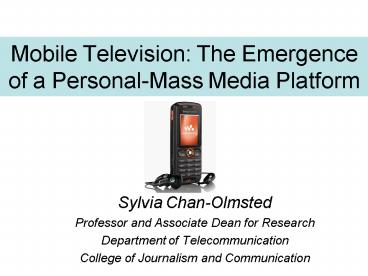
Title: Mobile Television: The Emergence of a PersonalMass Media Platform
1
Mobile Television The Emergence of a
Personal-Mass Media Platform
- Sylvia Chan-Olmsted
- Professor and Associate Dean for Research
- Department of Telecommunication
- College of Journalism and Communication
2
An Emerging Main Stream Medium everyone has it!
HK 130
Broadband Internet 53
Cable TV 70
3
An Emerging Main Stream Medium not just a
telephone!
Communication Interacting with the phone
4
Some U.S. Mobile Consumption Facts
- Browsing news/information on mobile Internet is
also a popular mobile activity. - Yahoo sites (email, IM, search, news, directory,
weather, etc.) are most popular in mobile usage
(14.1 million), followed by Google sites (8.2
million) - Top three mobile news sites are CNN/cnn.com,
Yahoo, and ESPN Sports News.
The importance of familiar media content and
brands
5
I want my mobile phone
Traditional media on a new platform
SMS MMS IM
Television High quality audio
Broadband Internet Email
Banking Bill payment Shopping
Gaming GPS
6
Presentation Outline
- Background Information
- Continuous demand for TV consumption
- Mobile Development Worldwide
- The Characteristics of Mobile TV
- Mobile TV Technology
- Characteristics of Mobile TV Consumers
- Mobile TV Consumption Patterns and Drivers
- Mobile TV Content Issues
- Mobile TV Regulatory Issues
- Mobile TV Business Considerations
7
Television vs. Mobile Television Traditional TV
Overview
- TV continues to be an important medium for the
Americans - 8 hours 11 minutes per day for an household
- 4 hours 31 minutes per day for an adult male
- 5 hours 17 minutes per day for an adult female
- 3 hours 19 minutes per day for teens/children
- Access to multiple TV sets on the rise
- 82.5 of households have multiple TV sets
- 3.17 sets per household
8
The Worldwide Growth of a New Content Delivery
Platform
- Americans began to receive broadcast TV on mobile
phones in early 2007 - Vodafone Germany delivered Tour De France live in
2006 - TU Media Korea has multiple mobile TV services
since 2005. One in seven Koreans watch TV on
their mobile phones. - 44 million mobile TV users globally by the end of
2005 Asia takes the lead (70 in Asia) - Europe and North America are expected to grow
substantially
9
Mobile TV Viewers Worldwide
VAS Research Series 2007
10
Television vs. Mobile Television The Nature of
Mobile TV
- Conceptual Mobile TV Mobile phone TV
Internet - Conceptual Mobile TV TV with Mobility and
Interactivity - Mobile TV in the Context of TV
Evolution
11
The Characteristics of Mobile TV
12
Mobile TV Development Issue I Technology
- Choice of Mobile TV platform is influenced by
cost, regulation, and applications planned.
13
Mobile TV Development Issue II Consumer
- Who are the mobile TV users?
- Early adopter profile
- Young males (65 male, 64 ages 20-30 in Korea)
- Urban mobile customers (82 in urban areas in
Korea) - Ethnically diverse in the U.S.
- Young adults who like texting, streaming,
podcasting, and other technologies - Prior multimedia experience (esp. for mobile
video), equipment, and age influence receptivity
of mobile TV
14
U.S. Mobile TV Consumers
Mobile TV users are ethnically diverse
Not just for the very young over half are In
the age group 18-36
Skewed toward male
Telephia Mobile Video Diary Report 2006
15
Mobile TV Development Issue II Consumption
Patterns
- Mobile TV was most used during commutes, waiting
situations, and work/school breaks. - In the United States Home (22), commuting
(22), shopping (16), and work (14) - Mobile TV prime time is between noon and 8 pm and
during weekdays. - Mobile TV consumption time is increasing from
short 5 minute snacking to up to 30 minutes. - Gradual increase of consumption time and number
of locations (increasing home access)
16
U.S. Mobile TV Usage by Daypart
Telephia Mobile Video Diary Report 2006
17
U.S. Mobile Video Usage
Small portion of mobile Users Infrequent usage
18
Mobile TV Development Issue II Consumption
Patterns/Motivations
- Motivations
- Flexibility, independence, and a sense of
community - Enhanced personal and intimate viewing experience
- Time and location-sensitive information
- Filling empty time
- Personal content creation
19
Mobile TV Development Issue II Consumption
Patterns/Motivations
- Conditions for mobile television adoption
- Affordable pricing
- Good technical functionality
- Simple and intuitive usability
- High-quality pictures and sounds
- Mobile device functions uncompromised by TV
applications - Suitable content for mobile viewing
- Brand (familiarity) is important during the
initial stage of adoption.
20
U.S. Mobile Subscribers Key Motivators in
Subscribing to Mobile TV Service
- Cost of service (64)
- Available channels (52)
- Picture quality (49)
- Screen size (47)
- Channel reception (46)
- Sound quality (39)
- Ease of use (36)
- Security (21)
- 2007 ComScore Survey
21
Mobile TV Development Issue III Content
- Technology enabler
- Content driver
- Content Types
- Repurposed Video (full-lengths and
recaps/previews/highlights) - On demand or scheduled rebroadcast
- Simulcast TV (Live broadcast)
- User-generated video
- Original made-for-mobile video
- Familiarity is important as this stage so
repurposed content is preferred (the brand
factor!)
22
Mobile TV Development Issue III Content
- Sample services
- US Verizon offers 8 channels (CBS, Comedy
Central, ESPN, Fox, MTV, NBC News, NBC
Entertainment, and Nickelodeon) Vcast mobile
video (streaming video clips). - MobiTV on ATT 50 channels (streaming video
clips such as ABC News, Access Hollywood, TLC,
Discovery, Animal Planet, etc.). - Orange France 51 channels Orange UK 16
channels Vodafone Germany 30 channels Italy
15 channels.
23
Mobile TV Development Issue III Content
- Typical content genres are drama, soaps, news,
sports, and reality programs - Highly-rated dramas/soaps are popular in Korea
- Reality mobile programs are popular in Europe
- News, weather, children/cartoon, comedy, and
sports are popular in the US. - New mobile content considerations no need for
details use of a simple plot
24
U.S. On-Demand Mobile TV Usage
Short clips - Music, news, Sports, Weather, Comed
y, Animations, Highlights
25
Mobile TV Channels Ranked by Share of Total
Audience
Telephia Mobile TV Diary Report 2006
26
U.S. Mobile TV Content Preferences
- Consumers prefer to watch traditional-style
mobile TV rather than modified or specialized
content (i.e., full-length and general content) - Consumers prefer local news, dramas, movies, and
sitcoms. - 2007 ComScore Survey
27
Mobile TV Development Issue III Content
- Two mobile TV views mobisodes (24 and Lost)
vs. mobile traditional TV (repurposing regular
TV) - Mobile TV production considerations limited time
length, plots, themes, props, and people - Access to traditional broadcast content a
critical key to mobile TV content development
(cases in Korea and Italy) - Incorporating user-generated content (H3G in
Italy, YouTube and Vcast) - From mobile company to media company (UKs
3 mobile company)
28
Mobile TV Development Issues IV - Regulation
- How to regulate converging telephone/television
industries? - Should mobile TV be regulated under the same
framework as traditional broadcast TV? - What about content rights of mobile contents?
E.g., retransmitted broadcast signals (Is the
broadcast right of a content product transferable
disregard of the reception device) - And the key question of today the unbundling,
open access of mobile platform - Googles bid of the newly available radio
frequencies - Verizons announcement to open its network
- Open access is likely to lead to more innovative
applications
29
Mobile TV Development Issues V Alliances and
Marketing
- Alliances are essential for emerging markets
especially with content producers (e.g., TIM
News Corp. Vodafone Mediaset) - Marketing is important for affecting new
consumption/behavior (brand recognition and
familiarity) cross-promotion on multiple
platforms
30
Mobile TV Development Issues V Business Models
- Mobile has been more successful in establishing
the receptivity toward consumers paying for
content ability to experiment with different
business models. - Often begin with short-term free trials
- 3G network pricing models (event or sub based)
- Free content but charge by data packet rate
(unsuitable for premium contents) - Content charge only (RPM problem)
- Content charge plus data-packet rate (confusing
to consumer) - Fixed subscription fee (more for frequent,
repeated access) - Bundled package pricing (strategic bundling
value) - People prefer packages rather than pay per view
(not good for premium contents) - Issues for the new broadcast platform
- Optimal pricing points for branded vs. unbranded
and original vs. repurposed content - Price a content that is free on other platforms
31
Mobile TV Development Issues V Business Models
- Content providers need incentives
(revenue-sharing) to develop/assemble content
products. - Revenue Sharing Models
- Upfront fixed-cost payment vs. revenue sharing
percentage to channel members - Japans DoCoMo keeps 12 Italys H3G keeps 85
of the revenues - Percentage to content providers influence
availability of good content products
32
Mobile TV Development Issues V Business Models
- Mobile Advertising targeted medium platform
with mobility, personalization, and
interactivity.
33
Ad Budget Shares of Emerging Media
AAF Nov. 2006
34
Mobile TV Development Issues V Business Models
- Mobile Advertising Scenario
- SMS/MMS type ads
- Multimedia placement ads with/without reduced
subscription rate for commercial breaks on mobile
TV - Use product placement or sponsorship
- Challenges
- Contextual targeting with personalized and
relevant content is critical - Lack of audience measurement data
- Consumers have low tolerance of mobile TV
commercials - More than half of consumers are not willing to
watch ads on their phones in return for free
mobile applications
35
Mobile Advertising Spending
E.g., SMS
E.g., placement ads
36
Overall Mobile Business Considerations
- State of the Business
- Messaging (text, multimedia and instant
messaging, and email) generates the largest
revenue (5.9 billion in 2007 projected to reach
15 billion in 2010). - Entertainment and information contents generate
similar levels of revenues now, but entertainment
is expected to outpace information revenues. - Package of mobile TV, high quality audio, and
data services might be most attractive.
37
U.S. Mobile Phone Application Revenues
38
Mobile TV Development Issues V Business
Considerations
- Mobile TV is a long-term strategy.
- It provides broadcasters opportunities for
personalization and targeting, not necessarily
revenue potentials. - It offers opportunities for recuperating 3G
license fees (e.g., European operators). - Its strategic value is in integrated services and
triple- to quadruple-play competition
39
Mobile TV Development Issues V Quadruple-Play
Business Strategy
40
Conclusions
- U.S. Mobile TV is in its infancy, worldwide
mobile development may serve as a reference
point. - Mobile TV is a convergence between telephone and
television There are fundamental differences in
consumer expectations and behavior. - Converging industries present challenging
technological, business, and regulatory issues
(e.g., changing consumer demand/usage patterns,
product development, cross-platform, unbundling
practices, and emerging, risky business models). - Mobile TV diverse needs content familiarity
- Mobile platform is a crucial part of the
multilateral competition between media/telecom
firms. - Mobile TV is complementary to fixed TV and offers
unique marketing utilities for traditional media
content. - The recent move toward open access means more
innovative applications so get ready for the
ride.
Recommended

