

Aim: How do rhetorical devices decorate our writing PowerPoint PPT Presentation
1 / 18
Title: Aim: How do rhetorical devices decorate our writing
1
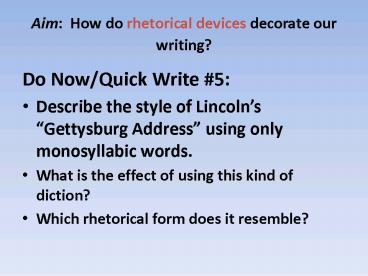
Aim How do rhetorical devices decorate our
writing?
- Do Now/Quick Write 5
- Describe the style of Lincolns Gettysburg
Address using only monosyllabic words. - What is the effect of using this kind of diction?
- Which rhetorical form does it resemble?
2
Rhetorical Devices The Gems of Writing
- Metonymy
- Synecdoche
- Apostrophe
- Anaphora
- Cataphora
- Polysyndeton
- Asyndeton
- Chiasmus
- Diacope
- Parallel structure
3
Metonymy
- Another form of metaphor, in which the thing
chosen for the metaphorical image is closely
associated with (but not an actual part of) the
subject for which it stands. - Hint Closely associated with is the key
concept here. - You cant fight city hall (A metaphor for the
mayor, or his subordinates)
4
Synecdoche
- A type of metaphor in which a part of a subject
stands for the whole subject - I saw some new faces in the meeting today.
- The word faces is the synecdoche and is used
instead of the word people.
5
Apostrophe
- Interrupts the narrative and directly addresses a
person (or idea, or deity). Its most common
purpose in prose is to give vent to intense
emotions. It is used as a kind of formal
invocation. - Hint The interjection O or Oh usually
appears in this rhetorical device. - O Jerusalem, Jerusalem, thou that killest the
prophets!
6
Anaphora
- The deliberate repetition of the same word (or
group of words) at the very beginning of several
consecutive phrases. - Mad world! Mad kings! Mad competition! (William
Shakespeare, King John, Act 2.1)
7
Cataphora
- Words or phrases like pronouns are cataphora when
they point forwards to something later on in the
text - As he was unaccustomed to it, Jake found the
pressure very hard to deal with. - Here, it is cataphoric because it refers forwards
to the noun pressure
8
Polysyndeton
- The use of a conjunction between each phrase in a
series of phrases, and is thus structurally the
opposite of asyndeton. The rhetorical effect of
polysyndeton, however, like asyndeton, creates a
feeling of energetic enumeration, of building
momentum.
9
Example of Polysyndeton
- I said, Who killed? and he said, I dont know
who killed him, but hes dead all right, and
it was dark and there was water standing in the
street and no lights or windows broke and boats
all up in the town and trees blown down and
everything all blown and I got a skiff and went
out and found my boat where I had her inside
Mango Key - (Earnest Hemingway, After the Storm)
10
Asyndeton
- Conjunctions are purposely omitted from a series
of related phrases. The rhetorical effect is an
energetic one. - I have done it. You have heard me. The facts
are before you. I ask for your judgment. - (Aristotle, Rhetoric, Book III)
11
Chiasmus
- A figure of speech employing two phrases (or
clauses) whereby the order of key words in the
first phrase (or clause) is then reversed in the
second phrase (or clause). - Ask not what your country can do for you, but
what you can do for your country.
12
Diacope
- Uninterrupted repetition of a word or phrase.
Or, the repetition of a word or a phrase in which
the repetition is briefly interrupted by one or
two words. - Hint The purpose of this device is to emphasize
important words.
13
Example of Diacope
- All lost! To prayers, to prayers! All lost!
- (William Shakespeare, The Tempest)
- All lost is interrupted to prayers is
uninterrupted. Both are examples of diacope.
14
Parallelism
- A series of phrases that displays identical
characteristics. If those phrases contain verbs,
it is especially important that the tenses of the
verbs within each phrase be identical in order
for the entire sequence to be considered truly
parallel. - He walked down the aisle, through the door, and
into the room.
15
Can you identify the rhetorical devices?
- I came, I saw, I conquered (Julius Caesar).
- Asyndeton
- One should eat to live, not live to eat.
- Chiasmus
16
What about these?
- It was the best of times, it was the worst of
times, it was the age of wisdom, it was the age
of foolishness - Anaphora
- One would have thought that we would find willing
ears on the part of the newspapers. - Synecdoche
17
Can you handle a few more?
- O books who alone are liberal and free, who give
to all who ask of you and enfranchise all who
serve you faithfully. - Apostrophe
- Patience, Iago, Patience.
- Diacope
18
Your Rhetorical Toolbox is complete!
- Now that you know these terms, we will be using
them throughout the year. - The goal is more than just observation we want
to be able to understand the EFFECT these devices
have as apart of a larger analysis of the
rhetoric in this years course.
Recommended

