

Advantages of Dynamic VPN PowerPoint PPT Presentation
Title: Advantages of Dynamic VPN
1
Advantage Of Using a Dynamic VPN
Firstly we Understand what Basically a Dynamic
VPN is ?
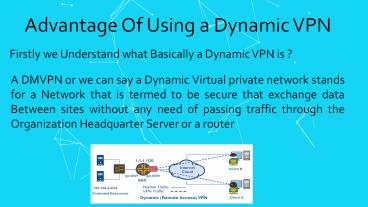
A DMVPN or we can say a Dynamic Virtual private
network stands for a Network that is termed to be
secure that exchange data Between sites without
any need of passing traffic through the
Organization Headquarter Server or a router
2
Some of the Advantages Following Dynamic VPN
Regarding IP Address
This phase comprises of various advantage
Regarding ISPs.It was such as that if one wants
an established connection then the only need is
the availability of relative small pools of IP
addresses. Apart from it Dynamic VPN are also
Beneficial for users. It was such as that in
order to get connected to the internet then there
is no such requirement to set up Static IP
addresses in advance, they can directly connect
to the web services as well as it's not necessary
to manage the IP addresses too. This helps a lot
in saving costs without indulging in the vast
process. Whereas if we say about the ordinary
process where a user has to firstly set up the
static IP address in order to set up the Internet
connection.
3
Dynamic DNS provides the capability for a
networked device to notify a DNS server to
change, in real time, the active DNS
configuration of its configured hostnames,
addresses or other information. It has a number
of benefits, including
4
Some of the Points Covering in Dynamic DNS
- Ease Efficiency - Theres no need to go from PC
to PC setting up static addresses every time your
network infrastructure changes. - Accessibility - You can access your system using
a consistent name in the URL even though the IP
address changes. - Savings - You only need as many addresses as will
be in use at any one time, rather than having one
for every possible user of IP.
5
Benefits According To Configuration
1. A new spoke in a DMVPN does not require
changes on a hub to which it is connected other
than authentication and authorization state which
are dynamically handled. No state is required on
other hubs because addresses are passed between
hubs using NHRPandIKE. This requirement is one
of the basic features of DMVPN. 2 NHRPis used
to distribute dynamic peer NBMA and Overlay
address mappings. These mappings will be
redistributed or rediscovered upon any address
change. This requirement is one of the basic
features of DMVPN. 3 DMVPN requires minimal
configuration in order to configure protocols
running over IPsec tunnels. The tunnels are
latched to their crypto socket according to
RFC5660.The routing protocols or other features
do not even need to be aware of the IPsec layer
or does IPsec need to be aware of the actual
traffic the tunnel carries.
6
Benefits According To Ports
1. Spokes can talk directly to each other if and
only if the Hub and Spoke policies allow
it.Sections Section 4.6 and Section 4.5
explicitly mention places where such policies
should be applied. 2. DMVPN peers have unique
authentication credentials and uses them for each
peer connection. The credentials do not need to
be shared or pre-shared unless the administrator
allows it. To this effect, DMVPN makes great use
of certificates as a strong authentication
mechanism. Cross-domain authentication is made
possible by PKI should the security gateways
belong to different PKI domains.
3. DMVPNGateways are free to roam. The only
requirement is that Spokes update their peers
with their new NBMA IP address should it change.
Implementations MAY choose to update their peers
via MOBIKE but MUST support e-registration and
re-discovery. Roaming across hubs requires that
the new Hublearns the prefixes behind the branch
which is what DMVPN does by construction.
7
4. Handoffs are possible and can be initiated by
a Hub or a Spoke. At any point in time, aSpoke
may create multiple simultaneous tunnels to
several Hubs and change its routing policies to
send or receive traffic via any or all of the
active tunnels. If a Hub wishes to off load a
connection to another Hub, the Hub can do so by
using an IKE REDIRECT as explained in RFC5685.
5 DMVPNsupports gateways behind NAT boxes
through the IKENAT Traversal Exchange. 6.
Changes of SA are reportable and manageable. This
document does not define a MIB nor impose message
formats or protocols (Syslog, Traps,...). All
tables such as NHRP, IPsec SA's and routing
tables are MIB manageable. The creation of IKE
session trigger messages and NHRP can be
instrumented to log and report any
necessaryevent. 7.With an appropriate PKI
authorization structure, DMVPN can support allied
and federated environments
8
8. DMVPN supports star, full mesh, or a partial
mesh topologies. The protocol stack can be
applied to all known scenarios. Implementers are
free to cover and support the adequate use
cases 9. DMVPN can distribute multicast traffic
by taking advantage of protocols such as PIM,
IGMP and MSDP. 10.DMVPNallows monitoring and
logging. All topology changes, connections and
disconnections are logged and can be monitored.
The DMVPN solution explained in this document
does not preclude any form of logging or
monitoring and additional monitoring points can
be added without impacting interoperability.
11L3VPNsare supported over IPsec/GRE tunnels.
The main advantage of a GRE tunnel protected by
IPsec is that L2 frames do not need any
additional IP encapsulation which means that L2
frames can be natively transported over DMVPN.
9
Resources
1. www.ietf.org
2. https//www.lancom-systems.de
Recommended

