

Why XML is considered a versatile language for data conversion PowerPoint PPT Presentation
Title: Why XML is considered a versatile language for data conversion
1
Why XML is considered a versatile language for
data conversion?
One of the chief parts of most businesses, Data
management services is considered reliable
as it helps to generate the relevant data to make
use of for business strategies or planning, which
also helps with business success. Data conversion
process is also an important aspect of data
management services. Data is converted to the
required format as per the purpose of use.
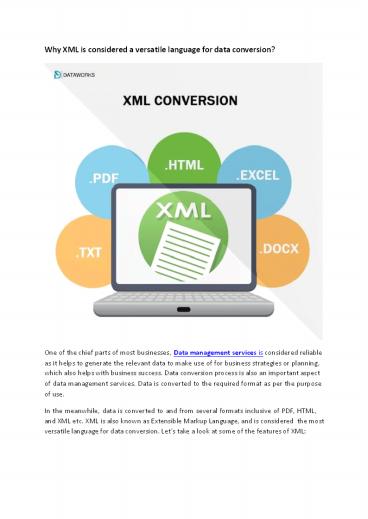
In the meanwhile, data is converted to and from
several formats inclusive of PDF, HTML, and XML
etc. XML is also known as Extensible Markup
Language, and is considered the most versatile
language for data conversion. Lets take a look
at some of the features of XML
2
XML Language features
Use of custom tags You can see that amidst
using XML language, the users have the
facility to use their own customized tags. They
are given the ability to define the order of the
tags, it display and so on. This also allows
for the users to define the updated elements
according to their preference or requirement. At
the same time, if you had been dealing with HTML
language, the tags and semantics would have
remained inflexible.
With XML, content is separate from HTML/CSS
HTML/CSS is normally used for display and layout
of the content. At the same time, XML helps to
store the content into separate XML files,
which enables you to edit or modify the
look of the document or web page as
required. These changes can be made without
altering any of the content.
Content modification is easy with XML It is
already been discussed that apart from
storing the data as separate XML files, it is
also now more easy to make modifications as
required to the content. In the instance that
HTML is being used, then to change the data would
have taken lot of work. Nevertheless, with XML,
the modifications were made without any
disruption to the HTML codes used.
Data processed to be reused with XML It is seen
that, making use of XML language, data processing
services can be made more efficient or
cost-effective. With XML, it is easier to
translate the webpages to the required
languages, or even for text formatting, migration
or updating the system etc. Using XML, it also
becomes easy to make use of the same data in
varied systems, thus saving time and costs for
the data conversion process.
You can thus see here that with these features,
XML has become the popular language to
be used to convert data. Other features adding to
its popularity includes simplified
data modification or transfer process, developing
new languages etc.
More clarifications send mail inquiry to
sales_at_outsourcedataworks.com
Recommended

