

India Encourages the Evolution in Solar Power Infrastructure: Ken Research PowerPoint PPT Presentation
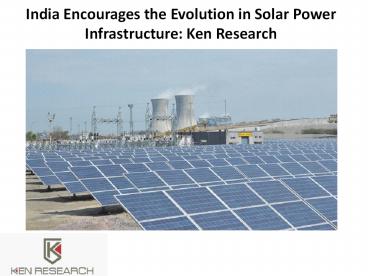
Title: India Encourages the Evolution in Solar Power Infrastructure: Ken Research
1
India Encourages the Evolution in Solar Power
Infrastructure Ken Research
2
India is the worlds second-most populous nation
with huge energy requirements. The countrys coal
demand would actually zero out in the near future
due to the technology driven changes that are
happening quickly than predicted. India is the
worlds third-largest carbon emitter and
basically relies on coal-fired power plants for
the production of most of its energy. The ever
growing population and a fast-industrializing
economy are the major factors that witness a
whooping consumption of energy. Coal consumption
in India has slowed down to its lowest level in
the past two decades although Indian economy is
growing at a consistent pace.
3
- The latest energy developments include
improvements in renewable energy capacity and new
innovative procedures to improve energy
efficiency. The Energy and Research Institute
(TERI) in New Delhi states that the energy
efficiency is growing rapidly than estimated. Due
to negligible growth in generating electricity,
low profitable power distribution, political
obstacles and slash on electricity subsidies is
affecting the growth in electricity demand in the
country. - The dropping costs for solar and wind energy and
high enthusiasm for hydropower has increased the
renewable energy generating capacity and is also
expected to increase by the year 2030. With the
improvement in battery technology that would
enable weather and time dependent solar and wind
power to serve as round-the-clock power sources
will help reduce coal use in the power generation
sector in India. The battery price has already
fallen and was estimated to reduce further. This
trend will encourage the solar
4
power with battery storage that will be cheaper
than coal-fired power. Indias installed power
plants capacity and power generation are using
various fuel types such as thermal conventional,
nuclear, large solar thermal and renewable energy
sources. The renewable power sources are wind
(both onshore and offshore), solar photovoltaic
(PV), concentrated solar power (CSP), small hydro
power (SHP), biomass, biogas and geothermal. The
renewable power market includes hydro, small
hydro, biopower and solar thermal energy
resources. The leading players in the solar
thermal power in India are Reliance Power
Limited, Megha Engineering and Infrastructure
Ltd., KVK Energy Infrastructure Pvt. Ltd. and
LANCO Infratech Limited. The latest solar
electricity price per unit was reduced compared
to the recent years and the Indian government has
raised its solar capacity target to 100GW by the
year 2030.
5
According to the study Solar Thermal Power in
India, Market Outlook to 2030, and Update
2017-Capacity, Generation, Power Plants,
Regulations and Company Profiles, in India
around 65GW of new thermal power plants are
already in the pipeline along with new solar
plants. This scenario threatens a rise in power
surplus at a time of moderate growth in this
sector and will follow a collapse in plant load
factor (PLF). Therefore, the collapse in PLF can
bankrupt many projects burdening the lenders.
Majority of the banks in India are already under
enormous bad debts and the surplus power is a
threat to the bank as well as the nations
economy. Therefore, the solar power growth is a
blessing, but can become a curse with much state
of affairs. Solar power generation is great
while the sun shines and stops at sunset. The
power consumption soars during evening. It was
also observed that the thermal power remains idle
during the day and is
6
ready to pick up the slack when solar production
suddenly stops. Such strained idleness evolves
huge hidden costs while estimating the solar
power generation initialization procedures. If
the cost of the solar equipment is decreasing
then it is true that the solar power has become
cheaper than coal-based power. Solar power
generation is sporadic because the process is
inevitable during night and on cloudy or foggy
days. The Indian government is promoting solar
energy through economic and promotional
incentives like capital investment or interest
subsidies, tax holidays on earnings for 10 years,
generation based incentives, accelerated
depreciation, viability gap funding, and
financing rooftop solar as part of home
loans. Indias power sector is most diversified
with sources of power generation range from
conventional sources such as coal, lignite,
natural gas, oil, hydro and nuclear power to
viable non-conventional sources such as wind,
solar, and agricultural and domestic waste. The
demand for electricity has increased rapidly and
is expected to rise
7
further in the coming years. GE Energy Financial
Services (GEEFS), Greenko Energy Holdings,
Private equity (PE), Mahindra and Mahindra Ltd,
Hero Future Energies Pvt Ltd., Tata Capital Ltd.,
CDC Group Plc, Japans JERA Co. Inc,
International Finance Corporation (IFC) are few
major investors in the development of the Indian
power sector. The power sector was identified by
the government of India as a major key sector to
focus and promote sustained industrial growth.
Pradhan Mantri Sahaj Bijli Har Ghar Yojana , no
clearance required for solar PV (photovoltaic)
power, solar thermal power projects, and solar
parks, Street Lighting National programme (SLNP),
Power for All program, Development of Solar Parks
and Ultra Mega Solar Power Projects are few
initiatives by the government of India to boost
the Indian power sector.
8
Power is one of the most critical components of
infrastructure crucial for the economic growth
and welfare of a country. The existence and
development of adequate solar power
infrastructure is essential for sustained growth
of the Indian economy. India's solar power
capacity is an addition to the already existing
power sector creating immense opportunities in
power generation, distribution, transmission, and
equipment. The Indian governments immediate goal
is to generate two trillion units of energy in
the near future which is doubling the current
production capacity to provide continuous
electricity for residential, industrial,
commercial and agriculture use. Key Factors
Considered in the Report India Solar Thermal
Power Market Research Report India Solar Thermal
Power Plants India Solar Thermal Power
Production Capacity
9
India Solar Thermal Power Levelized Cost of
Energy Investment Trends in India Solar Thermal
Power Market Regulation in India Solar Thermal
Power Sector Cost of the Solar Equipment in
India India Solar Equipment Imports GE Energy
Financial Services Share In Power Projects India
Power Generation Sector Research Report India
Power Generation Sector Future Outlook To know
more, click on the link below https//www.kenrese
arch.com/energy-and-utilities/clean-technology/sol
ar-thermal-power-india-capacity-generation-power/1
36380-103.html
10
Related Reports https//www.kenresearch.com/energ
y-and-utilities/clean-technology/solar-thermal-pow
er-us-market-outlook-2030/65851-103.html https//
www.kenresearch.com/energy-and-utilities/clean-tec
hnology/pdo-glasspoint-miraah-solar-thermal-power-
plant-1021-mw-oman/56069-103.html Contact Ken
Research Ankur Gupta, Head Marketing
Communications sales_at_kenresearch.com 91-124-42302
04
11
(No Transcript)
Recommended

