

Europe Conducting Polymers Market Research Report-Ken Research PowerPoint PPT Presentation
Title: Europe Conducting Polymers Market Research Report-Ken Research
1
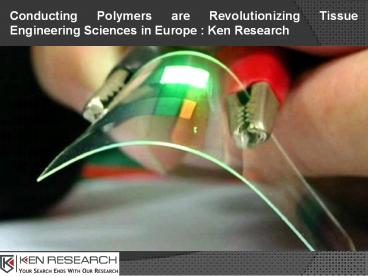
Conducting Polymers are Revolutionizing Tissue
Engineering Sciences in Europe Ken Research
2
Developing stimulus-responsive biomaterials with
easy-to-tailor properties is a highly desired
goal within the tissue engineering category.
Conductive polymer is novel type of electroactive
biomaterial that is being used in fuel cells,
computer displays, microsurgical tools, and
various applications in the field of
biomaterials. Conducting polymer is synthesised
as hydrogels combined into composites or
electrospun into microfibers which are
biocompatible and biodegradable. With increasing
applications of conducting polymers which are
used as very important materials for biosensors,
neural implants, drug delivery devices and tissue
engineering scaffolds. According to the study
Europe Conducting Polymers Industry Situation
and Prospects Research Report, conductive
polymers possess excellent control of the
electrical stimulus, optical properties that have
a high conductivity/weight ratio and can be made
biocompatible, biodegradable and porous. The main
advantage of conductive polymers is that their
chemical, electrical and physical properties can
be tailored to the specific needs based on
applications by incorporating antibodies, enzymes
and other biological processes. The properties
that make conductive polymers more attractive is
its wide range of electrical conductivity, which
can be achieved with various doping levels, while
maintaining mechanical flexibility and high
thermal stability. Conducting polymers have
advantages over other materials such as LED
lighting and electrical supercapacitors.
3
The use of electrically-conducting, nanocomposite
polymers and the hybrid fabrication process
alleviates problems with materials mismatch
between flexible nonconductive polymers and
metals/alloys or less flexible conductive
polymers for soft (polymer) (N)-M-EMS and
flexible lab-on-chip systems. The high degree of
biocompatibility of conducting polymers also
makes them particularly interesting materials for
biosensing and implantable electrodes. Electrical
ly conducting and thermally conducting are the
two types of conducting polymers available in
European markets. Various applications of
conducting polymers are ESD/EMI Shielding,
Antistatic Packaging, Electrostatic Coating and
Capacitors. Geographically, European conducting
polymers industry is spread across Germany,
Russia, UK, France, Italy and other regions. The
leading players in European conducting polymers
industry are Henkel, Agfa-Gevaert NV, Celanese
Corporation, The Lubrizol Corporation, Covestro
AG, Heraeus Holding, 3M, Solvay, Polyone
Corporation, Sabic, Arkema, Cabot Corporation,
Eastman Chemical Company, Electriplast
Corporation, Ensinger, Ferro Corporation and
Kemet. Advanced technological inventions in
field of polymers, nanotechnology and sciences is
paving way for new possibilities within
conductive polymers market. Europe is witnessing
evolution in many sectors with increasing RD in
every industry for the development of more
sophisticated products.
4
It was observed that the ongoing research and
development will revolutionize the world of
tissue engineering. This trend will continue in
conducting polymers industry over the next few
years in Europe. To know more, click on the link
below https//www.kenresearch.com/metal-mining-an
d-chemicals/chemicals/europe-conducting-polymers-i
ndustry-situation-and-prospects-research-report/14
5909-101.html Related Reports- https//www.kenr
esearch.com/metal-mining-and-chemicals/chemicals/n
orth-america-conducting-polymers-industry-situatio
n-and-prospects-research-report/146417-101.html
https//www.kenresearch.com/metal-mining-and-chemi
cals/chemicals/china-conducting-polymers-industry-
situation-and-prospects-research-report/146249-101
.html
5
Contact Us- Ken ResearchAnkur Gupta, Head
Marketing CommunicationsSales_at_kenresearch.com
91-9015378249
6
(No Transcript)
Recommended

