

Polycarbonate Roofs – How To Choose The Right Components? Tuflite Polymers PowerPoint PPT Presentation
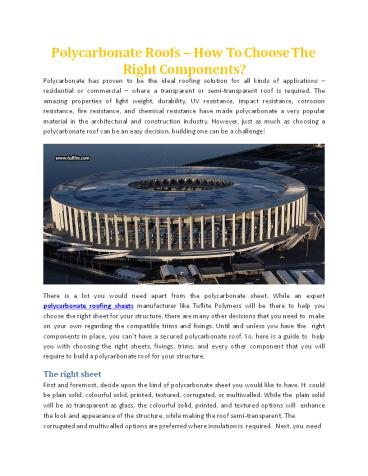
Title: Polycarbonate Roofs – How To Choose The Right Components? Tuflite Polymers
1
Polycarbonate Roofs How To Choose The Right
Components?
Polycarbonate has proven to be the ideal roofing
solution for all kinds of applications
residential or commercial where a transparent
or semi-transparent roof is required. The
amazing properties of light weight, durability,
UV resistance, impact resistance, corrosion
resistance, fire resistance, and chemical
resistance have made polycarbonate a very popular
material in the architectural and construction
industry. However, just as much as choosing a
polycarbonate roof can be an easy decision,
building one can be a challenge!
There is a lot you would need apart from the
polycarbonate sheet. While an expert
polycarbonate roofing sheets manufacturer like
Tuflite Polymers will be there to help you
choose the right sheet for your structure, there
are many other decisions that you need to make
on your own regarding the compatible trims and
fixings. Until and unless you have the right
components in place, you can't have a secured
polycarbonate roof. So, here is a guide to help
you with choosing the right sheets, fixings,
trims, and every other component that you will
require to build a polycarbonate roof for your
structure. The right sheet First and foremost,
decide upon the kind of polycarbonate sheet you
would like to have. It could be plain solid,
colourful solid, printed, textured, corrugated,
or multiwalled. While the plain solid will be as
transparent as glass, the colourful solid,
printed, and textured options will enhance the
look and appearance of the structure, while
making the roof semi-transparent. The corrugated
and multiwalled options are preferred where
insulation is required. Next, you need
2
to choose the right thickness. Polycarbonate
roofing sheets are available in a variety of
thicknesses, each designed for a specific
application. You need to be sure you have the
right polycarbonate thickness for your
particular project to maximize both durability
and insulation. 4-6 mm These sheets are ideal
for cladding like in the side panels of a
greenhouse, and not an entire roof. This is
because these are the most delicate
polycarbonates with minimal insulation
properties. 10-16 mm These sheets are ideal for
small roofing projects like carports as they can
withstand small amounts of pressures easily, and
they also offer a good amount of
insulation. 25-35 mm These sheets are the best
choice for large roofing projects like in the
case of conservatories, as they have amazing
impact resistance and offer the greatest
insulation. Glazing bars Glazing bars are
required to secure your polycarbonate panels to
the frame. They are available in aluminum and
PVC options, where aluminum beats PVC in terms of
strength. These glazing bars are simply screwed
into the rafters, and then are snapped down to
snuggly secure the polycarbonate roofing sheets
into place. When you order glazing bars, you will
receive them in three parts the head cap, the
base bar, and the end cap. In the case of
aluminum glazing bars, the base bar will be
replaced by rubber gasket. Drip trim Placed at
the lowest part of the polycarbonate roofing
system, the drip trims are placed away from the
wall, and do not allow water to trickle off, thus
preventing water from entering the chambers. PVC
drip trims are the most common. However, with
aluminum glazing bars, you can opt for end stop
bar. This bar is anyways used even in PVC glazing
bar systems to secure the left and right sides
of the sheet. H section Do you have to stack up
multiple sheets against each other on the width?
An H section is what you need. It acts as a
glazing bar, but without the need of purlin
support. Fixing buttons As the name itself
suggests, these are used to fix polycarbonate
sheets to the fasteners, with a screw that is
appropriately sized so as to secure them into the
rafters. Flashing tape
3
Lead flashing offers a professional finish to the
polycarbonate. But, because lead is difficult to
work with, it can be replaced with flashing tape,
which sticks to both the wall and the
polycarbonate sheet to hinder water ingress at
the top of the sheets. So now, get the right
components to have the most durable and rightly
fit polycarbonate roofing system in place!
Recommended

