

All You Need to Know about COLORECTAL POLYPS PowerPoint PPT Presentation
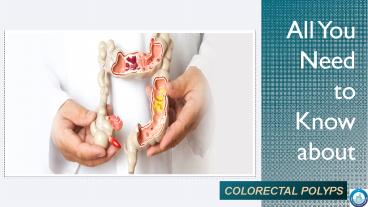
Title: All You Need to Know about COLORECTAL POLYPS
1
All You Need to Know about
- COLORECTAL POLYPS
2
- Introduction
- Facts
- Risk Factors
- Causes
- Symptoms
- Preventions
- Treatment
- How we can help you
3
- COLORECTAL POLYPS
- A colon polyp is a small clump of cells that
forms on the lining of the colon. Most colon
polyps are harmless. But over time, some colon
polyps can develop into colon cancer, which is
often fatal when found in its later stages. - There are two main categories of polyps,
non-neoplastic and neoplastic. Non-neoplastic
polyps include hyperplastic polyps, inflammatory
polyps and hamartomata's polyps. These types of
polyps typically do not become cancerous.
Neoplastic polyps include adenomas and serrated
types. In general, the larger a polyp, the
greater the risk of cancer, especially with
neoplastic polyps.
4
- FACTS OF COLORECTAL POLYPS
- Polyps are one of the most common colorectal
conditions, occurring in 15 - 20 percent of the
adult population. They can occur anywhere in the
large intestine or rectum, but are more commonly
found in the left colon, sigmoid colon, or
rectum. - Some colon polyps are benign, which means they
are not cancerous, but some can be precancerous
or cancerous. The relationship of certain polyps
to cancer is well established. Polyps can usually
be removed during colonoscopy.
5
- RISK FACTORS OF COLORECTAL POLYPS
- You are 50 years of age or older
- You have had polyps before
- Someone in your family has had polyps
- Someone in your family has had colon or rectal
cancer - You have had uterine or ovarian cancer before age
50 - You use tobacco products (smoking, chewing
tobacco, etc.) - You drink alcohol
- You dont exercise
- You are overweight
6
CAUSES OF COLORECTAL POLYPS
- Colorectal Polyps mainly cause from abnormal
tissue growth. - The body periodically develops new healthy cells
to replace old cells that are damaged or no
longer needed. The growth and division of new
cells is usually regulated. - In some cases, however, new cells grow and divide
before theyre needed. This excess growth causes
polyps to form. The polyps can develop in any
area of the colon.
7
SYMPTOMS OF COLORECTAL POLYPS
- Rectal bleeding. This can be a sign of colon
polyps or cancer or other conditions, such as
hemorrhoids or minor tears in your anus. - Change in stool color. Blood can show up as red
streaks in your stool or make stool appear black.
A change in color may also be caused by foods,
medications and supplements. - Change in bowel habits. Constipation or diarrhea
that lasts longer than a week may indicate the
presence of a large colon polyp. But a number of
other conditions can also cause changes in bowel
habits. - Pain. A large colon polyp can partially obstruct
your bowel, leading to crampy abdominal pain. - Iron deficiency anemia. Bleeding from polyps can
occur slowly over time, without visible blood in
your stool. Chronic bleeding robs your body of
the iron needed to produce the substance that
allows red blood cells to carry oxygen to your
body (hemoglobin). The result is iron deficiency
anemia, which can make you feel tired and short
of breath.
8
TREATMENT OF COLORECTAL POLYPS
PREVENTIONS OF COLORECTAL POLYPS
- Avoid excess alcohol and do not smoke tobacco.
- Lose any extra weight to normalize your body mass
index. - Exerciseincluding at least 150 minutes of
moderate aerobic activity and 2 sessions of
muscle strengthening per week. - Eat at least 3-5 servings of fruits and
vegetables a day. - Avoid fatty and processed foods and red meat in
excess. - Low-dose aspirin every day has been shown to
decrease colorectal polyps and cancer. Aspirin
can have side effects. The use, risks and
benefits of aspirin should be discussed with your
doctor
9
- TREATMENT OF COLORECTAL POLYPS
- See your doctor for the treatment of Colorectal
Polyps - Abdominal pain
- Blood in your stool
- A change in your bowel habits that lasts longer
than a week - You should be screened regularly for polyps if
- You're age 50 or older.
- You have risk factors, such as a family history
of colon cancer. Some high-risk individuals
should begin regular screening much earlier than
age 50.
10
- SHAH PILES FISTULA HOSPITAL
- The Piles hospital Ahmedabad has treated more
than 1.5 lac patients over the years suffering
from a spectrum of diseases which include Piles
(Masa\Babasir), Fissure(Wadhiya), Fistula
(Bhagandar), Pilonidal sinus, Rectal polyp and
all other problems related to the anal canal - .
- The vision of Shah Piles Fistula Hospital is to
serve the people suffering from the most common
heath problems related to Piles, Anal Canal. The
Shah Piles hospital in Ahmedabad has been brought
to action to serve society. and extraordinary
vision in the field of Proctology.
Recommended

