

CLEAN AGENT TYPE FIRE EXTINGUISHER PowerPoint PPT Presentation
Title: CLEAN AGENT TYPE FIRE EXTINGUISHER
1
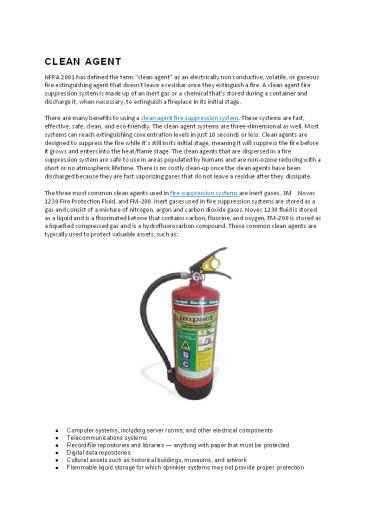
CLEAN AGENT NFPA 2001 has defined the term clean
agent as an electrically non conductive,
volatile, or gaseous fire extinguishing agent
that doesn't leave a residue once they extinguish
a fire. A clean agent fire suppression system is
made up of an inert gas or a chemical that's
stored during a container and discharge it, when
necessary, to extinguish a fireplace in its
initial stage. There are many benefits to using
a clean agent fire suppression system. These
systems are fast, effective, safe, clean, and
eco-friendly. The clean agent systems are
three-dimensional as well. Most systems can
reach extinguishing concentration levels in just
10 seconds or less. Clean agents are designed to
suppress the fire while its still in its initial
stage, meaning it will suppress the fire before
it grows and enters into the heat/flame stage.
The clean agents that are dispersed in a
fire suppression system are safe to use in areas
populated by humans and are non-ozone reducing
with a short or no atmospheric lifetime. There
is no costly clean-up once the clean agents have
been discharged because they are fast vaporizing
gases that do not leave a residue after they
dissipate. The three most common clean agents
used in fire suppression systems are inert gases,
3M Novec 1230 Fire Protection Fluid, and
FM-200. Inert gases used in fire suppression
systems are stored as a gas and consist of a
mixture of nitrogen, argon and carbon dioxide
gases. Novec 1230 fluid is stored as a liquid
and is a fluorinated ketone that contains carbon,
fluorine, and oxygen. FM-200 is stored as a
liquefied compressed gas and is a
hydrofluorocarbon compound. These common clean
agents are typically used to protect valuable
assets, such as
- Computer systems, including server rooms, and
other electrical components - Telecommunications systems
- Record/file repositories and libraries anything
with paper that must be protected - Digital data repositories
- Cultural assets such as historical buildings,
museums, and artwork - Flammable liquid storage for which sprinkler
systems may not provide proper protection
2
- Subfloors with critical building infrastructure
that can be damaged with exposure to water - Laboratory and medical equipment
- Clean agent systems are not typically required by
building or fire codes. However, more businesses
and organizations are turning to these systems to
protect their properties. - Are you ready for a Clean Agent Fire Suppression
System? - If you have questions or are thinking about
upgrading your current fire protection system,
contact Impact Fire and Safety Pvt. Ltd. today.
One of our fire suppression experts would be
happy to answer all of your questions about
clean agents. If you have a fire suppression
system already installed, IFS can take care of
the routine inspections and testing. Our experts
can design, install, and maintain your clean
agent fire suppression system, so contact us
today.
Recommended

