

Overcoming the Chaos, Concern and Fear of Ransomware with Seceon aiXDR PowerPoint PPT Presentation
Title: Overcoming the Chaos, Concern and Fear of Ransomware with Seceon aiXDR
1
Overcoming the Chaos, Concern and Fear of
Ransomware with Seceon aiXDR
Santanu (Shaan) Bagchi June 11, 2021 Tags
aiXDR Use Cases
Demand for ransom in exchange for something
valuable, captured forcefully, is an age old vice
that has found its parallel in the digital world
several years ago. Cyber criminals have resorted
to extortion, preying on individuals and
organizations (enterprises, businesses,
institutions) by encrypting files on personal
computers, workstations, tablets and mobile
devices. In order to salvage the situation,
helpless user would be coerced to pay up a
ransom, in return for the recovery key. While the
ransom could vary from a couple of hundred
dollars to thousands, depending on perceived
value of the data and asset, there is also a high
probability that parts of the data (personal,
confidential or business oriented) may be sold on
the dark web, if the demand remains unfulfilled
by the stipulated deadline. Welcome to the dark
world of old and new ransomware from WannaCry,
Ryuk, Petya, and Maze to Darkside, REvil and
Epsilon Red. While attack techniques and tactics
could vary, perpetrators are mostly elusive, as
with any complicated crime scenario, and cyber
sleuths have negligible success at reversing the
situation. That leaves us with only a few options
a.) Self-Awareness to avoid any trap b.)
Software based early detection c.) Rapid response
to minimize damage or eliminate threat Almost
all ransomware attacks originate from an email
phishing campaign or drive-by download (accessing
a blacklisted site or hijacked site). Seceon
aiXDR quickly swings into action, correlating
logs from email server with endpoint activities,
identifying access to blacklisted site (with
gathered Threat Intelligence) and applying
behavioral patterns to find traces of unusual or
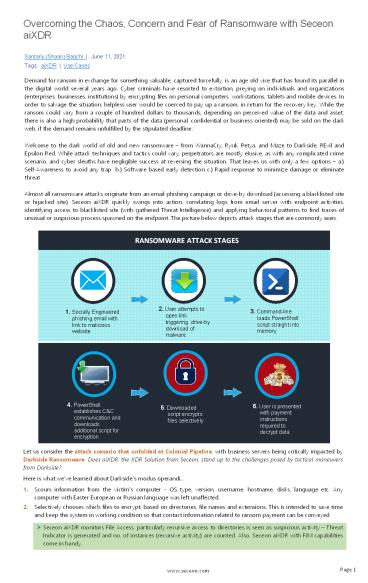
suspicious process spawned on the endpoint. The
picture below depicts attack stages that are
commonly seen.
- Let us consider the attack scenario that unfolded
at Colonial Pipeline, with business servers being
critically impacted by Darkside Ransomware. Does
aiXDR, the XDR Solution from Seceon, stand up to
the challenges posed by tactical maneuvers from
Darkside? - Here is what weve learned about Darksides modus
operandi - 1. Scours information from the victim's computer
- OS type, version, username, hostname, disks,
language etc. Any computer with Easter European
or Russian language was left unaffected. - 2. Selectively chooses which files to encrypt,
based on directories, file names and extensions.
This is intended to save time and keep the system
in working condition so that contact information
related to ransom payment can be conveyed - Seceon aiXDR monitors File Access, particularly
recursive access to directories is seen as
suspicious activity Threat Indicator is
generated and no. of instances (recursive
activity) are counted. Also, Seceon aiXDR with
FIM capabilities come in handy.
Page 1
www.seceon.com
2
- 3. For anonymity, attacker instructs designated
website (for payment arrangement) can be accessed
using TOR browser - Using netflow/J-flow/IPFix data, IP Address of
destination can be extracted despite use of TOR
browser - 4. Critical strings are encrypted using XOR
Encryption to avoid detection. Also, main
configuration is encrypted using base64 encoding - Seceon aiXDR can decrypt XOR Encrypted strings to
identify type of activity. Also, any process
associated with base64 encoding or any other
encryption/decryption (e.g OpenSSL) method is
identified by aiXDR and flagged as a Threat
Indicator - 5. Dynamically calls WinAPI by hashed names and
encrypted names instead of referring to the
import table of APIs, to avoid detection and
revelation of purpose - Any WinAPI call results in a process with an
unknown hash that gets picked up by aiXDRs
Machine Learning algorithm - 6. Pulls up a list of Shadow Copy backups and
gets rid of them, so the user can't restore files - It is quite a common behavior for ransomware to
hijack the windows program vssadmin.exe that
manipulates volume shadow copies of a file
system. Seceons aiXDR instantly catches this
attempt generally as a combination of
command-line vssadmin delete shadows and WMI
command wmic shadowcopy delete. This malicious
behavior and threat indicator is considered very
risky and the alert is elevated to severity level
Major or Critical. - Note, vssadmin requires Administrator privilege
to execute and is commonly used by other
ransomwares like Ryuk and WannaCry to wreak
havoc. Hence, privilege escalation by the malware
is also detected by aiXDR as a serious Threat
Indicator. - 7. Tries to disable various backup solutions
- Seceon aiXDR detects any attempt to disable a
service on the host/endpoint and creates a Threat
Indicator - 8. Uses both symmetric and asymmetric key
encryption, so that an intercepted public key
cannot be solely used for restoring access to
data - As noted earlier, any process associated with
encryption or decryption is promptly discerned by
aiXDR and tagged as potentially suspicious,
subject to other evidences. - In summary, an advanced XDR solution like Seceon
aiXDR relies on comprehensive set of information
streaming in from network, events, endpoints
(EDR), threat intelligence and vulnerability scan
to assign appropriate threat indicators. The AI
engine correlates these indicators and applies
behavioral aspects to conclude Ransomware
attack in progress, while immediately escalating
alert severity to critical/major with a high
degree of confidence. In fact, aiXDR goes a step
further by empowering the Security Analyst to
take rapid action through auto-remediation or
semi-automated remediation built into the
solution. Affected endpoint/host can be isolated
from the network or specific processes can be
eliminated promptly to block further damage. - To learn more about Seceon aiXDR, check out these
resources - End-to-end Cybersecurity with aiXDR
- Seceon aiXDR Datasheet
Santanu (Shaan) Bagchi Director, Pre-Sales Solutions Seceon Inc. https//www.linkedin.com/in/shaanbagchi/
Santanu (Shaan) Bagchi has 20 years of experience in Software Industry, leading through Product Management, Pre-Sales/Solutions Architecture, Consulting and Product Marketing roles for Product Vendors, MSSPs and System Integrators in North America. As someone who has expertise in multiple tracks of Cyber Security Advanced SIEM, Data Loss Prevention, Endpoint Security, Vulnerability Management, Threat Intelligence and Identity and Access Management he brings versatile perspective to product innovation and customer centric solutions. Before joining Seceon, he worked as Practice Director (Cybersecurity and Risk Services) for Wipro. Previously, he held Product Management positions at Secureworks (MSSP), Novell (Virtualization and IaaS), Digital Guardian (DLP) and Hitachi Data Systems (Cloud Storage-aaS). Shaan received MBA degree from Babson College (Wellesley, MA) and Bachelor of Engineering from IIEST (formerly Bengal Engineering College, Howrah, India). Santanu (Shaan) Bagchi has 20 years of experience in Software Industry, leading through Product Management, Pre-Sales/Solutions Architecture, Consulting and Product Marketing roles for Product Vendors, MSSPs and System Integrators in North America. As someone who has expertise in multiple tracks of Cyber Security Advanced SIEM, Data Loss Prevention, Endpoint Security, Vulnerability Management, Threat Intelligence and Identity and Access Management he brings versatile perspective to product innovation and customer centric solutions. Before joining Seceon, he worked as Practice Director (Cybersecurity and Risk Services) for Wipro. Previously, he held Product Management positions at Secureworks (MSSP), Novell (Virtualization and IaaS), Digital Guardian (DLP) and Hitachi Data Systems (Cloud Storage-aaS). Shaan received MBA degree from Babson College (Wellesley, MA) and Bachelor of Engineering from IIEST (formerly Bengal Engineering College, Howrah, India).
Page 1
www.seceon.com
Recommended

