

DIFFERENT TYPES OF WAREHOUSES PowerPoint PPT Presentation
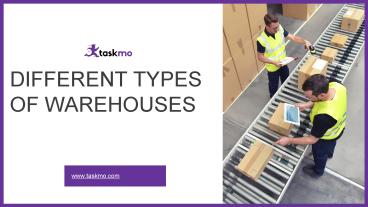
Title: DIFFERENT TYPES OF WAREHOUSES
1
DIFFERENT TYPES OF WAREHOUSES
www.taskmo.com
2
1. Public Warehouses
Public warehouses refers to those warehouses that
are owned by legal organizations in the country
and are made accessible to private organizations
and corporations. It is different from the other
kinds of public warehouses and stockrooms. These
warehouses can be leased or loaned by both
business and government and even in individuals
performing a specific business.Public stockrooms
can be loaned for both business and individual
use.
In case you're a SMB proprietor and need to store
your merchandise for a brief timeframe, a public
distribution center can be an incredible choice
when contrasted with different sorts of
stockrooms. However, here comes the limitation
with public warehouses. They are not that best in
class innovatively like various kinds of
information stockrooms, they are by and large the
most reasonable and open choice and in this
manner a strong decision for eCommerce new
businesses when contrasted with private
distribution centers.
3
2. Private Warehouses
A private warehouse is a warehouse or a stockroom
that is exclusively held by wholesalers,
merchants,producers, makers and large business
houses. On the other hand large scale retails
outlets and commercial centers also have their
own exclusive stockrooms. Private warehouses are
more expensive than public stock centers.
However, private stockrooms can in any case be an
extraordinary choice for ECommerce as they need a
long haul presence in important regions when
compared to other types of warehouses in the
supply chain process. Though the investment is
heavy, private warehouses can be a great option.
4
3. Distribution Centers
A distribution center or circulation center is a
stock room or storage house that is built solely
for a specific purpose. A distribution center can
also be called a makeshift warehouse as it is
used for temporary storage or any specific need
or items. These distribution centers hold goods
for a while and shift them quickly to the supply
chain.
When a seller, reseller or a retailer sets up a
distribution center, they receive a large amount
of inventory and distribute it to resellers
within a specific period of time. Distribution
centers mostly hold food and perishable items,
because they are distributed within a day.
Generally, distribution centers are affordable to
rent in and can vary greatly depending on what
types of products are being stored in them.
5
THANK YOU
Recommended

