

Explain the Uses and Benefits of Castable Refractory Cement PowerPoint PPT Presentation
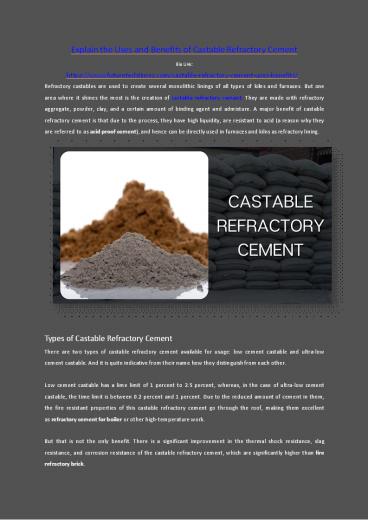
Title: Explain the Uses and Benefits of Castable Refractory Cement
1
Explain the Uses and Benefits of Castable
Refractory Cement Bio Link https//www.futuretech
times.com/castable-refractory-cement-uses-benefits
/ Refractory castables are used to create several
monolithic linings of all types of kilns and
furnaces. But one area where it shines the most
is the creation of castable refractory cement.
They are made with refractory aggregate, powder,
clay, and a certain amount of binding agent and
admixture. A major benefit of castable
refractory cement is that due to the process,
they have high liquidity, are resistant to acid
(a reason why they are referred to as acid proof
cement), and hence can be directly used in
furnaces and kilns as refractory lining.
Types of Castable Refractory Cement There are two
types of castable refractory cement available for
usage low cement castable and ultra-low cement
castable. And it is quite indicative from their
name how they distinguish from each other. Low
cement castable has a lime limit of 1 percent to
2.5 percent, whereas, in the case of ultra-low
cement castable, the time limit is between 0.2
percent and 1 percent. Due to the reduced amount
of cement in them, the fire resistant properties
of this castable refractory cement go through the
roof, making them excellent as refractory cement
for boiler or other high-temperature work. But
that is not the only benefit. There is a
significant improvement in the thermal shock
resistance, slag resistance, and corrosion
resistance of the castable refractory cement,
which are significantly higher than fire
refractory brick.
2
- Advantages and Application of Castable Refractory
Cement - Castable refractory cement is widely used
primarily as refractory lining in furnaces,
heating, heat treatment, shaft kilns, blast
furnace tapholes, and more. But that is not all
their application is limited to. - Due to them being high-tech refractory solutions
developed on common castables, they have low
porosity characteristics, small pore size, good
volume stability, superior strength, and high
density. In addition, they can easily handle
temperatures up to 800 to 1200 degrees Celsius,
which is not the case with regular castables.
That allows them to be far superior castable
refractory for boiler. - Different Castable Refractory Cement Has
Different Applications. - Clay and high alumina castable refractory cement
for boilers are typically used in heating
furnaces and soaking furnaces. - Low cement castable refractory cement, because of
its high-temperature resistance, is used in
burned linings, water cooling pipe wrapping
linings in a heating furnace, and more
applications of similar nature. Low cement and
ultra-low cement castables are particularly used
when the temperature required to work is quite
high. - Chromium containing corundum low cement castable
is used to line the refining device outside the
molten steel furnace (only certain parts). - Chromium containing corundum low cement castable
is also used to inline the power frequency
induction furnace. They are high-temperature,
wear-resistant castable serving multiple
purposes. - Low cement castables are used in blast furnaces
tapping troughs and integral spray guns for hot
metal pretreatment. - Because of their high strength, alkali, and
abrasion resistance, one can find that low cement
castables have already replaced several products
that were used in place for them and are now
widely used across the world. But before you
purchase castable refractory cement, you need to
be sure that your supplier provides you with the
right castable refractory cement. As mentioned
above, different castable refractory cement
serves different purposes. In addition, castable
cement has become an integral part of various
industries in various applications. So, the best
thing is to research the castable refractory
cement and their supplier before placing an
order for one. - Source Link
- https//www.refmon.in/
Recommended

