

Different Types of Medical Chart Reviews PowerPoint PPT Presentation
Title: Different Types of Medical Chart Reviews
1
Different Types of Medical Chart Reviews
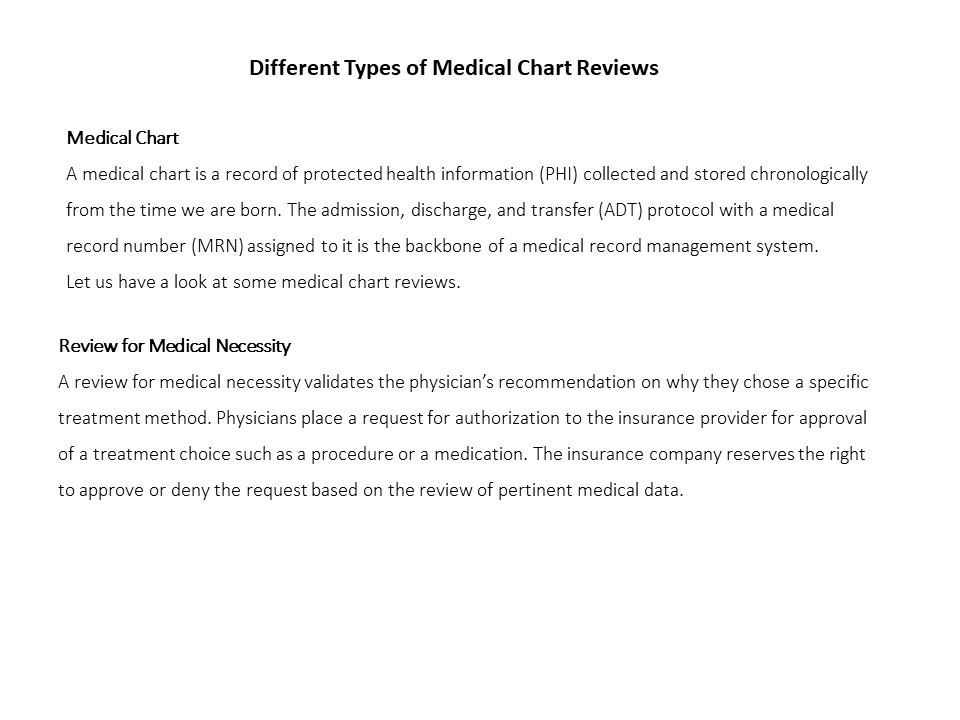
Medical Chart A medical chart is a record of
protected health information (PHI) collected and
stored chronologically from the time we are born.
The admission, discharge, and transfer (ADT)
protocol with a medical record number (MRN)
assigned to it is the backbone of a medical
record management system. Let us have a look at
some medical chart reviews.
Review for Medical Necessity A review for medical
necessity validates the physicians
recommendation on why they chose a specific
treatment method. Physicians place a request for
authorization to the insurance provider for
approval of a treatment choice such as a
procedure or a medication. The insurance company
reserves the right to approve or deny the request
based on the review of pertinent medical data.
2
Review for Medical-Legal Collaboration Attorneys
and physicians have little in common and they may
not understand each others language. However,
they need to collaborate when a medico-legal case
involves pay-outs. A patients attorney looks to
the doctor to simplify the patients case to
fight an insurance claim. Heres where an
in-depth medical records review helps. It is
usually executed by a team of professionals
with expertise in summarization. Review for
Workers Compensation The employer pays a
premium to the Workers Comp board to assist
workers to financially sustain themselves during
treatment through cash benefits and
reimbursements when the worker suffers an injury
at workplace. On occasion, when the insurer
insists on third-party review, the legal team
hires a Qualified Medical Examiner (QME) to rule
out any medical negligence and specifically
validate the claim made by the employee and to
determine the employees work status.
3
Review for Coding and Billing Medical records
review is also done for coding and billing
purposes. Medical records review for a coding
objective demands exceptional technical know-how
of medical conditions as coding errors may result
in large costs for the employer or the
insurer. Review for Insurance Underwriting Every
insurance agency usually performs an extensive
medical records review to identify risk factors
such as drug abuse, alcohol abuse, personal
history of ailments such as heart disease and
cancer, family medical history, and details of
previous claims for injuries and
disabilities. Review for Research Independent
investigators and researchers involved in
pharmaceutical advancement do a thorough medical
record analysis to understand patient behavior
after treatment. These data are used to modify
the treatment course including changes in
prescription dosage, diagnostic tools such as
scopes, or to chart a new method of treatment.
4
Review for Medical Audit Chart review for a
medical audit is a vital process for healthcare
systems to evaluate treatment outcomes and
patient satisfaction. A medical audit covers such
items as checking all numerical values,
medications, vital signs, lab values, cancer
stages, allergies, diagnosis, assessment, etc.,
involving the patients health. Hospitals often
make policy changes to improve patient care based
on medical audit results and analysis. Summary T
he records collected from different sources
provide accurate details of events that affect
the patients health status. These records are
highly confidential and are governed by the
Health Insurance Portability and Accountability
Act (HIPAA). These records can be collected only
when patient give authorization.
Recommended

