

Stages Of Complex Regional Pain Syndrome PowerPoint PPT Presentation
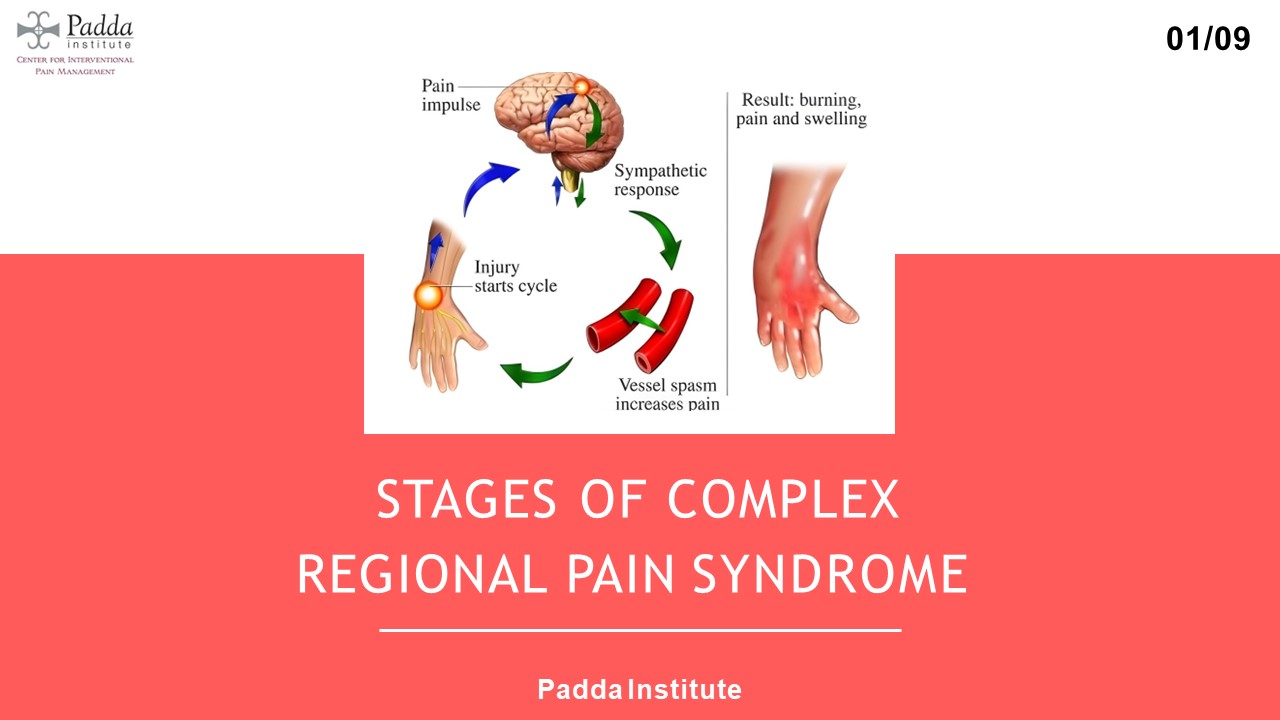
Title: Stages Of Complex Regional Pain Syndrome
1
01/09
STAGES OF COMPLEX REGIONAL PAIN SYNDROME
Padda Institute
2
02/09
Introduction In the 19th century, Silas Weir
Mitchell first described Complex Regional Pain
Syndrome (CRPS) as the amalgamation of pain.
Over time, the symptoms were not limited to just
simply an area of pain, but spread to involve
muscle, bone, joint, skin and blood vessels
eventually spreading to the spinal cord and
causing changes in the brain. This syndrome
usually starts after a trauma leading to changes
in the skin, causing severe pain and swelling in
the affected area, limiting movement. If CRPS is
not treated early, it can progress quickly,
becoming a chronic syndrome with severe permanent
disability.
3
03/09
- What Is A Complex Regional Pain Syndrome?
- Pain that persists after an injury has healed is
referred to as a chronic pain syndrome. Complex
Regional Pain Syndrome is a type of chronic pain
where the nerves themselves have developed an
injury, creating a short circuit in the nervous
system and causing a feedback loop of pain and
disability. It usually occurs in the legs or
arms. It is caused by a previous injury, which
often doesnt seem terribly severe. - Dysfunction of injured peripheral sensory neurons
causes the majority of CRPS, which has subsequent
consequences on the spinal cord and brain. CRPS
can also be caused by other major or minor
traumas, such as surgery, heart attacks,
infections, and even sprained ankles. Splintered
bones or a tight cast might generate nerve
damage or displacement. Its unclear why all
these types of injuries can provoke CRPS.
4
04/09
Understanding The Types Of CRPS
CRPS is of two types Types 1 and 2 were
initially called Reflex Sympathetic Dystrophy and
Causalgia. The distinction between these two
forms is whether or not there is nerve
injury. Type 1 causes no nerve damage. However,
type 2 causes nerve impairment. As per the
National Institute of Neurological Disorders and
Stroke, approximately 90 of persons with CRPS
have type 1. Although CRPS is more common in
women, it can affect anyone including children.
5
05/09
Symptoms of Complex Regional Pain
Syndrome While there are numerous symptoms, not
all symptoms are seen in all individuals Constan
t or fluctuating pain during movement. Changes in
the affected limbs skin temperature, texture,
color, or inflammation. Excessive or persistent
pain upon use or contact. Sweating abnormally,
as well as nail and hair growth. Rigid
joints Excessive bone growth Hampered muscle
strength
6
06/09
Diagnosis
Detailed examination by a doctor acquainted with
typical patterns of sensory nerve anatomy, such
as a neurologist, orthopedist, or plastic
surgeon. Nerve conduction investigations can
detect some CRPS-related nerve damage. To image
nerves, ultrasound or magnetic resonance imaging
(MRI), can sometimes show underlying nerve
damage. Excess bone resorption associated with
CRPS can sometimes be seen on triple-phase bone
scans (using a dye), which can aid in diagnosis
and localization. However, these tests might
confirm CRPS but are not absolutely definitive.
They will assist in determining therapy choices.
7
07/09
CRPS Treatment Options Desensitization therapy is
the essential treatment for CRPS. It keeps the lim
bs moving, improves blood circulation, maintains
flexibility, and prevents muscle and tissue
loss. Psychotherapy If you are sad, nervous, or
suffering from post-traumatic stress disorder,
you should get help from a psychologist. Consider
having stimulating electrodes inserted into the
spine via the spinal cord with the help of a
needle. This aids in blocking pain felt and
normalization of the brain-spinal cord
connection. Medication To assist you in dealing
with symptoms, your doctor may prescribe various
drugs. You may be prescribed blood pressure
drugs, antidepressants, and pain relievers to aid
inflammation. Surgery Surgery includes severing t
he nerves and blocking pain signals from reaching
the brain. It is considered a last resort.
8
08/09
The Bottom Line It is crucial to diagnose and
treat complex regional pain or regional
sympathetic neuropathy syndrome early, if you
want the best results. CRPS or RSD should be
treated as soon as it is discovered or even
considered as a possible diagnosis. The Padda
Institute Center For Interventional Pain
Management offers long-term pain reduction
strategies. We are considered one of St. Louis
best pain treatment specialists and are known to
have helped many suffering from chronic pain
related disorders. Get help today!
9
09/09
5203 Chippewa Suite 301 Saint Louis, MO 63109
USA
314-481-5000 info_at_painmd.tv www.painmd.tv
Thank You
Recommended

