

Heat Treatment for Bolts and Fasteners - Classic Metallic PowerPoint PPT Presentation
Title: Heat Treatment for Bolts and Fasteners - Classic Metallic
1
Heat Treatment of Bolts Fasteners
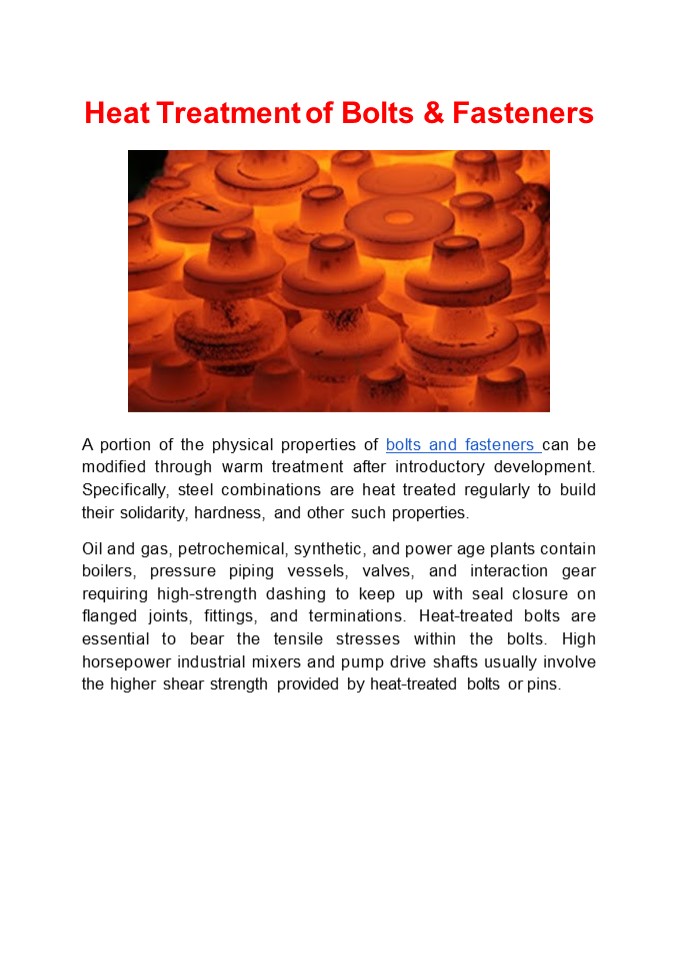
A portion of the physical properties of bolts and
fasteners can be modified through warm treatment
after introductory development. Specifically,
steel combinations are heat treated regularly to
build their solidarity, hardness, and other such
properties. Oil and gas, petrochemical,
synthetic, and power age plants contain boilers,
pressure piping vessels, valves, and interaction
gear requiring high-strength dashing to keep up
with seal closure on flanged joints, fittings,
and terminations. Heat-treated bolts are
essential to bear the tensile stresses within the
bolts. High horsepower industrial mixers and
pump drive shafts usually involve the higher
shear strength provided by heat-treated bolts or
pins.
2
Importance of Heat Treatment of Bolts
Fasteners There are different standards governing
the heat treatment of bolts and fasteners. The
two most normal principles are from the SAE
International (Society of Automotive Engineers)
and ASTM global (American Society for Testing
and Materials). There are additional norms from
every association covering consumption
opposition, high and low-temperature openness,
and other physical boundaries that require
particular fasteners. High-strength or
heat-treated bolts and fasteners are frequently
expected to deal with the tensile, shear, or
combination loads on the darted joints in
requesting applications. Various demanding
applications require high-strength fasteners to
deal with high tensile and shear stresses
created by the applied burdens on the bolted or
fastened joints. The heat treatment process
utilises cooling and heating activities applied
on composites or metals in the strong condition
of the issue. Bolts and fasteners are exposed to
heat to accomplish modification in rigidity,
smoothness, malleability, and material strength.
The microstructure of the metal parts is
adjusted by the most common way of strengthening
to dial down the assembling activity. What is the
Process of Heat Treatment of Bolts
Fasteners? Steel alloys with higher carbon and
alloying components can be solidified and
changes will happen all through the part even at
lower cooling rates, which diminishes remaining
pressure and mutilation during heat treatment.
In lower hardenability alloys, solidifying will
just happen part way into the composite from the
surface. The chemistry of an element plays an
important role in influencing the reaction of
heat treatment and the capacity of the fastener
to carry out its planned operation.
3
- Five elementary heat treatments are helpful to
alter the metals internal structure - Hardening heated to make the metal harder where
the combination is heated over the solvus
temperature and soaked until a homogeneous solid
solution is made. - Case Hardening this process involves hardening
the outer layer of the metal/socket
screw/fastener whilst retaining a soft inner
metal core. - Annealing adjusts the physical and chemical
design of the metal/socket screw/fastener which
permits it to be extended under tensile
pressure. It is utilised to lessen hardness,
increment ductility, and assist in eliminating
internal stresses. - Normalising this gives the metal/socket
screw/fastener a uniformed and fine grain
structure - Tempering this process heats the metal/socket
screw/fastener to a precise temperature below the
critical point and is usually carried out in the
air, vacuum, or inert atmosphere. - Some of the common procedures applicable for
fasteners and bolts include - 1. High carbon and low carbon hardening Steels
with high carbon content can be hardened, but
steels with low carbon content are considered
non-hardenable. Heat treatments of impeccable
bolts are utilized to break up coarse chromium
carbide particles, which might lessen erosion
opposition and strength. The carbide arrangement
treatment of hardened steel fasteners can
further develop cryogenic or low-temperature
sturdiness and is important for the ASTM A320 in
particular. ASTM A325, ASTM A490 SAE grade 5,
and SAE grade 8 fasteners are made of higher
carbon plain or composite steels, which can be
solidified through an extinguishing and treating
process. Heat-treated SAE grade 8 bolts have two
times the base tensile strength of SAE grade 2
bolts.
4
2. Quench and temper hardening process In this
process, steel fasteners are first heated up to
a temperature where their construction is
changed over into austenite and afterward
extinguished or quickly cooled in water, and oil
or air to precious stone designs that change to
martensite. Then, the martensitic steel
fasteners are heated at a moderate treating
temperature to change the martensite to ferrite,
with an exceptionally fine
Steels cooled gradually from as well
as non-hardenable, low
scattering of cementite.
austenitizing temperatures,
- carbon grade steels, structure a softer, coarser
pearlite construction of ferrite and iron
carbides (cementite). The cooling rate must be
quick enough to keep away from the development
of pearlite. - Case Hardening Process While hardening heat
treatments increment latch material strength,
the solidified alloys have decreased
flexibility, and that implies they will break
under more modest strains or distortion
contrasted with toughened fasteners. Case
hardening is a cycle for hardening a surface or
"case" layer of low carbon and alloy steel. Case
hardening is a cycle for hardening a surface or
"case" layer of low carbon and alloy steel. The
steel is first carburized or carbonitrided, to
expand the carbon content in the external layer
or case. - Carburized Steel Fastener Hardened The
carburized steel pin or clasp is then
traditionally solidified with an extinguish and
treat process. The subsequent latch has a
delicate, extreme, low carbon steel inward
center with a callous, high carbon steel
external surface. The solidified surface opposes
scraped area, wear, or cutting. The soft,
extreme internal center keeps fasteners from
being snapped or sheared. Pins and sheet metal
screws frequently utilize unfeeling surfaces.
Bolts, shackles, and other equipment for locks
are much of the time unfeeling because they do
not effectively saw sliced and have the
sturdiness to oppose break from a hammer blow.
5
Outlook
Using heat-treated bolts and fasteners in a
design can give structural advantages. In many
cases, heat-treated bolts will have higher costs
in comparison with unhardened, low-carbon steel
bolts. Equipment failure can possibly result if
heat-treated or high-strength bolts are replaced
with softer bolts during a redesign, retrofit, or
update activity. If you want quality Industrial
fasteners for your business, you can call us at
971-506349042, 971 6 575 1335. Email us at
sales_at_clmet.com/info_at_clmet.com for ordering
industrial fasteners.
Recommended

