

parliament of india | by affairs of india PowerPoint PPT Presentation
Title: parliament of india | by affairs of india
1
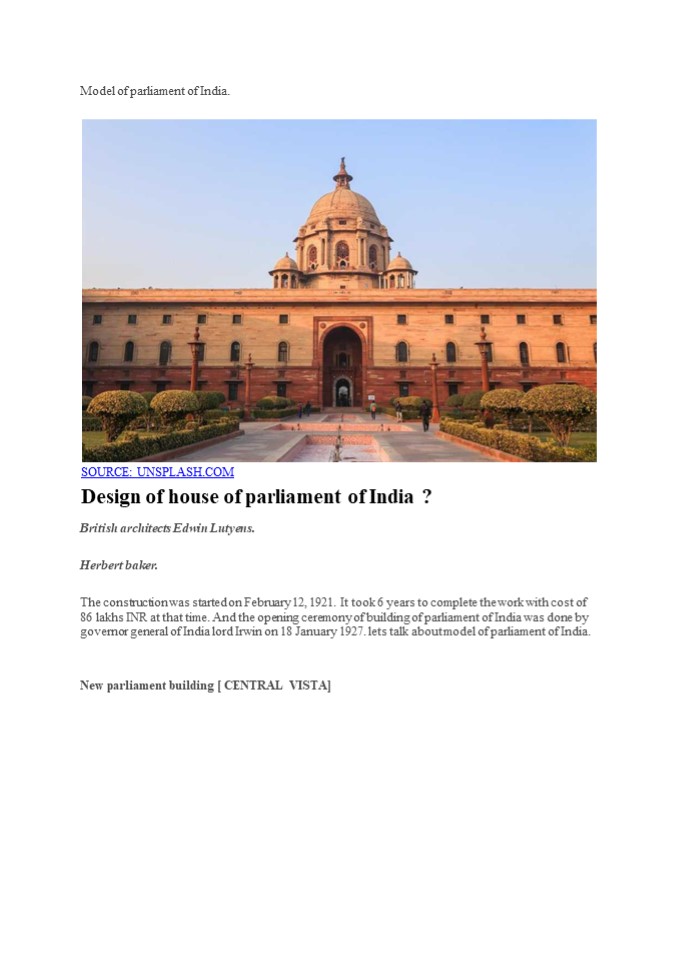
Model of parliament of India.
SOURCE UNSPLASH.COM Design of house of
parliament of India ?
British architects Edwin Lutyens.
Herbert baker.
The construction was started on February 12,
1921. It took 6 years to complete the work with
cost of 86 lakhs INR at that time. And the
opening ceremony of building of parliament of
India was done by governor general of India lord
Irwin on 18 January 1927. lets talk about model
of parliament of India.
New parliament building CENTRAL VISTA
2
SOURCE the news minute A four-storey building.
Seating capacity 1,224 MPs. Total area 64,500
sq. m Cost Rs 970c.
Other features- A grand Constitution Hall to
showcase Indias democratic heritage Lounge for
MPs Library Multiple TOI Unlike the present
Parliament however, the new building will not
have a Central Hall committee rooms Dining areas
Ample parking space. Organization of parliament
of India? The Indian Parliament, made up of the
Lok Sabha (House of People) and Rajya Sabha
(Council of States), is a bicameral legislature.
The Lok Sabha (House of the People)
3
Total strength- 552.
530 represent the states. 20 represent the union
territory. 2 members from Anglo Indian
community nominated by president of India. At
present, Lok Sabha has 545 members 530 members
from states 13 from union territory 2 from
Anglo Indian community nominated by
president. the Rajya Sabha (Council of
States) maximum total strength 250 238
members from states and union territory 12
members nominated by president. At present, Rajya
Sabha has 245 legislators.! 229 members from
states and 4 members from union territories 12
members nominated by president who have well
experience or knowledge in field of art , culture
, sports, science, literature, social service.
AMERICAN SENATE HAS NO NOMINATED MEMBER
The president serves as head of state and
appoints cabinet ministers to form an executive
branch responsible for implementing laws passed
by parliament.
The judiciary consists of various courts,
including the Supreme Court at its highest level
,high courts at intermediate levels in each state
or union territory where they exist, district
courts at lower levels in each state or union
territory where they exist.
Head of the state - chief minister. elect
directly from amongst themselves. This position
can also be fill directly by central government
when no party have enough majority. Duration and
sessions of parliament? 1. Budget session -
February to may. 2. The monsoon session- July
to September. 3. The winter session - November
to December. Parliament cannot be on rest for
more than 6 months , in other words
parliamentarian should meet at least twice a year.
Hours and motion of Indian parliament?
4
Question hours.
Zero hours. Closure motion. Privilege
motion. Calling attention motion. Adjournment
motion. No- confidence motion.
Types of bill in Indian parliament? Ordinary Bill
These bills are concerned with any matter except
the fiscal bills, plutocrat bills, and
constitution correction bills. Both houses can
introduced these bill firstly except the
plutocrat bill or money bill. This bills needs
only simple majority to pass. No prior
recommendation of president needed to introduced
these bills except the money bill. Financial bill
can only be intro in the Lok Sabha. After the
bill is passed from both of the houses with
simple majority then the bill is transferred to
the chairman for final blessing and hand.
Money bill only introduced in Lok Sabha with
prior recommendation of president. Rajya Sabha
then does not play a major part, as it can either
pass the bill with a simple maturity or can
further it to the chairman for blessing and shoot
it back to Lok Sabha with a recommendation. Now
its depend upon the member of the Lok Sabha
whether they will accept or reject the
suggestions. Indigenous Correction Bill These
bills contain legal vittles mentioned in
composition 368 of the Indian constitution .Both
houses have power to introduced this bill.
Procedure of passing a bill in Indian
parliament? After the bill is drafted, it goes
through four stages before getting final blessing
by the chairman. First, the bill is introduced in
both the houses of parliament in India, Lok Sabha
and Rajya Sabha.. an bill is known as government
bill when it will introduced by minister and
known as private bill when it will introduced by
an private member. Before the bill is introduced,
its necessary for a member- in- charge of the
bill to ask for leave. However , also only the
bill is passed, If the leave is granted by the
house. This is known as first stage of bill
called first reading. After the preface of the
bill, the presiding officer of the concerned
houses can relate the bill to the concerned
standing commission for examination. The
alternate reading of the bill has two stages, the
first stage or the commission stage, which
includes a general discussion on the bill, opting
a commission to examine the bill completely, and
clause by clause. Without altering the principles
it can amend the vittles and after all the
reading it reports the Bill back to the house.
The alternate stage or the consideration stage
includes the duties of the Houses. After entering
the bill from the commission, the houses,
consider the vittles in the bill clause by
clause.
5
In the third step, if the maturity of the members
bounce in favor of the vittles, the Bill is
accepted .However, itll not be accepted, If the
bill does not get the needed votes. In the fourth
stage, the bill is passed to the alternate stage
where all the three stages are again performed
consequently. The alternate house has the power
to pass the bill without any fresh emendations,
pass the bill with emendations and return it to
the first house, reject the bill or may not
modernize and take any action leaving the bill in
pending status. The final stage is blessing and
hand from the President. The chairman has the
following powers, he can give his assent and the
bill will come an act. He can withhold his assent
and the bill is cancelled or he can return the
bill for retrospection. Respect the
constitution You are a citizen of India. Your
country has a constitution and laws that govern
it, which you must respect. The Constitution of
India was adopted by referendum on 26 November
1950, after much debate and discussion over many
years. It came into effect on 26 January 1950
when President Rajendra Prasad signed it into law.
Conclusion
I hope this article has helped you understand a
little bit about the Indian constitution. We are
a very diverse country with many different
cultures, religions and political ideologies. I
believe that we can all learn something from each
other . So please feel free to comment below if
there is anything else you would like me to write
about.
Recommended

