

Global SLAM Technology Market Research Report Analysis | 2030 PowerPoint PPT Presentation
Title: Global SLAM Technology Market Research Report Analysis | 2030
1
SLAM Technology Market A Quick Glimpse into its
Diverse Functional Areas
Until recently, robots worked in zones with
predefined dimensions of the environment. Whether
it was a hospital or a warehouse, robots had
pre-existing knowledge of the environment and
performed a fixed set of tasks. However, with
increasing autonomy, it becomes difficult for
robots to navigate dynamic, complex, and new
terrains without prior knowledge.
This is where SLAM technology can make a drastic
difference for such devices since it collects
spatial information, constructs a virtual map,
and updates real-time coordinates to help
navigation. As per Inkwood Research, the global
SLAM technology market is set to project a CAGR
of 40.46 during the forecast period, 2022-2030.
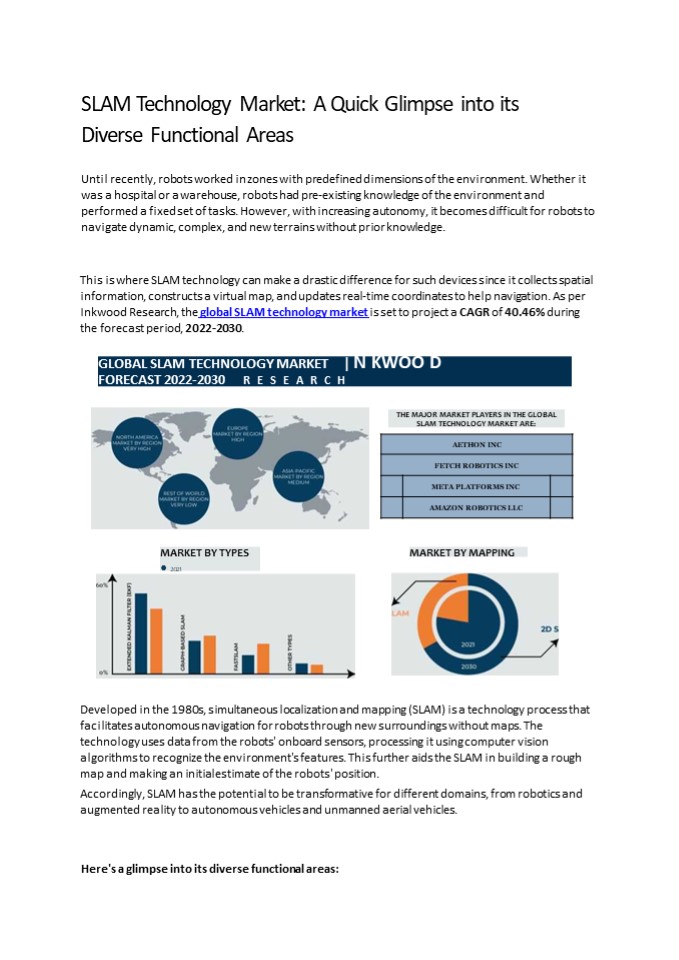
GLOBAL SLAM TECHNOLOGY MARKET N KWOO
D FORECAST 2022-2030 research
THE MAJOR MARKET PLAYERS IN THE GLOBAL SLAM
TECHNOLOGY MARKET ARE
AETHON INC AETHON INC AETHON INC
FETCH ROBOTICS INC FETCH ROBOTICS INC FETCH ROBOTICS INC
META PLATFORMS INC
AMAZON ROBOTICS LLC
MARKET BY TYPES 2021
MARKET BY MAPPING
Developed in the 1980s, simultaneous localization
and mapping (SLAM) is a technology process that
facilitates autonomous navigation for robots
through new surroundings without maps. The
technology uses data from the robots' onboard
sensors, processing it using computer vision
algorithms to recognize the environment's
features. This further aids the SLAM in building
a rough map and making an initial estimate of the
robots' position. Accordingly, SLAM has the
potential to be transformative for different
domains, from robotics and augmented reality to
autonomous vehicles and unmanned aerial vehicles.
Here's a glimpse into its diverse functional
areas
2
Augmented Reality
In augmented reality (AR), two aspects of
information are required to offer precise
augmented visuals of the real world. These
include the current real-world view that needs to
be augmented and the virtual object geometry and
its exact registration with the real
world. Accordingly, AR applications do not have
the required information regarding virtual
objects and overlays to display in an unknown
environment. As a result, the possible
integrations of SLAM systems have been
considered. Additionally, SLAM can facilitate the
creation of models for end-users that require
annotations and tracking on the fly. For
instance, Apple introduced ARKit in June 2017. It
uses floor recognition and position tracking to
place AR objects. However, Google Tango is the
more advanced SLAM technology that creates a
network of the surrounding, tells the floor's
location, and identifies walls and objects,
allowing everything around the user to be
elements of interaction. Our evaluations state
that Augmented Reality (AR) is the
fastest-growing application in the global SLAM
technology market, estimated to register a CAGR
of 55.85 by 2030.
Drones In terms of sensors, SLAM is divided
into visual SLAM (vSLAM) and LiDAR SLAM.
According to an article on Wevolver, researchers
at the University of Michigan developed an
ultra-energy-efficient processor to aid
autonomous micro aerial vehicles in navigating
their environment. Also, they leveraged highly
efficient deep learning algorithms to realize
visual simultaneous localization and mapping
(vSLAM) technology in a single chip that measures
a little over a centimeter. Since SLAM's goal is
to construct a 3D map as the robot navigates its
surrounding, it is also widely used in different
sensing and location techniques like cameras,
GPS, and LiDAR. Also, visual SLAM relies solely
on cameras and is the preferred method for
autonomous aerial vehicles. Furthermore, autonomy
in the drone industry is gradually becoming
popular, given the demand for drone operations
beyond the visual line of sight. Additionally,
drones with commercial applications are gradually
becoming autonomous to minimize human interaction
and reduce the total expenditure on drone
operation. Moreover, the incorporation of SLAM
technology and artificial intelligence renders
drones capable of flying and gathering data. It
also enables drones to simultaneously localize
and map its surrounding. Several leading
manufacturers are already developing SLAM-based
solutions for drones. For instance, Parrot has
launched PARROTS.L.A.M.dunk, an integrated kit
for developers to manufacture advanced navigation
applications for unmanned aerial vehicles. As per
our research, Extended Kalman Filter (EKF) is the
largest revenue-generating type in the global
SLAM technology market, with a revenue share of
56.70 in 2021.
Mining The mining sector is a lucrative area
with regard to advanced autonomous robots'
implementation. This is attributed to their
benefits, like minimal human presence in
hazardous locations, robot action
3
repeatability, and increased safety. Hence, SLAM
techniques are used in such devices to facilitate
simultaneous localization and navigation in the
working environment. Additionally, SLAM
technology can enable the acquisition of dense
spatial data in the form of 3D point clouds in
specific cases. This can be further used for
different 3D modeling and spatial analysis
purposes. Also, drones are being sent to hitherto
unexplored areas underground using LiDAR and SLAM
technologies, where GPS navigation is not
feasible. These include abandoned declines, mine
shafts, stopes voids, sections compromised by
illegal mining or unsupported ground conditions,
etc. Moreover, such technologies can help miners
produce comprehensive images of their
mission-critical, high-value assets in mines.
This can be achieved through the active or
passive deployment of digital scanning and
mapping payloads. According to our estimations,
3D SLAM is the fastest-growing mapping technique
in the global SLAM technology market, expected to
record a CAGR of 46.63 by 2030.
SLAM Technology Future Implications SLAM
technology has witnessed substantial progress
over the last 30 years. SLAM and related
techniques, like visual-inertial odometry, are
increasingly deployed in several real-world
settings, from autonomous cars to mobile devices.
In addition, SLAM techniques will have more
preference in the future for obtaining reliable
metric positioning in situations where
infrastructure-based solutions like GPS are
unavailable. Furthermore, the aforementioned
varied functional areas define the growth
trajectory of the global SLAM technology market.
Moreover, with increasing developments and
innovations in the form of new applications,
sensors, and computation tools, the answer to
whether or not SLAM is necessary, is affirmative.
FAQs Which country offers lucrative growth
opportunities in the global SLAM technology
market? A Japan offers lucrative growth
opportunities in the global SLAM technology
market. Which are the key players in the
global SLAM technology market? A Amazon Robotics
Inc, Aethon Inc, Intel Corporation, Apple Inc,
etc., are among the key players in the global
SLAM technology market.
Recommended

