

Automotive Embedded Systems Market: Autonomous Cars to pilot Growth Prospects PowerPoint PPT Presentation
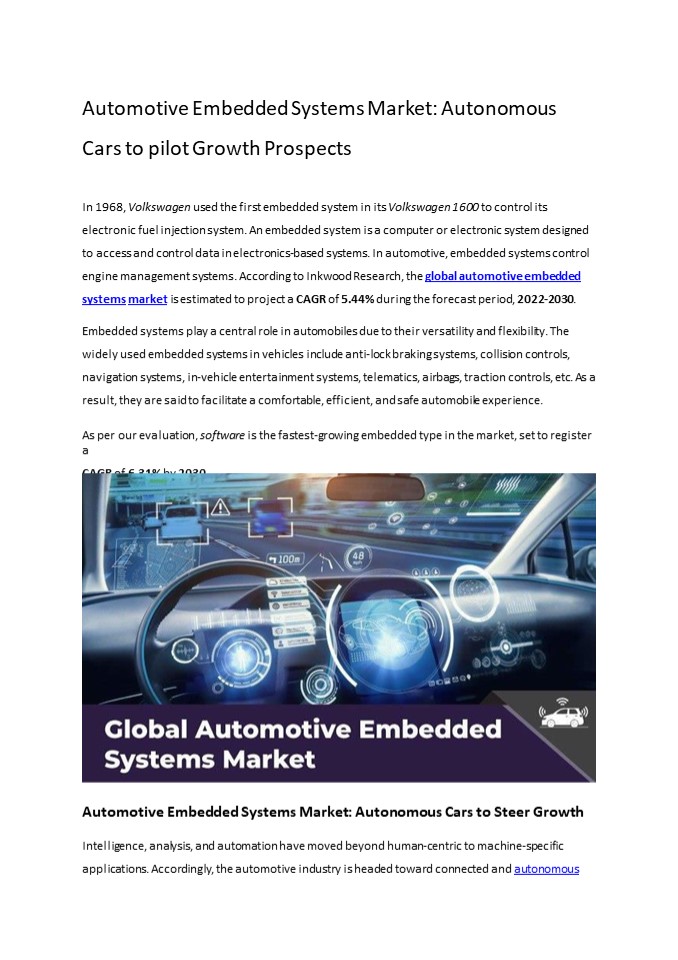
Title: Automotive Embedded Systems Market: Autonomous Cars to pilot Growth Prospects
1
Automotive Embedded Systems Market Autonomous
Cars to pilot Growth Prospects
In 1968, Volkswagen used the first embedded
system in its Volkswagen 1600 to control its
electronic fuel injection system. An embedded
system is a computer or electronic system
designed to access and control data in
electronics-based systems. In automotive,
embedded systems control engine management
systems. According to Inkwood Research, the
global automotive embedded systems market is
estimated to project a CAGR of 5.44 during the
forecast period, 2022-2030. Embedded systems play
a central role in automobiles due to their
versatility and flexibility. The widely used
embedded systems in vehicles include anti-lock
braking systems, collision controls, navigation
systems, in-vehicle entertainment systems,
telematics, airbags, traction controls, etc. As a
result, they are said to facilitate a
comfortable, efficient, and safe automobile
experience. As per our evaluation, software is
the fastest-growing embedded type in the market,
set to register a CAGR of 6.31 by 2030.
Automotive Embedded Systems Market Autonomous
Cars to Steer Growth Intelligence, analysis, and
automation have moved beyond human-centric to
machine-specific applications. Accordingly, the
automotive industry is headed toward connected
and autonomous
2
- cars. The primary factor propelling this
transition is the surging recognition of human
error in automobile accidents and fatalities. As
per a Stanford Law School report, human errors
are, in part or fully, responsible for at least
90 of total motor vehicle crashes globally. - As a result, autonomous cars are evaluated to
play a central role in accomplishing the
automotive industry's ambitious goals of 'zero
accidents,' 'zero congestion,' and 'zero
emissions.' The evolution of embedded systems has
enabled enhanced qualities and new
functionalities in autonomous cars. These include
assisting and alerting drivers about imminent
accidents, information about traffic conditions,
autonomous upgradation and diagnosis, etc. - Further, autonomous cars' cost-effectiveness,
efficiency, and reliability majorly rely on the
seamless integration of their computer control,
perception unit, and navigation sensors, and
subsequently, how well they meet transportation
needs. In addition, the cars must integrate their
intelligent controls and environmental perception
capabilities for optimal path-planning
strategies. These strategies must be able to
minimize pollution exposure, fuel consumption,
and time of travel, and avoid obstacles. Such
developments increase the need for advanced
embedded systems in autonomous cars. - According to our assessment, commercial vehicles
are the fastest-growing vehicle in the global
automotive embedded systems market, expected to
record a CAGR of 6.64 by 2030. - Accordingly, here are a few technologies used in
autonomous cars that address the need for
automotive embedded systems - Global Positioning System (GPS)
- With no human intervention, an autonomous car
operates on its own as it moves along different
destinations. For this, it needs a global
positioning system (GPS). This is because GPS
uses at least four satellites to provide
positioning information, helping the car know its
location, speed, and direction. Also, the
increasing accuracy of GPS devices has enabled
them to discover the fastest routes and monitor
traffic, thereby saving time for passengers. - At the same time, GPS is vulnerable to radio
interference and can be blocked by skyscrapers or
other environmental factors. Nevertheless,
several embedded systems are being developed for
navigation, such as automotive inertial
measurement systems like gyroscopes and
accelerometers to supplement the GPS. - Digitally-Controlled Braking Systems
3
- Automatic braking systems are vital for
automobile safety. As per the Insurance Institute
for Highway Safety (IIHS), crash avoidance
features can prevent or lessen the impact of
around 1.9 million crashes annually. Automatic
braking systems, thus, play a central role in
crash prevention. This is attributed to their
principal use in adaptive cruise control and
precrash collision avoidance systems. - Radar Systems
- Cars with blind spot monitoring systems or
adaptive cruise control embedded systems use
radars. However, their use in autonomous cars is
broad because autonomous cars must have
front-facing or rear-facing radar systems to
provide information about the surrounding
objects. In addition, they alert the driver when
objects are too near. For instance, the 24 GHz
radar, placed in the rear and front bumpers, is
already in use for short and mid-range collision
avoidance, blind spot detection, and
self-parking. As such, autonomous cars need more
advanced radar systems. - Lane Departure Warning System (LDWS)
- The Lane Departure Warning System's (LDWS)
purpose is to avoid sideswipe and run-off-road
crashes and supplement lane-keeping. For this
purpose, the vehicle must sense the lane and road
boundaries and the position of the vehicle in the
lane. Accordingly, several methods are being
researched for this task performance, image
processing, highly accurate GPS and digital maps,
and embedded magnetic markers. - For instance, the magnetic markers project a
magnetic field that could be detected by the
vehicle's sensors, which gives a path to stay in
between the sets of road magnets. Whereas another
approach is the integration of the roadway lanes'
highly accurate digital mapping with
satellite-positioning accuracies in the order of
0.5m or more. - According to Inkwood Research, sensors and
drivers are the largest revenue-generating
component - in the global market, with a revenue share of
52.30 in 2021. - Next Generation Autonomous Cars Converging AI
and Embedded Systems - The next generation of fully-autonomous cars will
need more advanced embedded systems than current
ones. The operation of intricate artificial
intelligence (AI) software and systems would be a
requisite for such vehicles. As a result, the
need for a new generation of embedded processors
to address the computational and cognitive
demands offers growth opportunities for
automotive embedded systems.
4
- Besides, AI is already gaining traction with the
increasing number of advanced embedded designs.
The convergence of AI and embedded systems will
substantially improve the image and video
recognition. Subsequently, the advancements in
embedded technology may aid in developing imaging
equipment with more compact designs and greater
computing capability. Such developments offer
lucrative growth opportunities for the global
automotive embedded systems market. - FAQs
- Which are the key players in the global
automotive embedded systems market? - A Infineon Technologies AG, Panasonic
Corporation, Samsung Electronics Co Ltd (Harman
International), NXP Semiconductors NV, etc., are
among the key players in the global automotive
embedded systems market. - Which is the fastest-growing application in the
global automotive embedded systems market? - A Body Electronics is the fastest-growing
application in the global automotive embedded - systems market.
- Which country offers lucrative growth
opportunities for automotive embedded systems? - A Germany offers lucrative growth opportunities
for automotive embedded systems.
Recommended

