

Energy Management Systems Market: What makes Home EMS popular? PowerPoint PPT Presentation
Title: Energy Management Systems Market: What makes Home EMS popular?
1
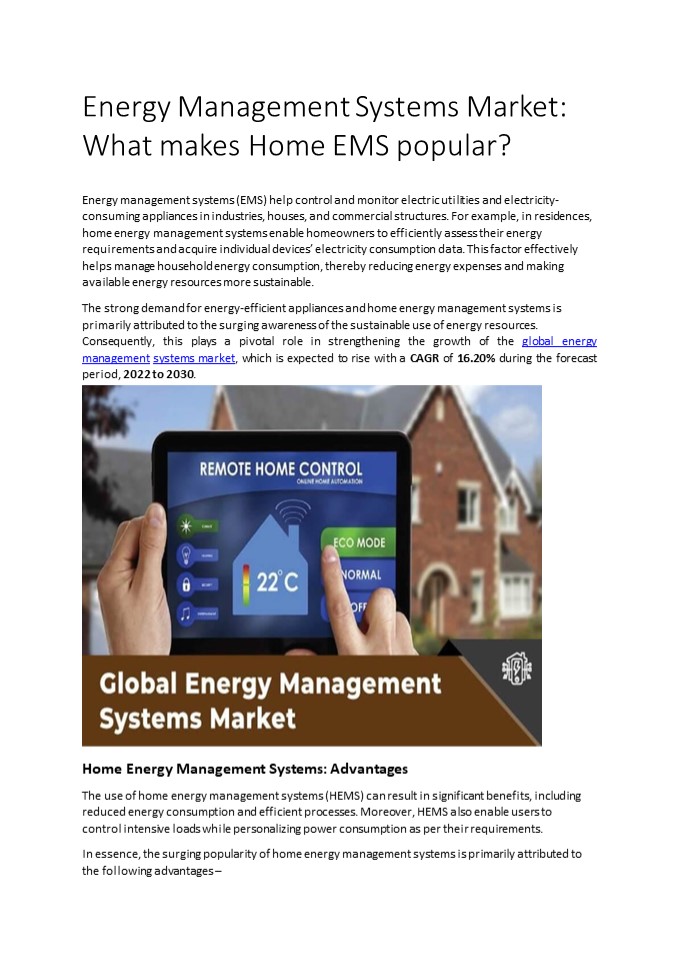
Energy Management Systems Market What makes Home
EMS popular? Energy management systems (EMS) help
control and monitor electric utilities and
electricity- consuming appliances in industries,
houses, and commercial structures. For example,
in residences, home energy management systems
enable homeowners to efficiently assess their
energy requirements and acquire individual
devices electricity consumption data. This
factor effectively helps manage household energy
consumption, thereby reducing energy expenses and
making available energy resources more
sustainable. The strong demand for
energy-efficient appliances and home energy
management systems is primarily attributed to the
surging awareness of the sustainable use of
energy resources. Consequently, this plays a
pivotal role in strengthening the growth of the
global energy management systems market, which is
expected to rise with a CAGR of 16.20 during the
forecast period, 2022 to 2030.
Home Energy Management Systems Advantages The
use of home energy management systems (HEMS) can
result in significant benefits, including reduced
energy consumption and efficient processes.
Moreover, HEMS also enable users to control
intensive loads while personalizing power
consumption as per their requirements. In
essence, the surging popularity of home energy
management systems is primarily attributed to the
following advantages
2
- Easy Operability While it is possible to operate
home and building systems manually, this method
lacks efficiency. In this regard, an energy
management system provides a central interface to
regulate all systems, and through this, users can
easily access and control various electrical
systems and devices via a single source. As a
result, daily operations have become more
convenient, easier, and faster. - Reduce Costs The majority of electrical energy
management systems are employed in collaboration
with photovoltaic (PV) systems, enabling
homeowners to assess performance as well as
determine the return on investment. Besides, even
in a conventionally powered home, the efficient
management of energy through the use of HEMS can
result in improved efficiency and substantial
savings. - Minimize Energy Consumption Although electrical
energy management systems dont reduce
consumption on their own, they offer the required
data that assists homeowners in making smart
choices. And once the user is familiar with the
current consumption, both in terms of kilowatt
(kW) usage as well as the monthly costs, an
energy management system can prove beneficial in
taking actionable measures to conserve energy. - Innovative Developments in HEMS
- As per Inkwood Research, the home energy
management systems segment, under the product
type category, is set to grow with the highest
CAGR of 17.09 during the forecast period. Hence,
in order to exploit this augmenting market,
several companies, as well as products, have
emerged over the last decade, including
centralized home automation systems. For
instance, in 2021, Schneider Electric (France)
introduced the Square D Energy Center that offers
a grid to plug home energy management, thus
facilitating resilient energy and more efficient
homes. In the same year, Enel X (United States)
partnered with Virtual Peaker, a cloud-based
energy management platform, to deliver smart home
energy solutions. Moreover, Uplights (United
States) energy personalization system includes
multiple products, including home energy reports
and demand response. - Whats Next for Home Energy Management Systems
Market? - Energy management systems are anticipated to
witness high installations in order to control
and monitor energy supply across different
applications. While the implementation plays a
vital role in reducing the overall expense of
operations, it also improves sector-wise
productivity and helps conserve energy
significantly. - Aligning with this, here are some of the key
areas expected to drive the future growth of the
global market - Smart Homes
- With notable advancements in power monitoring as
well as display technologies, the global market
has witnessed a significant rise in the
development of intelligent devices, including
smart meters, sensors, and thermostats, that can
be equipped in smart homes. Over the upcoming
years, remote regions are also expected to
benefit from HEMS as they help analyze energy
consumption and reduce environmental impact. - Building EMS Applications
3
- Energy management systems for buildings entail
computerized systems for controlling energy-
associated services, like ventilation and air
conditioning, heating, power systems, alarms,
lighting, fire, and smoke detection, in addition
to other controls. With the potential to maximize
the performance of buildings, the implementation
of these systems is observing an increasing
trend, especially in malls, office spaces, and
educational institutions. - Smart Grid Technology
- Smart grid technologies include computer
processing and control systems, comprising
sensors known as Phasor Management Units that
help operators assess grid stability. It also
consists of digital meters that provide better
information to the customers by automatically
reporting outages. The modernized grid also makes
it possible for customers to access their own
data and thus manage their energy consumption. - Furthermore, the rising standards of living and
comfort requirements, as well as increased
digitization, have resulted in the rapid adoption
of smart grids in residential spaces.
Accordingly, this factor is set to play an
integral role in fueling the global energy
management systems market growth during the
forecasted period. - Frequently Asked Questions (FAQs)
- What factors contribute to Europe being the
largest energy management systems market? A The
increasing electricity demand, combined with the
increase in government measures to alleviate
carbon emissions, is anticipated to drive the
growth of the energy management systems market in
Europe. Moreover, the European Union (EU)
parliament agreed with member states to reduce
carbon emissions by at least 55 by 2030,
compared to the levels in 1990. - What are the key verticals analyzed in the
report? - A Power energy, telecom IT, manufacturing,
retail offices, healthcare, and other verticals
are analyzed in the report.
Recommended

