

Surfarray™ Cell Microarray Technology for CAR T Cell Research PowerPoint PPT Presentation
Title: Surfarray™ Cell Microarray Technology for CAR T Cell Research
1
NK CELL-BASED THERAPEUTICS
Adoptive transfer of NK cells without genetic
engineering
1
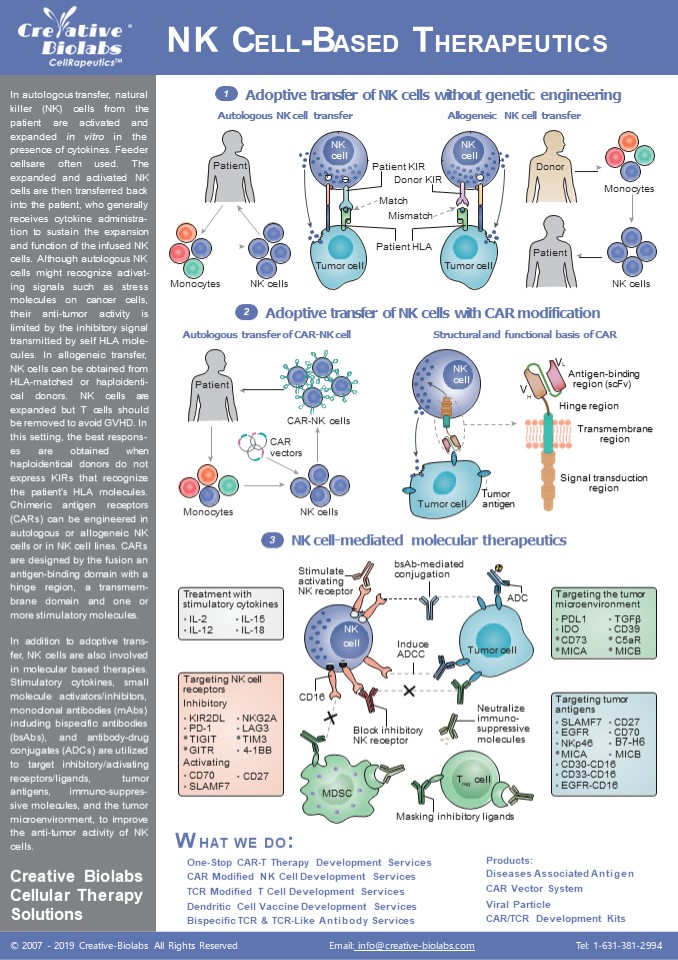
In autologous transfer, natural
killer (NK) cells from the patient are
activated and expanded in vitro in
the
Autologous NK cell transfer Allogeneic NK cell
transfer
NK cell
NK cell
presence of cytokines. Feeder cellsare often
used. The expanded and activated NK cells
are then transferred back into the patient, who
generally receives cytokine administra- tion
to sustain the expansion and function of the
infused NK cells. Although autologous NK cells
might recognize activat- ing signals such
as stress molecules on cancer cells,
their anti-tumor activity is limited by
the inhibitory signal transmitted by self HLA
mole- cules. In allogeneic transfer, NK cells
can be obtained from HLA-matched or
haploidenti- cal donors. NK cells are
expanded but T cells should be removed to
avoid GVHD. In this setting, the best respons- es
are obtained when haploidentical
donors do not express KIRs that recognize
the patients HLA molecules. Chimeric
antigen receptors (CARs) can be engineered in
autologous or allogeneic NK cells or in NK
cell lines. CARs are designed by the fusion an
antigen-binding domain with a hinge region, a
transmem- brane domain and one or more
stimulatory molecules.
Patient
Patient KIR Donor KIR Match Mismatch
Donor
Monocytes
Patient HLA
Patient
Tumor cell
Tumor cell
Monocytes
NK cells
NK cells
Adoptive transfer of NK cells with CAR
modification
2
Autologous transfer of CAR-NK cell Structural and
functional basis of CAR
V
L Antigen-binding region (scFv)
NK cell
Patient
V H
Hinge region
CAR-NK cells
Transmembrane region
CAR vectors
Signal transduction region
Tumor antigen
Tumor cell
Monocytes
NK cells
NK cell-mediated molecular therapeutics
3
bsAb-mediated conjugation
Stimulate activating NK receptor
NK cell
Treatment with stimulatory cytokines
Targeting the tumor microenvironment
ADC
- PDL1
- IDO
- CD73
- MICA
- TGFß
- CD39
- C5aR
- MICB
- IL-2
- IL-12
IL-15 IL-18
In addition to adoptive trans- fer, NK cells
are also involved in molecular based therapies.
Stimulatory cytokines, small molecule
activators/inhibitors, monoclonal antibodies
(mAbs) including bispecific antibodies (bsAbs),
and antibody-drug conjugates (ADCs) are
utilized to target inhibitory/activating
receptors/ligands, tumor antigens,
immuno-suppres- sive molecules, and the tumor
microenvironment, to improve the anti-tumor
activity of NK cells.
Induce ADCC
Tumor cell
Targeting NK cell receptors Inhibitory
CD16
- Targeting tumor antigens
- SLAMF7 CD27
- EGFR CD70
- NKp46 B7-H6
- MICA MICB
- CD30-CD16
- CD33-CD16
- EGFR-CD16
Neutralize immuno- suppressive molecules
- KIR2DL
- PD-1
- TIGIT
- GITR
- Activating
- CD70
- SLAMF7
- NKG2A
- LAG3
- TIM3
- 4-1BB
Block inhibitory NK receptor
- CD27
T cell
reg
MDSC
Masking inhibitory ligands
WHAT WE DO One-Stop CAR-T Therapy Development
Services CAR Modified NK Cell Development
Services TCR Modified T Cell Development Services
Dendritic Cell Vaccine Development Services
Bispecific TCR TCR-Like Antibody Services
Products Diseases Associated Antigen CAR Vector
System Viral Particle CAR/TCR Development Kits
Creative Biolabs Cellular Therapy Solutions
2007 - 2019 Creative-Biolabs All Rights Reserved
Email info_at_creative-biolabs.com
Tel 1-631-381-2994
Recommended

