

Global Synthetic Leather Market Share | Global Opportunities PowerPoint PPT Presentation
Title: Global Synthetic Leather Market Share | Global Opportunities
1
Demand for Bio-based Products Drive Synthetic
Leather Market
Triton Market Research presents the Global
Synthetic Leather Market report segmented by Type
(Polyurethane PU, Polyvinyl Chloride PVC,
Bio-based), End-use (Footwear, Automotive,
Clothing, Furnishing, Bags Wallets, Other
End-uses), and Regional Outlook (Middle East and
Africa, North America, Asia-Pacific, Europe,
Latin America).
The report further includes the Market Summary,
Industry Outlook, Parent Market Overview,
Manufacturing Process Overview, Impact Analysis,
Key Insights, Porters Five Forces Analysis,
Market Maturity Analysis, Industry Components,
Key Buying Impact Analysis, Regulatory Framework,
Key Market Strategies, Drivers, Challenges,
Opportunities, Analyst Perspective, Competitive
Landscape, Research Methodology Scope, Global
Market Size, Forecasts Analysis
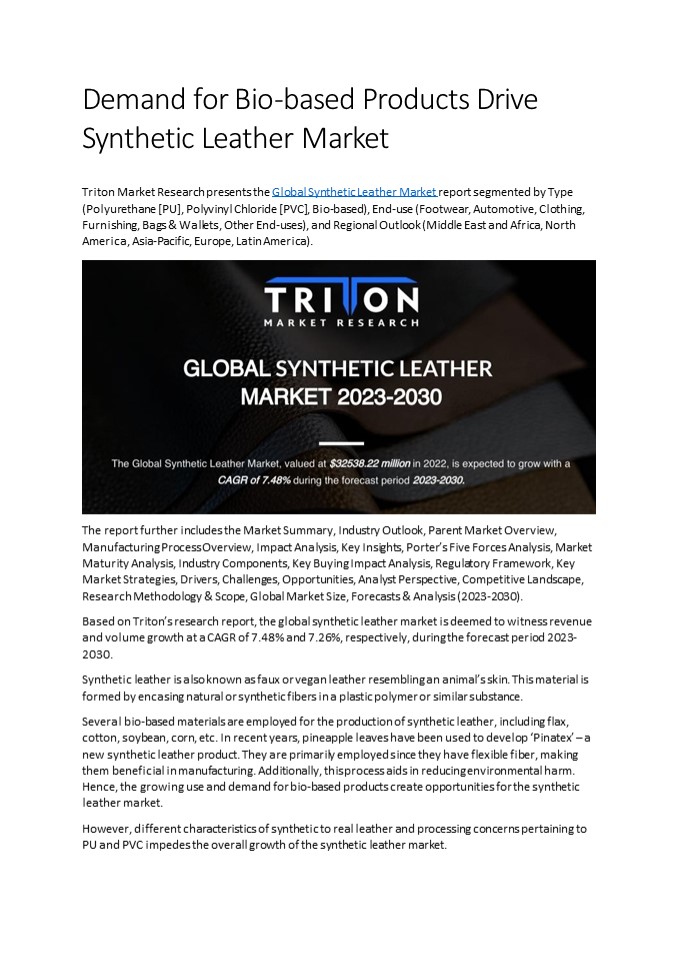
(2023-2030). Based on Tritons research report,
the global synthetic leather market is deemed to
witness revenue and volume growth at a CAGR of
7.48 and 7.26, respectively, during the
forecast period 2023- 2030. Synthetic leather is
also known as faux or vegan leather resembling an
animals skin. This material is formed by
encasing natural or synthetic fibers in a plastic
polymer or similar substance. Several bio-based
materials are employed for the production of
synthetic leather, including flax, cotton,
soybean, corn, etc. In recent years, pineapple
leaves have been used to develop Pinatex a
new synthetic leather product. They are primarily
employed since they have flexible fiber, making
them beneficial in manufacturing. Additionally,
this process aids in reducing environmental
harm. Hence, the growing use and demand for
bio-based products create opportunities for the
synthetic leather market. However, different
characteristics of synthetic to real leather and
processing concerns pertaining to PU and PVC
impedes the overall growth of the synthetic
leather market.
2
The North America is estimated to witness the
fastest growth over the forecast period. The
growing innovations related to bio-based leather
and rising concerns about animal rights support
the markets growth to a large extent. Further,
there is a rising demand for formal footwear,
along with vegan fashion, which has also
elevated the adoption of synthetic leather to
meet the demand. These trends have influenced
players to increase RD of artificial leather,
thereby propelling the studied market on a
growth path. The major companies listed in the
synthetic leather market include Mayur Uniquoters
Limited, San Fang Chemical Industry Co Ltd,
Achilles USA Inc, BASF SE, Nan Ya Plastics
Corporation Inc, Teijin Limited, Alfatex Italia
SRL, Kuraray Co Ltd, HR Polycoats Pvt Ltd, and
Toray Industries Inc. Large players have a wide
geographic presence with strong pricing
strategies. Moreover, the initial fixed costs
are higher in the market. These factors have thus
intensified the competition among existing
players. Also, the established players own
imported technologies and advanced RD
facilities, which significantly lowers the entry
of players with less capital. Thus, the entry of
new players is expected to be low or moderate,
while the competition among players is likely to
be high over the forecast period.
Recommended

