

Dietary Fibers Market: Scope for Multidimensional Applicability PowerPoint PPT Presentation
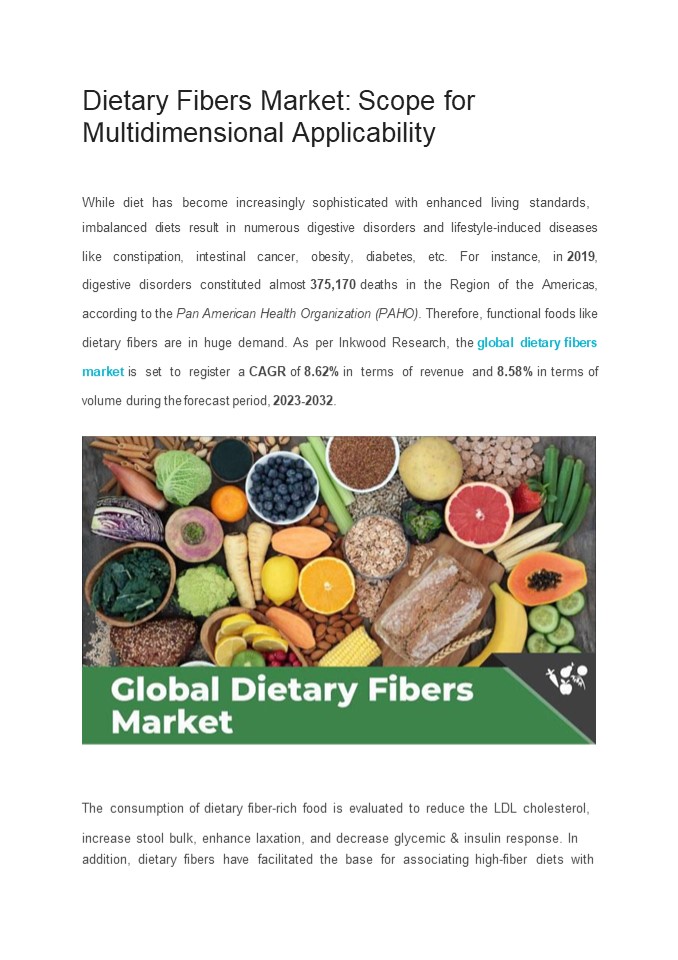
Title: Dietary Fibers Market: Scope for Multidimensional Applicability
1
Dietary Fibers Market Scope for Multidimensional
Applicability
While diet has become increasingly
sophisticated with enhanced living
standards, imbalanced diets result in
numerous digestive disorders and
lifestyle-induced diseases like constipation,
intestinal cancer, obesity, diabetes,
etc. For instance, in 2019, digestive
disorders constituted almost 375,170 deaths in
the Region of the Americas, according to the
Pan American Health Organization (PAHO).
Therefore, functional foods like dietary fibers
are in huge demand. As per Inkwood
Research, the global dietary fibers market is
set to register a CAGR of 8.62 in terms of
revenue and 8.58 in terms of volume during the
forecast period, 2023-2032.
The consumption of dietary fiber-rich food
is evaluated to reduce the LDL cholesterol,
increase stool bulk, enhance laxation, and
decrease glycemic insulin response. In
addition, dietary fibers have facilitated
the base for associating high-fiber diets
with
2
- minimized risk of many chronic diseases like
diabetes mellitus, cardiovascular disease, bowel
cancer, constipation, obesity, colonic
diverticulosis, etc. Therefore, dietary fibers - are said to aid in disease prevention and health
maintenance. - Accordingly, our blog briefly examines the
relevant and ongoing multidimensional facets of
dietary fibers - Dietary fibers in the Food Beverage Industry
- Foods undergo different physical, thermal,
enzymatic, and chemical treatments during
processing that directly or indirectly
impact the total fiber composition.
Similarly, incorporating fiber-rich ingredients
and products (dietary) can influence the
sensory attributes, rheological behavior,
texture, and consistency of the end
products. As a result, there is an ongoing
trend of finding new dietary fiber sources for
utilization in the food beverage industry. - Our analysis of the global dietary fibers market b
y application includes pharmaceuticals, animal
feed, and food beverage, both in terms of
revenue and volume. - Foods
- When added to food products, dietary fibers
offer improvement and modification in - texture, shelf-life, and sensory
characteristics of foods, attributed to
their thickening, anticlumping, anti-sticking,
fat mimetic, gel-forming, and
water-binding capacities. However, a dietary
fiber must meet the food ingredient
standard satisfactorily to be included as a
food product. - For instance, with regard to functionality,
citrus fiber can play several roles. It
can be used to add color and manage
moisture in fat replacement. Also, it may be
used as a tool for enhancing texture, as a
natural antioxidant, and as a bulking agent in
reduced-
sugar applications.
3
- Furthermore, bakery products have
transitioned from adding wheat flour
unrefined cereals to dietary products from
different sources, giving them additional
nutritional - quality. Dietary fibers incorporated into
bakery products prolong their freshness,
given their capacity to retain water, which
further minimizes economic losses. For
instance, - they can modify breads softness, springiness,
firmness, and loaf volume. Whereas they enhance
texture, fat binding, water binding, and cooking
output in meat products. - Beverages
- Incorporating dietary fibers in beverages
drinks raises their stability and viscosity.
In - this case, soluble fibers, since these are more
dispersible in water than insoluble fibers. - Such soluble fibers include ß-glucans, fractions
of grains and multi-fruits, polydextrose,
pectins, and cellulose beet-root fiber. Also,
they aid in improving the chemical physical
properties since the beverage particles get
uniformly distributed, preventing stratification - precipitation, and enhancing stability.
Therefore, such functional beverages reduce the
need for other high-calorific foods, promote
weight management, and result in satiety. - According to a National Center for Biotechnology
Information (NCBI) article, oat fiber can be
effectively utilized in preparing milkshakes,
sports drinks, iced tea, wine, cappuccino, etc.
Also, an April 2018 report by PreScouter
states that inulin is evaluated as an ideal - ingredient for use in instant beverages,
particularly functional beverages. Inulin
is a soluble fiber found in plants that
helps improve digestive health, regulate
diabetes, promote weight loss, and relieve
constipation. Similarly, the growing
inclination toward artificial sweeteners to
enhance nutrition, taste, and texture has
propelled the demand for soluble fibers like
chicory inulin, which contributes to the global
dietary fibers market growth. - As per our analysis, Beta-Glucan is the
fastest-growing soluble fiber in the market
in
terms of volume, estimated to register a CAGR of
11.23 by 2032.
4
Dietary Fibers Nutraceuticals Sustaining the
Transitioning Diet Health Paradigm Chronic
diseases are on the rise. Obesity is now a
globally recognized complex disease, whereas
heart diseases continue to be a leading cause of
death worldwide. Consumers have therefore
embarked on a prevention-better-than-cure
course, seeking functional and alternative
food habits for sustenance. In this regard,
nutraceuticals have gained prominence over the
years. Nutraceuticals, a hybrid of
nutrition and pharmaceutical, in essence,
are food or components of food that play
a significant role in maintaining and
modifying normal physiological functions. Food
products used as nutraceuticals can be
categorized as dietary fibers, antioxidants,
polyunsaturated fatty acids, probiotics,
prebiotics, etc. These aid in combating some
severe problems of the century, including
obesity, cholesterol, diabetes, arthritis,
osteoporosis, etc. The use of nutraceuticals
has a long history. However, the recent
scientific evidence supplementing its medicinal
and nutritional characteristics has rendered it
an emerging class of natural products that
blur the line between food and drugs. As
a result, nutraceuticals of plant animal
origins hold lucrative opportunities for food
industries to create novel food
products. Accordingly, food and
pharmaceutical companies are investing in
the nutraceutical industry, given the
logistical, regulatory, and
technological challenges. For instance,
Nestle has put up a venture capital fund
for investing in companies in their nascent
stage of nutraceutical businesses. Similarly,
Roquette is engaged in offering non-viscous
soluble fiber under its brand,
NUTRIOSE, for the nutraceutical,
pharmaceutical, and food industries.
5
Furthermore, nutraceuticals are swiftly
replacing pharmaceuticals in preventing and
managing acute and chronic health problems.
They project immense scope to flourish due
to their preventive and curative properties.
Besides, the shifting consumer interest
toward healthy dietary patterns has surged
the interest in nutraceuticals. This
was evidently in focus during and
post-COVID-19, which influenced
immunity-building through dietary supplements.
Therefore, the ongoing diet health transition is
lucrative to global dietary fibers market
growth. By Akhil Nair FAQs Which is the
fastest-growing region in the global dietary
fibers market? North America is the
fastest-growing region in the global dietary
fibers market in terms of revenue and
volume. What are some good sources of insoluble
dietary fibers? Green beans, cauliflower, nuts,
beans, potatoes, wheat bran, whole-wheat flour,
etc., are among the good sources of insoluble
dietary fibers.
Recommended

