

Microgrid Market: Top Drivers, Global Opportunities & More PowerPoint PPT Presentation
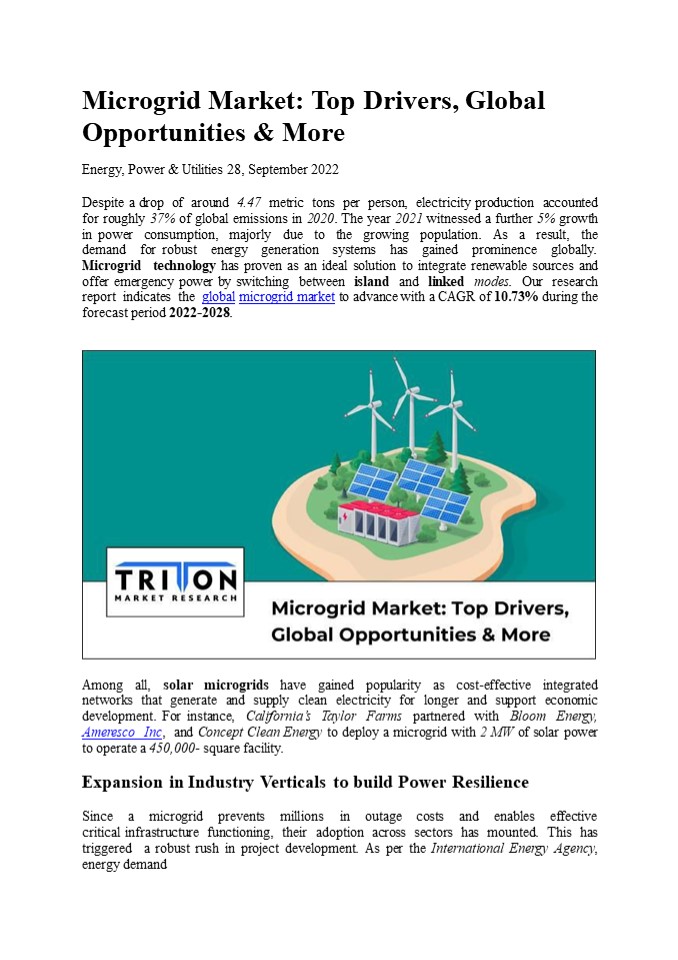
Title: Microgrid Market: Top Drivers, Global Opportunities & More
1
Microgrid Market Top Drivers, Global
Opportunities More Energy, Power Utilities
28, September 2022 Despite a drop of around
4.47 metric tons per person, electricity
production accounted for roughly 37 of global
emissions in 2020. The year 2021 witnessed a
further 5 growth in power consumption, majorly
due to the growing population. As a
result, the demand for robust energy
generation systems has gained prominence
globally. Microgrid technology has proven as an
ideal solution to integrate renewable sources and
offer emergency power by switching between
island and linked modes. Our research
report indicates the global microgrid market
to advance with a CAGR of 10.73 during the
forecast period 2022-2028.
Among all, solar microgrids have gained
popularity as cost-effective integrated
networks that generate and supply clean
electricity for longer and support economic
development. For instance, Californias Taylor
Farms partnered with Bloom Energy, Ameresco
Inc, and Concept Clean Energy to deploy a
microgrid with 2 MW of solar power to operate a
450,000- square facility. Expansion in Industry
Verticals to build Power Resilience Since a
microgrid prevents millions in outage
costs and enables effective critical
infrastructure functioning, their adoption
across sectors has mounted. This has
triggered a robust rush in project development.
As per the International Energy Agency, energy
demand
2
- is anticipated to increase by 40 by 2040,
encouraging an expansion of distributed power
systems across industry verticals such as - The commercial microgrid has emerged as the
fastest growing category in the industrial
vertical segment due to the growing reliance on
renewable sources. Several companies opt for
hybrid electric structures as they limit
interruptions and continue operation despite
system breakdown. For instance, in 2020,
AlphaStuxure partnered with John F. Kennedy
International Airport to deploy microgrid
technology to capture and convert solar or wind
sources into electricity. - Estimates suggest that the healthcare
category captures the highest share in the
industry vertical segment. These facilities
require a high energy supply for daily
business, making power outages lethal for
patient security. Microgrids have taken
center stage in optimizing various power
components and establishing reliable power - supply. For instance, the Indian Institute of
Science installed a 5.2 kW microgrid plant as a
backup power source. Hence, the medical
sectors power supply advancement majorly
drives the market. - Advancements in technology have influenced
governments to boost funding for - hybrid and mobile grid solutions for military
applications. The US military is among the major
forces supporting the North America
microgrid market expansion. For example, the
countrys army announced microgrid installation
across 130 locations by 2035. Presently, the
government and its partners are investing
in on-site renewable production units,
microgrids, and battery storage to strengthen
military operations. - The studied markets growth in the
educational institute category is primarily
attributed to the rising initiatives to
demonstrate efficient energy-saving measures.
The pre-existence of combined heat and
power (CHP) systems is another factor
responsible for its robust adoption in schools,
universities, and colleges. For instance, 10
renewable microgrids were deployed across schools
in Puerto Rico, which proved beneficial during
severe weather conditions or grid failures.
In this regard, grid- connected microgrids
determine economic viability for academic
institutes. - Smart City Initiatives A New Pathway
- According to the UN, approximately 55 of the
worlds population resides in urban settings,
which is expected to reach around 68 by
2050. This increases overall power demand.
Globally, Asia-Pacific power consumption has
soared immensely, with China and India
accounting for the highest demand. This has
compelled governments to invest in smart city
development, pushing for rapid uptake of
digital technologies to meet the high
demand. These aspects largely support the
Asia-Pacific microgrid market. - For instance, the HOMER hybrid optimization
software by the US Department of Energy
beats the technical complexities of energy
planning and creates programs to qualify island
microgrid projects for funding. Besides, the
Indian and the US governments invested in new
research on smart energy grids and energy
storage to improve the efficiency of
electric infrastructure. Such initiatives
create new pathways for contenders,
contributing heavily to the studied market. - Future Outlook IoT Integration to create High
Demand
3
In line with robust energy demand, IoT
amalgamation with microgrids is expected to
expand their capabilities for remote
management. From load balancing to
moderating line voltage, the internet of things
significantly reduces losses in the system and
inspection times by isolating fault locations.
Additionally, if a microgrid generates more power
than required, this technology helps users sell
the excess energy to a utility, creating a new
income source. The IoT is a strategic necessity
for digitally transforming industrial operations,
which may create ample opportunities for the
global microgrid market over the forecast
period. FAQs Q1) What is the size of the
microgrid market? The global microgrid market was
valued at 23.26 billion in 2021 and is estimated
to reach 46.21 billion by 2028. Q2) Which are
the major end-users in the microgrid market? The
commercial and healthcare sectors are among
the major end-users in the microgrid market.
Recommended

