

Smart Agriculture Market: Core Technologies cultivating Growth PowerPoint PPT Presentation
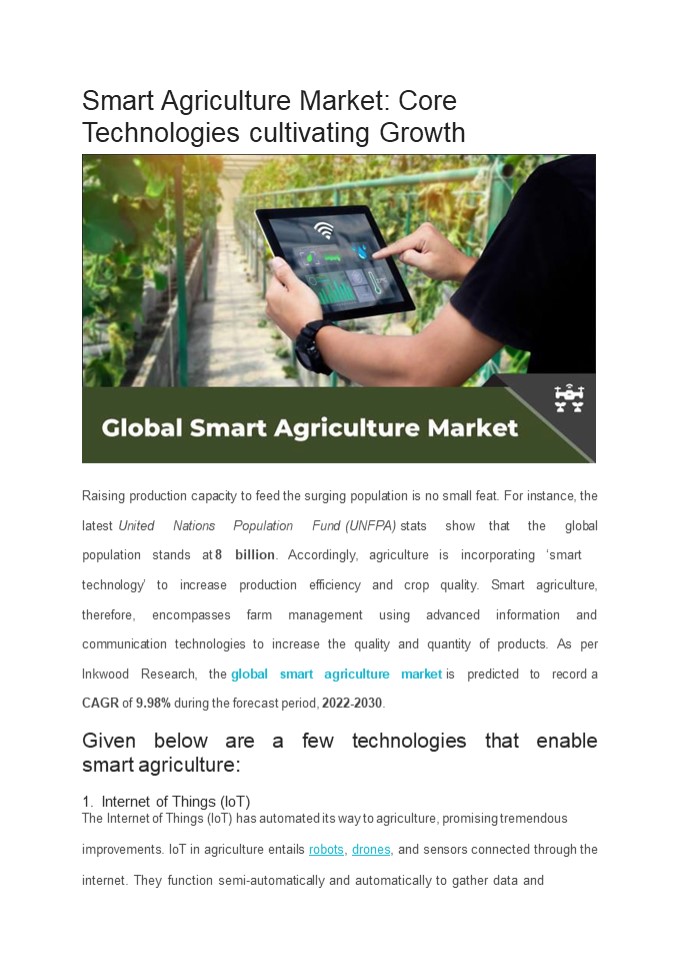
Title: Smart Agriculture Market: Core Technologies cultivating Growth
1
Smart Agriculture Market Core Technologies
cultivating Growth
Raising production capacity to feed the surging
population is no small feat. For instance, the
latest United Nations Population Fund
(UNFPA) stats show that the global
population stands at 8 billion.
Accordingly, agriculture is
incorporating smart technology to
increase production efficiency and crop
quality. Smart agriculture, therefore,
encompasses farm management using
advanced information and communication
technologies to increase the quality and
quantity of products. As per Inkwood
Research, the global smart agriculture
market is predicted to record a CAGR of
9.98 during the forecast period,
2022-2030. Given below are a few
technologies that enable smart agriculture 1.
Internet of Things (IoT) The Internet of Things
(IoT) has automated its way to agriculture,
promising tremendous improvements. IoT in
agriculture entails robots, drones, and sensors
connected through the internet. They function
semi-automatically and automatically to
gather data and
2
perform operations with predictability
and efficiency. Also, with the growing
labor shortage globally, agriculture robots,
more commonly known as agribots, have taken
the midfield among farmers. For instance,
according to Cropin, a global ag-ecosystem
intelligence provider, crop production
decreased by around 3.1 billion a year in
the US due to labor shortages. Accordingly,
recent advancements in artificial
intelligence (AI) technology and sensors
allow machines to train on their
surroundings rendering agribots more
notable. Furthermore, John Deere, an American
farm equipment company, is connecting
its tractors to the internet, allowing farmers
to track their tractor productivity on their
phones. But how will IoT benefit smart
agriculture? IoT facilitates waste reduction,
enhanced product distribution, and cost
management, attributed to better control over
production. Besides, monitoring livestock
health or crop growth can mitigate the risks
of yield loss. Furthermore, automation
offers enhanced efficiency. The use of smart
devices can automate multiple processes
across the production cycle. For instance, pest
control, fertilizing, and irrigation. Similarly,
data collected by smart agriculture sensors,
including crop growth progress, soil
quality, weather conditions, cattle
health, etc., can be used to track
overall performance, efficiency, and
output. Also, better internal process
control means minimized production risks. 2.
Robotics The agriculture sector is embracing new
technologies like robotics. This can
potentially redefine the role of farmworkers and
ease the workload while ensuring efficiency in
input costs, increased yields, and crop
efficiency. For instance, robots use machine
vision technology to determine the readiness of
crops for harvesting, identify crops, and avoid
hazards. Machine vision entails multiple cameras
that feed information to the robots and
3
- enable them to locate and access crops.
Also, it makes robots perform tasks like
packing, sorting, harvesting, growth monitoring,
and weed picking. - Furthermore, with regard to seeding, automated
drone seeders are projecting potential use in
agriculture. They can enable replanting
in impenetrable patches without - endangering workers. Also, they seed with
more precision than conventional drone
seeders or broadcast spreading seeders. This
is done by generating a field map that
includes information on soil properties such as
soil quality and density. - 3. Big Data
- Big data processes a large amount of information
from various sources and ensures the - interoperability of digital tools to
exploit, analyze, and organize data.
With smart agriculture becoming data-enabled
and data-driven, there is abundant data in scope
and quantity. For instance, technologies like
Global Positioning Data (GPS) allow data to be
allocated to a specific land area. Whereas
data collected from sensors help calculate
and subsequently administer the required
fertilizer composition for that particular area. - Accordingly, big data is used in smart
agriculture for - Risk Management Farmers can leverage big
data to determine the chances of uncertain
events like shifting weather patterns,
drought, crop failure, and other calamities. - Operational Management Sensors in vehicles
offer a lot of data that can assist - fleet and equipment management, resulting in
increased productivity and minimized downtime. - Yield Production Yield production utilizes
mathematical models to gain insight - into the biomass index, leaf, chemicals,
yield, and weather alongside machine learning
to enhance decision-making and statistics.
This further enables insights into the type
and location of the plant/crop. - Food Safety Modern farming is adept at handling
and instantly detecting microbes - and contamination. Similarly, data collection
centering on chemical proportion, humidity,
and temperature smoothens the overall
agricultural progress. Early detection helps
minimize wastage and reduce costs.
software in the solution segment, with a CAGR of
12.15.
4
Vertical Farming A Layered Future for Smart
Agriculture? The increasing population has
raised the demand-supply gap for food,
highlighting the need for alternative
farming techniques like vertical farming.
Vertical farming is a revolutionary approach
to food production in vertically stacked
layers like shipping containers, warehouses,
skyscrapers, etc. It facilitates a large quantity
of nutritious and quality fresh food without
relying on high soil fertility, skilled labor,
high water usage, and favorable
weather. According to World Bank, urban
areas house almost 56 of the worlds
population. At the same time, the land
constraints in metropolitan areas have led to
producers finding new ways to generate fresh
vegetables. Vertical farming will thus enable
users to grow crops in multi-story structures in
layers. As a result, the optimum use of vertical
space, the scarcity of cultivable land, the
demand for fresh, organic, and high-quality food,
and balanced energy utilization raise
vertical farming demands. Such trends define
the global smart agriculture market growth. By
Akhil Nair FAQs Which are the prominent
companies operating in the global smart
agriculture market? Afimilk Ltd, Aker
Technologies Inc, AGCO Corporation, AgEagle
Aerial Systems Inc, AgJunction, etc., are among
the prominent companies operating in the global
smart agriculture market. Which country offers
lucrative opportunities for smart agriculture?
India offers lucrative opportunities for smart
agriculture.
Recommended

