

"Optimizing Pipe Fitting Techniques for Efficient and Reliable Industrial Systems" PowerPoint PPT Presentation
Title: "Optimizing Pipe Fitting Techniques for Efficient and Reliable Industrial Systems"
1
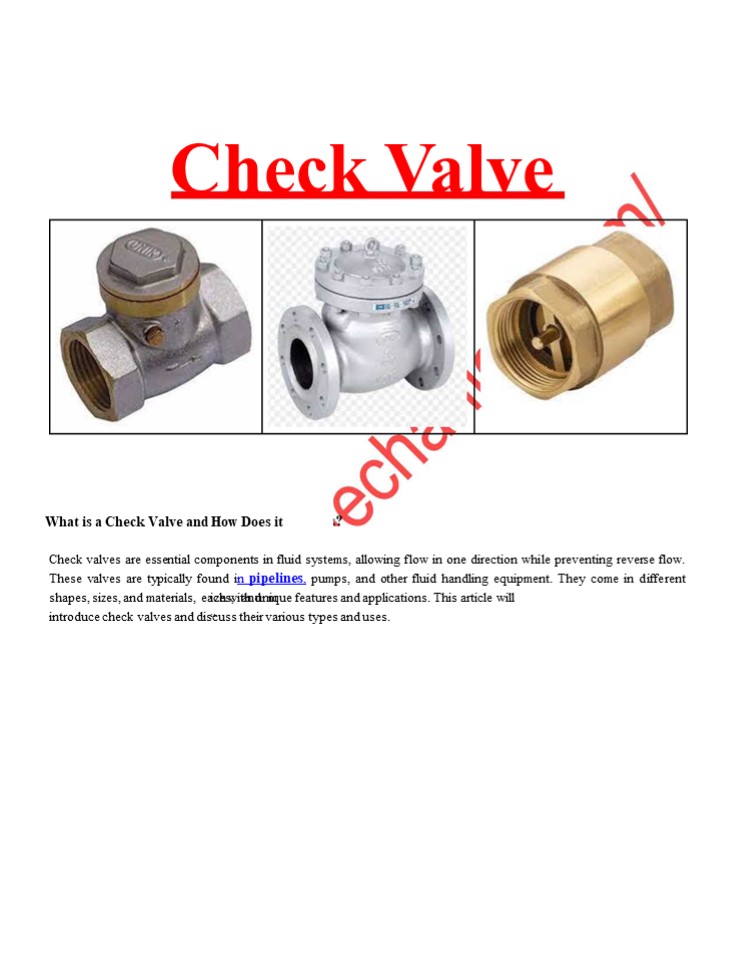
Check Valve
What is a Check Valve and How Does it
Check valves are essential components in fluid
systems, allowing flow in one direction while
preventing reverse flow. These valves are
typically found in pipelines, pumps, and other
fluid handling equipment. They come in different
shapes, sizes, and materials, each with unique
features and applications. This article will
izes, and m
introduce check valves and discuss their various
types and uses.
2
caption id"" align"alignnone" width"3648M
This File is
take from Swing-check-valves--The-All
ockist.JPG - wikimedia Commons/caption
A Comprehensive Guide to Ty
plications of Check valve
Swing Check Valve when fluid flow the opposite
direlt in water and wastew
heck valve uses a hinged disc to block reverse
flow. It swings open rrect direction, allowing
the fluid to pass through. When the fluid flows
in e valve shuts, preventing backflow. Swing
check valves are commonly used applications.
Ball C flo
e A ball check valve uses a spherical ball to
control the flow of fluid. When the fluid 'rrect
direction, the ball is pushed away from the valve
seat, allowing the fluid to pass hen the fluid
flows in the opposite direction, the ball is
forced against the seat, blocking ow. Ball check
valves are ideal for low-pressure applications.
3
gt?
fluid. The piston moves
Piston Check Valve A piston check valve
uses a piston to control
m check valves are
up and down to allow or block flow, depending on
the direction
commonly used in high-pressure applications.
Wafer Check Valve A wafer check valve is a
thin, lightweight valve that can be sandwiched
between
flanges. It uses a swinging disc to control the
flow of fluid. When the fluid flows in the
correct direction, the disc swings open, allowing
the fluid to pass through. When the fluid flows
in the
opposite direction, the disc shuts, preventing
backflow. Wafer check valves are ideal for use in
low-
pressure applications.
4
A '
iThis file is
ist.JPG - Wikimedia Commons
taken from Wafer-check-valve-The-Alloy-
Ivlt
Uses of Check Valves
Check valves are used in many i
and applications, including
Oil and Gas Chec
es are commonly used in the oil and gas industry
to prevent backflow in ations.
pipelines and drillin
Water and Waste
heck valves are used in water and wastewater
systems to prevent backflow rom contamination.
and protect the syste
alves are used in heating, ventilation, and air
conditioning systems to regulate the ids and
prevent reverse flow.
everage Check valves are used in food and
beverage processing to prevent contamination
ensure the quality of the product.
nclusion Check valves are essential components
in fluid systems, providing a vital function in
preventing backflow and protecting equipment and
processes. There are several types of check
valves available, each with unique features and
applications. Choosing the right valve for a
specific application is critical for ensuring
efficient and reliable operation.
5
Choosing the Perfect Check Valve A Step-by-Step
Guide to Selection and Sizing
Selecting the right check valve is crucial for
ensuring efficient and reliable operation of
fluid systems. In this article, we will discuss
the properties of check valves that should be
considered when selecting the appropriate
valve for a specific application.
. The
Flow Rate The flow rate of the fluid is an
essential consideration when selecting a check v
valve must be capable of handling the maximum
flow rate of the system without creating exc
pressure drops or flow restrictions. It is
essential to calculate the flow rate accurately
to
that
the selected valve is suitable for the
application.
the system.
Pressure Rating The pressure rating of the
valve must match the pressure requir
saks, and system damage. It
Selecting a valve with a lower pressure rating
can result in valve failure, is essential to
verify the maximum pressure that the valve will
be expos select a valve that is rated for that
pressure.
during operation and
Type of Fluid The type of fluid being
transported is another crucial factor to consider
when selecting a check valve. Different types of
fluids have different properties that can affect
valve performance. For example, some fluids may
be corrosive, abrasive, or viscous, which can
damage the valve or
il that is compatible with the fluid
impede flow. It is important to choose a valve
made of
being transported.
Installation Orientation The orientation of
the va
installation is also an important
consideration. Some types of check valves, su
ng check valves, require a specific orientation
to function correctly. It is important to ve
ufacturer's installation instructions to ensure
that
the valve is installed correctly. Standards
and Codes There are se
standards and codes that must be considered when
selecting a
check valve. For example, ANS
16.34 specifies the dimensions and testing
requirements
for check valves. API 598 pro
elines for valve inspection and testing. It is
important to
verify that the selected v
es with the applicable standards and codes.
6
Example
For example, suppose you are selecting a check
valve for a water treatment plant. The maximum
flow rate is 500 gallons per minute, and the
maximum pressure is 100 psi. The fluid being
transported is water with a pH of 7.5. The valve
will be installed in a horizontal orientation.
Based on these requirements, a swing check valve
made of ductile iron with an ANSI/ASME B16.34
pressure rating of 150 psi would be an
appropriate choice.
Conclusion Selecting the appropriate check valve
for a specific application requires careful
consideration of several factors. Flow rate,
pressure rating, fluid type, installation
orientation, and compliance with standards and
codes are all crucial considerations. By taking
these factors into account, you can choose a
valve that will provide reliable and efficient
operation for your fluid system.
Tailoring Check Valve Solutions Meeting Specific
Requirements for Diverse Industrial Applications
Check valves play a cri
e in fluid systems by preventing backflow and
protecting equipment from ications require
different types of check valves with specific
requirements. In
damage. However, different
this article, we will
e specific requirements for check valve uses.
Water
ent In water treatment applications, check
valves must be able to handle a wide range
of
tes and pressures. They should also be made of
materials that are resistant to corrosion and
such as stainless steel or PVC. Additionally,
they must comply with NSF/ANSI 61 standards
afe drinking water.
and Gas In the oil and gas industry, check
valves must be able to handle high temperatures
and
pressures. They should also be able to withstand
the corrosive nature of oil and gas fluids.
Materials such as carbon steel or alloy steel are
commonly used in this application.
7
HVAC In heating, ventilation, and air
conditioning systems, check valves must be able
to handle varying flow rates and pressures. They
should also be able to prevent backflow and
maintain system efficiency. Materials such as
brass or bronze are commonly used in this
application.
Food and Beverage In food and beverage
processing, check valves must be able to prevent
contamination and maintain product quality. They
should also be made of materials that are safe
for
safe for
food contact and easy to clean, such as stainless
steel or food-grade plastics.
Pharmaceutical In pharmaceutical applications,
check valves must be able to maintain high levels
of
to maintain high levels o
cleanliness and sterility. They should also be
made of materials that are resistant to
iistant to chemical and
biological agents, such as PTFE or titanium.
Chemical Processing In chemical processing
applications, check valves must be
! to withstand
highly corrosive fluids and high temperatures.
They should also be able to prev maintain system
efficiency. Materials such as Hastelloy or PVDF
are commonly 1
low and
id in this
ng Size and r
application.
Type with Formulas and
Right-Sizing Check Valves for Optimal Pipeline
Performance Calculati
Examples"
aeon of
The size and type of check valve required for a
pipeline de
various factors such as the flow rate,
pressure, and fluid properties. Here we will
discuss the
he correct size and type of check valve
for a pipeline.
lts
8
N-NO. OF HOLE
0DIA. OF HOLE
L Face To Face 1.6mm
Determine the flow rate The first
ining the size of the check valve is to calculate
the flow rate
of the fluid through the pipeline.
e done using the following formula
1. Q V A Where
2. Q flow rate (
gpm)
3. V fluid velocit
ft/s)
4. A cross-sectional a
of the pipeline (m2 or ft2)
Calculate t
The next step is to calculate the velocity of
the fluid in the pipeline. The velocity should
be kept
recommended range for the type of fluid being
transported. The recommended velocity
is typically between 0.6 to 2.5 meters per second
(2 to 8 feet per second).
rang
Determine the type of check valve The type of
check valve required depends on the pipeline
application. There are several types of check
valves available, such as swing check valves,
lift check valves, and ball check valves. Each
type has different advantages and disadvantages
depending on the application.
9
Determine the size of the check valve The size
of the check valve is determined based on the
flow rate, pressure, and pipe diameter. The valve
should be selected to match the pipe size to
prevent flow restrictions or pressure drops. The
valve size can be calculated using the following
formula
Cv Q / (SG AP) Where Cv valve flow
coefficient Q flow rate (m3/hour or gpm) SG
specific gravity of the fluid AP pressure drop
across the valve (psi)
om the manufacturer's valve
Once the Cv value is determined, the appropriate
valve size can be
_
sizing chart.
Code and Standards for Check Valve Parts A Guide
to E
uality and Reliability in Selection
-
When selecting a check valve, several codes and
stan
dards must b
e considered to ensure safety and reliability.
onsid
Here are the key parts, codes, and standards to
consider
rgt
IT. DESCRIPTION
1 COVER
2 BOLT
3 BODY
4 HINGE PIN
5 SEAT RING
6 HINGE
7 DISC
10
Body The body of the check valve is typically
made of a durable material such as stainless
steel, carbon steel, or bronze. The body must
meet the dimensional requirements specified in
standards such as ANSI/ASME B16.34. Disc The
disc of the check valve is designed to prevent
backflow by closing against the seat. The
disc must be made of a material that is
compatible with the fluid being transported and
must meet the
dimensional requirements specified in standards
such as API 598. Seat The seat of the check
valve is the area where the disc comes into
contact to prevent
The seat must be made of a material that is
compatible with the fluid being transporter
eet
the dimensional requirements specified in
standards such as API 598.
Standards and codes There are several standards
and codes that must be consid d when selecting a
check valve. ANSI/ASME B16.34 specifies the
dimensions and testing requirenits for check
valves. API 598 provides guidelines for valve
inspection and testing. Other stan 'ds to
consider
include ASME Section VIII and API 6D.
Conclusion Selecting the correct size and type
of check valve for a pipel
es careful consideration of
several factors. By calculating the flow rate and
velocity, selectin
iate type of check valve, and
considering the relevant codes and standards, you
can choose a va t
ill provide reliable and efficient
operation for your pipeline.
Prevent Leaks with Our Comprehensive Leakage Cl
ypes of Valves
Leakage class is a term used to describe the peri
ount of leakage through a valve when it is fully
closed. There are several types of leakage classe
lves, including
est level of permissible leakage through eakage
is allowed. For example, in nucle
a valve. It is typically used
Class I Class I leakage is the lowe
1. For example, in nuclear power plants or in
high-
in critical applications where pressure gas
applications.
Class II Class II leakage is slightly
higher than Class I leakage and is typically used
in applications where small amounts of leakage
are permissible, but still need to be minimized.
For example, in chemical processing or water
treatment plants. Class III Class III
leakage is higher than Class II leakage and is
typically used in applications where
moderate levels of leakage are permissible. For
example, in general industrial applications or in
water
and w
reatment plants.
Cla
s IV leakage is the highest level of permissible
leakage through a valve. It is typically
lications where higher levels of leakage are
permissible, such as in HVAC systems or in
sure water applications.
The leakage class for a particular valve depends
on the type of valve, the application, and the
industry standards. Here are the leakage classes
for some common types of valves
Globe valves Globe valves typically have Class
I, II, or III leakage, depending on the
application and the industry standards.
11
Ball valves Ball valves typically have
Class II, III, or IV leakage, depending on the
application and the industry standards. Gate
valves Gate valves typically have Class II, III,
or IV leakage, depending on the application and
the industry standards. Check valves Check
valves typically have Class II or III leakage,
depending on the application and
the industry standards. Butterfly valves
Butterfly valves typically have Class II, III, or
IV leakage, depending
application and the industry standards.
such as
It is important to note that the leakage class of
a valve should be considered along with other
valve material, size, and operating conditions
when selecting a valve for a particular applic
timal Performance
Maximizing Efficiency How to Calculate Pressure
Drop in Check Valves
Pressure drop is an important factor to consider
when selecting a check
pipeline application. The
pressure drop across a check valve is the
difference in pressure betwe
stream and downstream sides
of the valve.
The pressure drop can be calculated using
the following flt
-a
Coefficient x Dynamic Pressure)
(Frictional Loss C
Pressure Drop (K Factor x Velocity Head)
Where K Factor a dimensionless
constant that repr Velocity Head the
kinetic energy of the
sents the pressure
drop caused by the valve
enters the valve
Frictional Loss Coefficient a dime
nstant that represents the resistance of the
fluid to
flow through the valve
Dynamic Pressure the pressure fluid as it
enters the valve
The K Factor and Frictional Loss efficient values
for a check valve can be obtained from the
manufacturer's data sheet or from industry
standai 5. The Velocity Head and Dynamic Pressure
values can be calculated using
the fluid properties and pipeline p ameters.
ich is the Better Choice for Your Application?
Gate Valve vs Check Val
Check valves
alves are two common types of valves used in
pipeline applications. While both valves
have their
e features and advantages, there are some
differences between them that can affect their
suitabili
rticular application.
One key difference between check valves and gate
valves is their flow direction. Check valves
allow flow in only one direction, while gate
valves can be used to control flow in both
directions. This makes check valves more suitable
for applications where backflow prevention is
critical.
Another difference is the pressure drop across
the valves. Check valves generally have a lower
pressure drop than gate valves, which means they
can provide a more efficient flow rate in
high-pressure applications.
12
Finally, there is a difference in the cost and
maintenance requirements of the two valves. Check
valves are generally less expensive and require
less maintenance than gate valves.
Ultimately, the choice between a check valve and
a gate valve depends on the specific needs of the
application,
including factors such as flow rate, pressure,
and backflow prevention requirements.
Check Valve vs Non-Return Valve Which is the
Better Choice for Your Application
Check valves and non-return valves are both types
of valves that prevent backflow in pipeli
ions.
While they may seem similar, there are some key
differences between the two that should
be considered w
red when
selecting a valve for a particular application.
lt
Design Check valves are designed with a hinged
flap or disc that opens in the direction of flow
and
directn
closes to prevent backflow. Non-return valves, on
the other hand, use a spring-loaded disc or
piston to
prevent backflow. Installation Check valves can
be installed horizontally or vertilt typically
installed vertically to ensure proper operation
of t Flow Rate Check valves generally have a
higher flow r on a spring to control the flow of
fluid.
non-return valves are
aded mechanism.
-return valves, as they do not rely
Pressure Drop Non-return valves generally have a
lower pressure drop than check valves, which can
be important in high-pressure applications where
efficiency is a concern. Maintenance Check
valves require more maintenance than non-return
valves, as the hinged flap or
disc can become stuck or corroded over t
Ultimately, the choice between a check valve and
a non-return valve depends on the specific needs
of the application, including factors such as
flow rate, pressure, and maintenance
requirements. Both types of valves have their
advantages and disadvantages, and it is important
to carefully consider these factors when
selecting
a valve for a particular applicatio
Ensuring Proper Install
mprehensive Checklist for Check Valve Installation
Check the valve
hysical damage or defects prior to installation.
Ensure that the valv
ompatible with the fluid and temperature of the
application.
Chec
ation of the valve to ensure it is installed in
the correct direction of flow.
En
at the valve is properly aligned with the
pipeline and any accompanying flanges.
correct torque to the bolts or nuts to ensure a
proper seal.
ten all bolts or nuts in a cross pattern to
ensure even distribution of force.
erify that any accompanying gaskets or seals are
properly installed.
Test the valve after installation to ensure
proper operation and leak-tightness.
Ensure Optimal Performance A Comprehensive Check
Valve Inspection Checklist
Check the valve for any physical damage or wear
and tear.
13
Verify that the valve is operating properly,
including opening and closing smoothly and fully.
Check for any signs of corrosion or erosion
that may affect the valve's performance.
Ensure that any accompanying gaskets or
seals are in good condition and properly
installed.
Verify that the valve is properly aligned
with the pipeline and any accompanying flanges.
Check the pressure drop across the valve and
compare it to the manufacturer's specifications.
Test the valve for leak-tightness using a
hydrostatic or pneumatic pressure test.
Record any inspection results and note any
necessary repairs or maintenance.
Troubleshooting Check Valve Failures Identifying
Causes and Solutions for Optimal
ch can
Failure Causes Improper installation
Incorrect installation can lead to misalig cause
damage to the valve or reduce its effectiveness.
to the fluid,
Wear and Tear Over time, check valves can become
worn or damaged due to exposure
pressure and temperature of the application
?
pressure, and temperature of the application.
Corrosion Corrosion can cause the valve's
components to weaken or fail over time, leading to
vJ
reduced performance or complete failure.
e and prevent proper operation.
Fouling or Clogging Buildup of debris or
sediment can cl
og the valve
Misapplication Choosing the wrong type of
valve for
application can lead to premature failure or
reduced effectiveness.
ety of problems, including wear and tear,
Poor Maintenance Lack of maintenance can le
corrosion, and clogging. Troubleshooting
e or wear and tear.
Inspect the valve for signs of phy
d with the pipeline and any accompanying flanges.
Verify that the valve is proper
rosion that may affect the valve's performance.
Check for any signs of corn
ipeline to remove any debris or sediment that may
be causing
Clean the valve and su clogging.
Verify that any accompanying gaskets or seals are
in good condition and properly installed. Check
the pressure drop across the valve and compare it
to the manufacturer's specifications. Test the
valve for leak-tightness using a hydrostatic or
pneumatic pressure test. Consider upgrading to a
more robust or appropriate type of valve for the
application.
ht Material A Comprehensive Guide to Check Valve
Material Specifications and
Selectin
Grai
Check valves are used to prevent backflow in
pipelines and process systems, and selecting the
right material is crucial for their efficient
operation and longevity. The right material
choice ensures that the valve can withstand the
particular pressures, temperatures, corrosive
media, and aggressive chemical environments of
the application.
14
This guide provides an overview of the various
materials available for check valves, the
standards used to determine their suitability,
and grades used to determine their properties.
1. Cast Iron - Cast iron is a popular material
for check valves due to its affordability, high
strength, and resistance to wear and tear. Cast
iron valves can handle temperatures up to 300F
and pressures up to
250 psi. They are commonly used in municipal
water supply and sewage applications.
ASTM Standards ASTM A126, ASTM A395
O and du
Grade Class 30, 35, 45, 50, 60, 65, 70, 80
ength an mre.
durability,
2. Ductile Iron - Ductile iron is a higher grade
of cast iron that provides more sta_0.
making it ideal for larger-sized valves or
applications that require higher pressure.
ASTM Standards ASTM A536
Grade 60-40-18, 65-45-12, 80-55-06
3. Carbon Steel - Carbon steel is a widely used
material i
material in the valve ii Carbon steel valves cai
ndustry due to its high strength,
corrosion resistance, and cost-effectiveness.
can handle temperatures up to
1000F and pressures up to 2500 psi. They are
re often used in ste rV
steam and gas applications.
ASTM Standards ASTM A216, ASTM A105
Grade WCB, WCC, LCC 4. Stainless Steel -
Stainless steel i
hly corrosion-resistant material that can
withstand high
temperatures and aggressive e
nts. Stainless steel check valves can handle
temperatures up to
1000F and pressures up
si. They are commonly used in chemical,
pharmaceutical, and food
processing industries.
ASTM Standards AST
lSTM A182
F8M, CF3, CF3M - Bronze is a copper alloy
Grade CF8, CF8M, CF3
that provides excellent corrosion resistance and
can handle high
5. Bronz
es and pressures. Bronze check valves are
commonly used in marine and seawater
ons.
ASTM Standards ASTM B62, ASTM B148
Grade C83600, C95500
15
6. PVC - Polyvinyl chloride (PVC) is a
lightweight, corrosion-resistant material that is
commonly used in water treatment and chemical
industries. PVC check valves are ideal for
low-pressure applications and can handle
temperatures up to 140F.
ASTM Standards ASTM D2466, ASTM D1784
nd can handle 200F and
7. CPVC - Chlorinated polyvinyl chloride (CPVC)
is a higher grade polymer than PVC and
higher temperatures and pressures. CPVC check
valves can handle temperatures up to
pressures up to 400 psi.
ASTM Standards ASTM F439, ASTM F437 Grade
SDR11, SDR13.5, SDR21 In conclusion, selecting
the right check valve material is essential for
ensuri
performance, longevity,
and minimizing the risk of failure or downtime.
Understanding the available m
ials, their ASTM standards,
and grades can enable engineers and designers to
make informed dec isions fc
eir specific application needs.
Ball Valves Types, Selection, Applications
pdf All Types of Pipe Fittings Used in Piping
pdf Butterfly Valves Types, Selection, and
Applications PDF Globe Valves Types, Selection
PDF Troubleshooting of Gate Valve Part 5 Gate
Valve vs. Ball Piston Globe Valves Gate
Valves selection application and design Gate
Valve Operation Selection and Material
ss
Recommended

