

Strategic Developments in 3D Bioprinting Market: What’s New? PowerPoint PPT Presentation
Title: Strategic Developments in 3D Bioprinting Market: What’s New?
1
Strategic Developments in 3D Bioprinting Market
What's New?
3D bioprinting largely focuses on the fabrication
of anatomical replicas. It offers significant
accuracy in the spatial placement of
biomaterials, drugs, DNA, proteins, and cells to
better guide tissue formation and generation.
According to Inkwood Research, the global 3D
bioprinting market is expected to project a CAGR
of 16.69 during 2023-2032 and garner a revenue
of 5693.82 million by 2032.
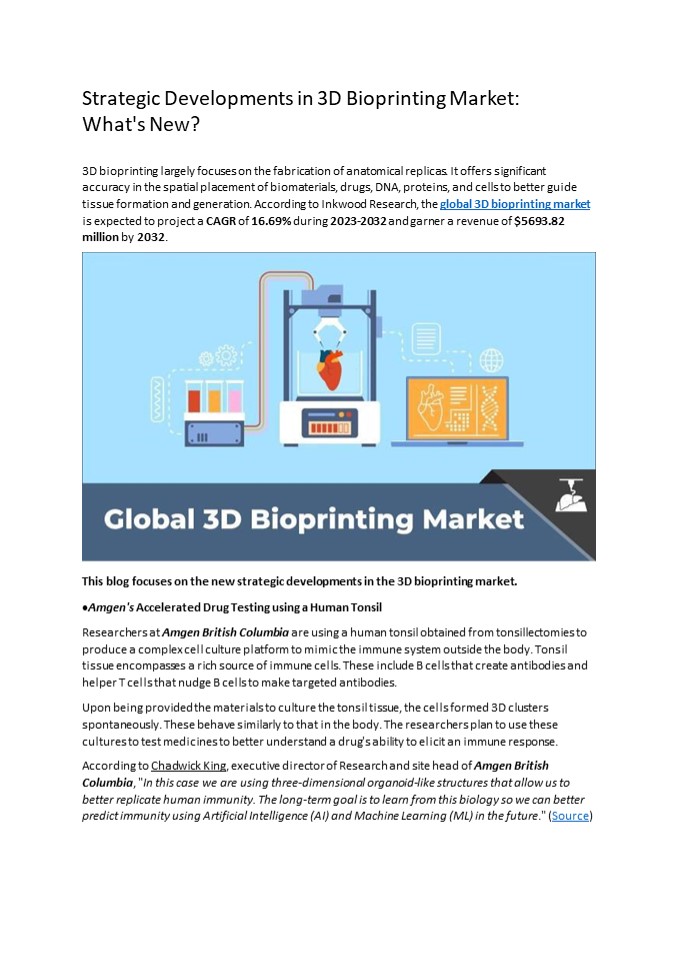
- This blog focuses on the new strategic
developments in the 3D bioprinting market. - Amgen's Accelerated Drug Testing using a Human
Tonsil - Researchers at Amgen British Columbia are using a
human tonsil obtained from tonsillectomies to
produce a complex cell culture platform to mimic
the immune system outside the body. Tonsil tissue
encompasses a rich source of immune cells. These
include B cells that create antibodies and helper
T cells that nudge B cells to make targeted
antibodies. - Upon being provided the materials to culture the
tonsil tissue, the cells formed 3D clusters
spontaneously. These behave similarly to that in
the body. The researchers plan to use these
cultures to test medicines to better understand a
drug's ability to elicit an immune response. - According to Chadwick King, executive director of
Research and site head of Amgen British Columbia,
"In this case we are using three-dimensional
organoid-like structures that allow us to better
replicate human immunity. The long-term goal is
to learn from this biology so we can better
predict immunity using Artificial Intelligence
(AI) and Machine Learning (ML) in the future."
(Source)
2
- Predicting which protein-based medicines evoke an
immune response that can neutralize the molecule
remains a big pain point in drug development.
Accordingly, the immune tissue platforms may
assist in producing new antibodies for
development. - BioArm joins Cancer Research
- Researchers at the University of Cambridge and
King's College London developed BioArm, a low-
cost extrusion-based bioprinter. It can be easily
transported, folded, and reassembled for
printing. It can manufacture complex tumoroids
(around 90 seconds per tumoroid) to test
potential immunotherapy treatments. Tumoroids are
3D cell cultures that mimic tumor tissues. - Immunotherapy uses the immune system to identify
and fight cancer cells. There have been increased
efforts to mimic the tumor microenvironment with
regard to in vitro cancer models for therapeutic
testing. Also, modeling a tumor in vitro can help
minimize the animal model used for treatment
methods in cancer research. - In this regard, 3D bioprinting is an efficient
tool to help construct in vitro cancer models.
However, the existing bioprinters are difficult
to maneuver or reassemble. In comparison, BioArm
is portable and can be assembled and disassembled
within 15 minutes. - Corrado Mazzaglia, Research Associate in the
Biointerface Research Group, says, "Bioprinted
cancer models mimic the 3D heterogeneity of real
tumors. BioArm has the potential to screen a wide
range of tumor therapies and could play a crucial
role in the future development of cancer drug
testing approaches." (Source) - CollPlant and Stratsys merge Technologies for
Industrial-Scale Bioprinting of Organs and
Tissues - On 4th April 2023, Stratasys and CollPlant
announced a joint development commercialization
agreement to develop a solution to bio-fabricate
human organs and tissues. This will be done using
CollPlant's collagen-based bioinks and Stratasys'
P3 technology-based bioprinter. It will further
enable the production of CollPlant's
state-of-the-art breast implants designed to
regenerate an individual's natural breast tissue
without evoking an immune response. This is
evaluated to facilitate a revolutionary
alternative for reconstructive and aesthetic
procedures. - Says Yehiel Tal, CEO of CollPlant, "We believe
that our rhCollagen-based regenerative implant
has the potential to overcome the challenges of
existing breast procedures that use silicone
implants or autologous fat tissue transfer."
(Source) - Easy Gulping DEGLUMED's 3D Printed Personalized
Medicine to Dysphagia Rescue - Dysphagia is a swallowing disorder. It affects 1
in 25 people in the United States. Dysphagia
patients need more time and effort to move food
from the mouth to the stomach. Also, it affects
patients with neurodegenerative pathologies. For
instance, over 50 of acute stroke patients in
Europe are affected by post-stroke dysphagia
(PSD). - DEGLUMED is a Spanish project funded by the
Valencian Institute of Business Competitiveness
(IVACE). The participants include Centrum
Pharmaceutical Specialties, IT3D GROUP,
NutriSpain, and AIMPLAS (Plastics Technology
Centre). The project aims to provide solutions
for people with swallowing problems. - The project integrates several technologies and
methods to design drugs. These include hot melt
extrusion, which facilitates complex formulations
that can be used to obtain films. These films
3
- further disintegrate in the mouth. Additionally,
a filament would be acquired to be used for Fused
Deposition Modeling (FDM) 3D printing. - 3D printing is evaluated to save energy and
enable the bioavailability and reproducibility of
the drug. Also, it offers advantages like the
production versatility of short series at
affordable costs, savings in materials,
personalization, the printing of complex
structures integrating different materials, etc. - Toward Four-Dimensional (4D) Bioprinting?
- In 4D bioprinting, the fourth dimension, 'time,'
is incorporated with 3D bioprinting. The printed
bioconstructs can change their functionalities or
shapes either through external or internal
stimuli. It is estimated to be a promising
direction in the fabrication of living tissues in
a shorter duration of in vitro culture. This does
not require extensive casting in molds that
prevent the integration of larger tissues with
vascular networks or their fabrication. - One of our major findings with regard to the
global 3D bioprinting market is the emergence of
4D bioprinting as a substitute for 3D
bioprinting. It is assessed to be a disruptive
innovation in tissue engineering since it
facilitates the construction of functional
complex structures with stimuli- responsive
materials. - FAQs
- Which region projects immense growth potential in
the global 3D bioprinting market? - A Asia-Pacific projects immense growth potential
in the global 3D bioprinting market. - What are the main growth restraints of the global
3D bioprinting market? - A Operational challenges and the lack of skilled
professionals are the global 3D bioprinting
market.
Recommended

