

The Sources of Common DXA Scan Errors | Atlantis Worldwide PowerPoint PPT Presentation
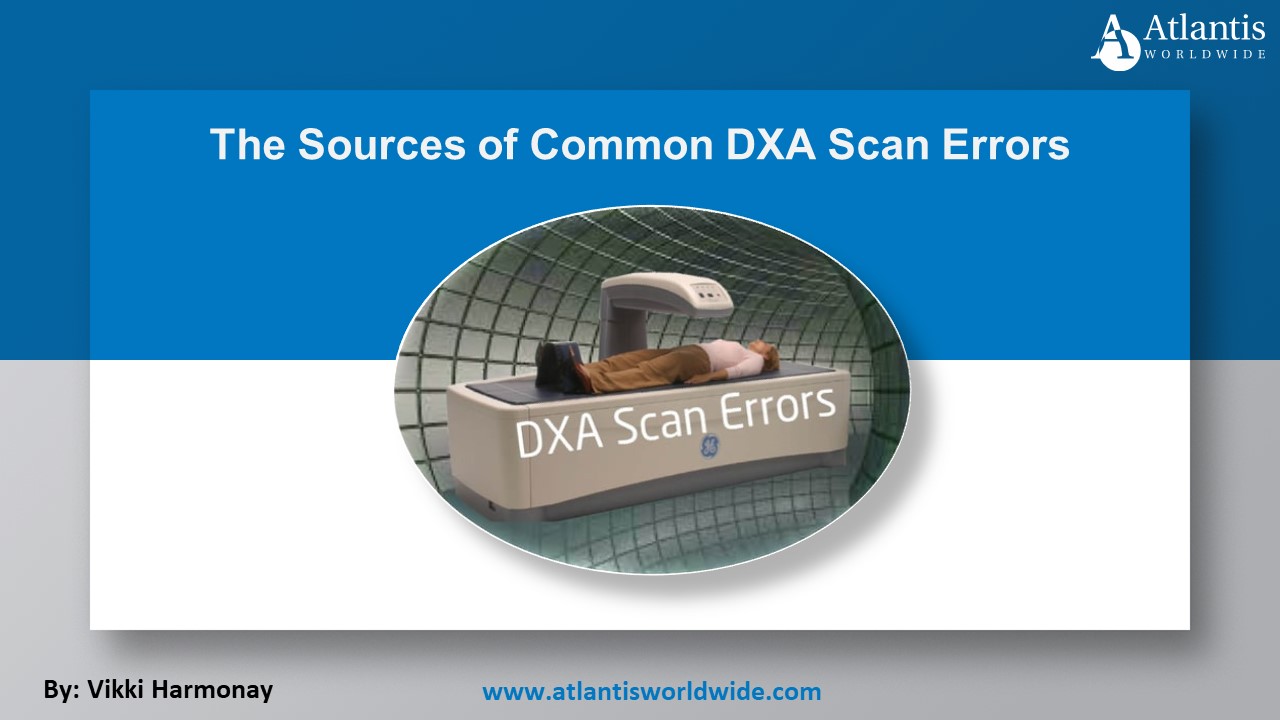
Title: The Sources of Common DXA Scan Errors | Atlantis Worldwide
1
The Sources of Common DXA Scan Errors
www.atlantisworldwide.com
By Vikki Harmonay
2
DXA is the most widely used radiological modality
for measuring bone density. There are other
modalities and each has its own advantages and
disadvantages. However, because DXA is the most
common, lets take a look at certain DXA scan
errors that general radiographers and DXA
operators should be aware of. Its important to
note than BMD results acquired from different
radiological modalities cant be compared. In
fact, even when the technology used is the same,
cross-calibration is necessary in order to
compare results from different devices. The skill
of the radiologic technologist is key to limiting
DXA scan errors, especially since precision
errors are inherent to BMD testing.
www.atlantisworldwide.com
3
BMD precision refers to the reproducibility of
the BMD result, which is calculated by scanning
patients three times in one day, or 30 patients
two times on the same day. Following each scan,
the patient must be repositioned. The precision
calculation is used in order to calculate the
least significant change of LSC. DXA facilities
must adhere to the manufacturers recommendation
for quality control and maintenance. In addition,
every DXA facility must perform precision
assessment, as well as perform comparison of BMD
measurements between different radiologic
technologists in order to reduce DXA scan errors.
Errors in BMD resting are also common because the
training and education of technologists for bone
densitometry varies widely.
www.atlantisworldwide.com
4
What Are The Sources of DXA Scan Errors?
- There are three sources of DXA scan errors
technique, artifacts and bone disease. - Errors that happen due to technique are caused by
movement, patient positioning and ROI placement. - Errors due to artifacts include foreign bodies
like surgical material, calcifications and
contrast media. - Errors due to bone diseases include sclerotic or
lytic lesions, fractures and degenerative changes
www.atlantisworldwide.com
5
There are four potential sources of DXA scan
errors
1. The patient A patients height and weight
have an effect on BMD because the manufacturers
algorithms are based on a normal BMI. They are
not valid for extremely overweight or underweight
individuals. If you dont keep this in mind, DXA
scan errors can happen. In addition, if there are
metal objects on a patients artifacts can be
produced. If a patient has been recently exposed
to contrast or nuclear medicine investigations,
this too can be a factor.
www.atlantisworldwide.com
6
2. The instrument Differences exist between
different machines. There can also be differences
between the same machine installed at different
centers. Algorithms and reference databases can
also vary from manufacturer to manufacturer.
Thats why you cant directly compare the results
of a current report to a prior report that was
obtained from a different machine or at a
different facility. Scan errors can also be
caused by equipment with hardware or software
problems. These can include image errors like
detector streaks and even typing errors. Other
mechanical issues can include atypical sounds
from the device, phantom and QA issues and
software error messages. The environment of the
instrument can also cause scan errors. Humidity,
temperature, power outages and power surges can
lead to mechanical problems.
www.atlantisworldwide.com
7
3. The technologist If patients are not
positioned correctly by the technologist, DXA
scan errors can occur. For example, if the
rotation of a femur is incorrect, it can
negatively affect the area of the bone to be
scanned. The same holds true for spine scans. The
incorrect selection of the region of interest can
be a source of error. In addition, osteophytes
and deformities in the vertebrae can often make
it difficult to define vertebral levels and can
lead to inconsistent findings. 4.The report
Because DXA reports have so much information,
its important that technologists can identify
and understand all items on the DXA report. At
the same time, DXA operators must record the
reference data correctly to make sure the
radiologist can provide the right interpretation.
www.atlantisworldwide.com
8
DXA Scanning Mistakes
- Not performing BMD testing in a high risk patient
- The failure to follow the manufacturers
instructions for the system maintenance for the
device and the failure to conduct phantom
measurements. - Again, incorrect positioning of the patient and
the selection of the wrong scan mode can cause
scan errors. - Entering incorrect patient demographic
information or age/gender information can cause
scan errors. - Incorrect labeling of vertebral bodies, Review
and correction of default bone edge and ROI
identification are common DXA errors. - Incorrect interpretation of the test is also a
common problem.
www.atlantisworldwide.com
9
- DXA scan errors can also be caused by common
artifacts, like a penile implant, breast
implants, bracelets, watches, anklets, a battery
pack of an external hearing aid in a patient
pocket, total or partial hip or knee
replacements, obesity and more.
Do You Have Questions About DXA Scan Errors?
Dont hesitate to reach out to an expert. The
team at Atlantis Worldwide is happy to answer any
questions you might have about medical imaging
equipment, or to help you with the perfect
refurbished equipment for your practice, clinic,
hospital or Urgent Care. Contact One of Our
Experts Today!
www.atlantisworldwide.com
10
Some blogs you may have missed
- 3 Bone Densitometer Comparisons
- Top Mammography Articles
- Portable Bone Densitometer Enters U.S. Market
- Radiologists, Healthcare and Social Media
- Your Body Image New Uses for DXA
- Women's Health Articles
www.atlantisworldwide.com
11
https//info.atlantisworldwide.com/blog/the-source
s-of-common-dxa-scan-errors
www.atlantisworldwide.com
12
- Contact Us
60 East 42nd Street, Suite 4600, New York, NY
10165 Phone 1-212-366-9100 Toll Free
1-800-533-3356 Fax 646-762-6562
info_at_atlantisworldwide.com https//www.atlantisw
orldwide.com https//info.atlantisworldwide.com/b
log
Recommended

