

How a Diaphragm Gas Meter Works: A Step-by-Step Explanation PowerPoint PPT Presentation
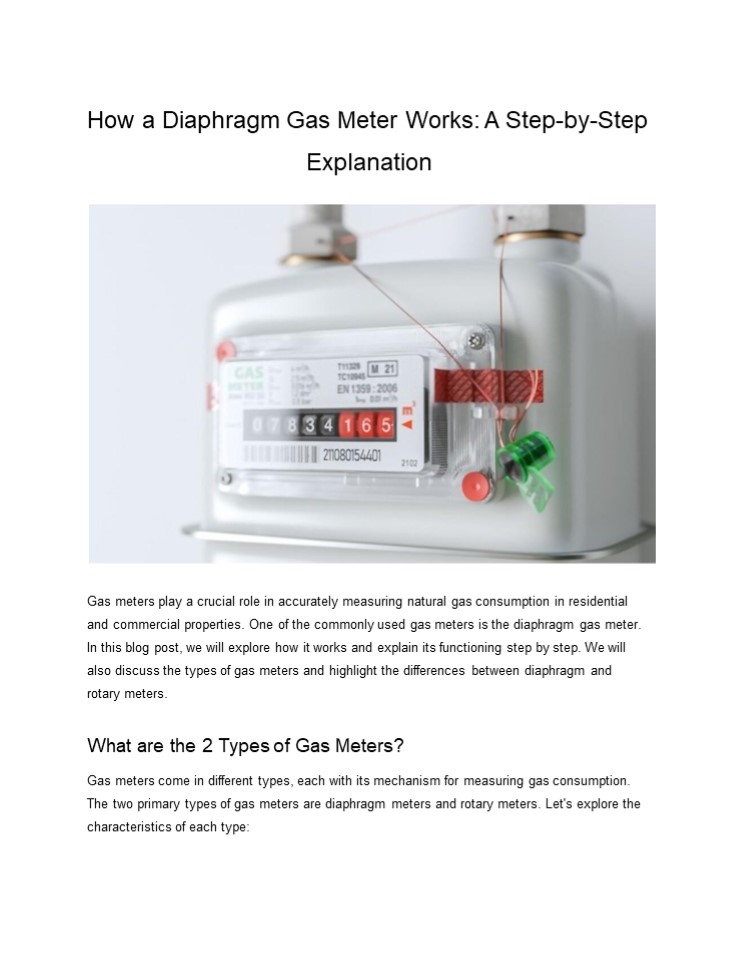
Title: How a Diaphragm Gas Meter Works: A Step-by-Step Explanation
1
How a Diaphragm Gas Meter Works A Step-by-Step
Explanation
Gas meters play a crucial role in accurately
measuring natural gas consumption in residential
and commercial properties. One of the commonly
used gas meters is the diaphragm gas meter. In
this blog post, we will explore how it works and
explain its functioning step by step. We will
also discuss the types of gas meters and
highlight the differences between diaphragm and
rotary meters. What are the 2 Types of Gas
Meters? Gas meters come in different types, each
with its mechanism for measuring gas consumption.
The two primary types of gas meters are
diaphragm meters and rotary meters. Let's explore
the characteristics of each type
2
What is a Diaphragm Gas Meter? As the name
suggests, a diaphragm gas meter utilizes
diaphragms to measure gas flow. These meters are
commonly used in residential and small commercial
applications. They offer high accuracy and
reliability, making them suitable for monitoring
household gas consumption. They are known for
their robust construction and ability to handle
varying gas pressures. What is a Rotary Gas
Meter? On the other hand, rotary gas meters
employ a different mechanism for measuring gas
flow. They consist of two rotating impellers or
rotors that trap and measure gas as it passes
through the meter. Rotary meters are often used
in industrial and large-scale commercial settings
where high gas volumes are consumed. These
meters are known for their durability and ability
to handle heavy-duty applications. Differences
Between Diaphragm and Rotary Meters Measurement
Mechanism Diaphragm meters rely on the expansion
and contraction of diaphragms to measure gas
flow, while rotary meters use rotating
impellers. This fundamental difference in the
measurement mechanism sets the two types of
meters apart. Accuracy and Precision Diaphragm
meters are generally more accurate and precise in
measuring gas consumption, especially in low to
medium flow rates. They are designed to
accurately measure small gas volumes, making
them ideal for residential applications. Rotary
meters, on the other hand, are better suited for
high flow rates and larger volumes of
gas. Pressure Handling Diaphragm meters can
handle a wider range of gas pressures, including
variations in pressure within the gas supply
network. This flexibility allows them to maintain
accuracy even when the gas pressure fluctuates.
Rotary meters, although durable, may be more
sensitive to pressure changes and require
additional pressure regulation.
3
Application Diaphragm meters are widely used in
residential and small commercial settings due to
their accuracy, reliability, and ability to
handle low to medium flow rates. They are
suitable for monitoring gas consumption in
households, apartments, and small businesses.
With their capacity to handle high flow rates,
rotary meters are commonly used in industrial
applications, large commercial buildings, and
gas distribution networks. How Does a Diaphragm
Gas Meter Works? Step 1 Gas Inlet The diaphragm
gas meter starts its operation at the gas inlet.
The incoming natural gas flows into the meter
through a pipe connected to the supply line. It
is important to note that the gas pressure is
regulated before entering the meter to ensure a
consistent flow. Step 2 Metering Chambers Once
the gas enters the diaphragm meter, it moves into
the metering chambers. These chambers are
designed to accommodate the diaphragms, which
play a crucial role in the measurement process.
The chambers are sealed to prevent any gas
leakage. Step 3 Diaphragm Movement The
diaphragms within the metering chambers are the
key components responsible for measuring the gas
flow. As the gas flows through the chambers, it
causes the diaphragms to expand and contract.
This movement is directly proportional to the
volume of gas passing through the meter. Step
4 Recording Mechanism The movement of the
diaphragms is transferred to a recording
mechanism, typically a set of gears and dials,
which translates the diaphragm movement into a
readable measurement. The recording mechanism
displays the gas consumption in units such as
cubic feet or cubic meters. It allows gas
utility companies and consumers to determine
their gas usage accurately.
4
- Step 5 Gas Outlet
- After measuring the gas, it exits the diaphragm
meter through the gas outlet. From here, it
continues its journey through the pipeline to its
intended destination, such as a gas stove or a
heating system. - How Do You Read a Diaphragm Gas Meter?
- Reading a diaphragm gas meter is a
straightforward process that involves
interpreting the numbers and dials on the meter.
Here are the steps to read it - Locate the gas meter They are typically
installed outside the building or in a utility
room. Find the meter and ensure it is easily
accessible. - Identify the dials and numbers Look for the
meter's series of dials and numbers. Each dial
represents a specific unit of measurement, such
as cubic feet or cubic meters. - Start from left to right Begin reading the dials
from left to right. Note down the value of each
dial. If a dial is between two numbers, consider
the lower number. Some dials may rotate in the
opposite direction, so be cautious while reading. - Calculate the total consumption Once you have
recorded the values of all the dials, add them
up to calculate the total gas consumption. This
value represents the amount of gas used during a
specific period. - Record the reading If required, record the gas
meter reading for billing or monitoring
purposes. Make sure to follow the specific
guidelines provided by your gas utility company. - Conclusion
- Understanding how a diaphragm meter works is
essential for gas utility companies and
consumers. The diaphragm gas meter manufacturers
have designed these meters to measure gas
consumption and provide reliable readings
accurately. By comprehending the step-by-step
explanation of their functioning, consumers can
make informed decisions about gas usage and
effectively manage their energy consumption.
Whether they use a diaphragm meter for
residential applications or a rotary meter for
industrial use, gas meters ensure fair and
accurate billing while promoting efficient gas
utilization.
Recommended

