

Global Paints & Coatings Market: Waterborne Technology’s Lucrative Foothold PowerPoint PPT Presentation
Title: Global Paints & Coatings Market: Waterborne Technology’s Lucrative Foothold
1
Global Paints Coatings Market Waterborne
Technologys Lucrative Foothold
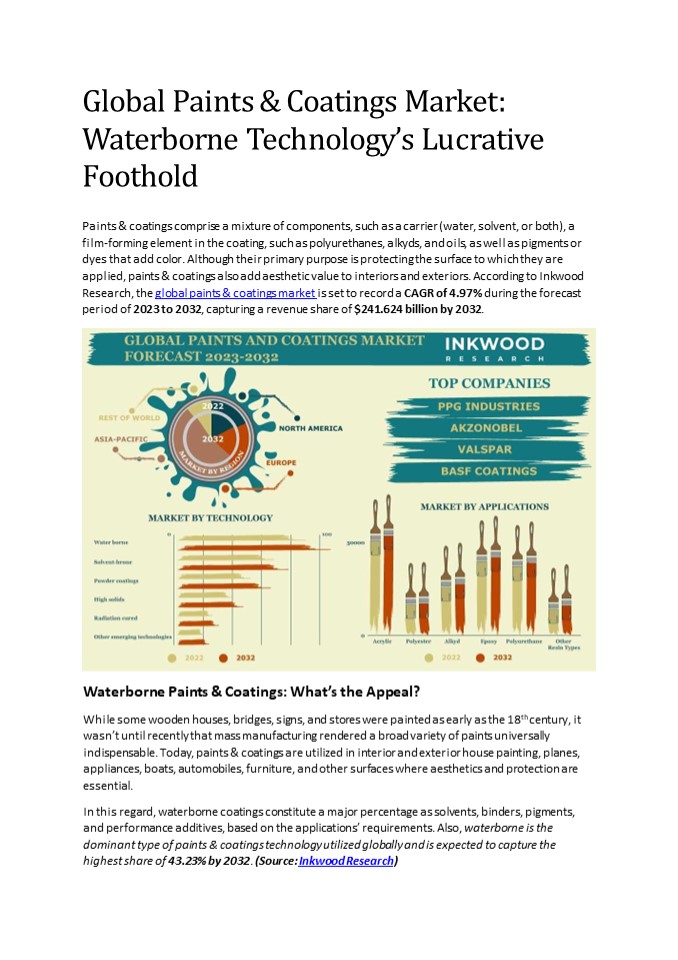
Paints coatings comprise a mixture of
components, such as a carrier (water, solvent, or
both), a film-forming element in the coating,
such as polyurethanes, alkyds, and oils, as well
as pigments or dyes that add color. Although
their primary purpose is protecting the surface
to which they are applied, paints coatings
also add aesthetic value to interiors and
exteriors. According to Inkwood Research, the
global paints coatings market is set to record
a CAGR of 4.97 during the forecast period of
2023 to 2032, capturing a revenue share of
241.624 billion by 2032.
Waterborne Paints Coatings Whats the
Appeal? While some wooden houses, bridges, signs,
and stores were painted as early as the 18th
century, it wasnt until recently that mass
manufacturing rendered a broad variety of paints
universally indispensable. Today, paints
coatings are utilized in interior and exterior
house painting, planes, appliances, boats,
automobiles, furniture, and other surfaces where
aesthetics and protection are essential. In this
regard, waterborne coatings constitute a major
percentage as solvents, binders, pigments, and
performance additives, based on the applications
requirements. Also, waterborne is the dominant
type of paints coatings technology utilized
globally and is expected to capture the highest
share of 43.23 by 2032. (Source Inkwood
Research)
2
- The market share of waterborne paints coatings
has grown rapidly over the years, given their
favorable properties such as increased
availability, fast-drying nature, and lower VOC
levels. - Moreover, they entail a wide variety of resin
types, like acrylic, urethane, polyester, alkyd,
fluoropolymer, epoxy, and waterborne powders. As
per Inkwood Research, the acrylic segment, under
the resin type category, is expected to grow with
the fastest CAGR of 5.11 by 2032, capturing the
highest revenue share of 31.35 in 2022. - Waterborne Technology Market Observations
- Waterborne coatings in the architectural
(interior/exterior) segment expected CAGR by
2023 5.29 are projected to show healthy growth
in the next five years. The growth is mainly
driven by the following - Significant investments in infrastructure
developments - Rise in housing projects
- Renovation of existing residential and commercial
buildings - The increasingly eco-friendly nature of
waterborne coatings, along with their versatile
properties, are boosting their demand across
developing economies, primarily in the Asia-
Pacific. - Accordingly, Asia-Pacific is set to lead and
dominate the global paints coatings market
over the forecast period, capturing a revenue
share of 49.38 by 2022 and a CAGR of 5.85 by
2032. - Waterborne coatings are commonly required in
automotive paints. Aligning with this, there has
been a steady shift toward waterborne acrylics,
particularly in automotive basecoats, owing to
environmental challenges. - This factor, in turn, plays a vital role in
positioning automotive (OEM) as one of the
fastest-growing applications, with a CAGR of
5.15 by 2032. - Painting a Strategic Landscape with Waterborne
Technology - The growing focus on environmental
sustainability, in addition to stringent
government regulations to minimize the use of
harmful substances, is anticipated to promote the
demand for water-based paints during the
forecast period. This has also encouraged
companies to increase their investments and
advance their strategic ventures in waterborne
paints, predominantly given the advantages and
subsequent profits they yield. - For example
- In January 2022, PPG Industries (United States)
announced that it would invest over 10 million
to expand the production capacity of automotive
original equipment manufacturer (OEM) coatings
at its site in Weingarten, Germany. The expansion
was completed in Q2 2022, in addition to its
existing facility with a capacity to produce more
than 5,000 metric tons of waterborne basecoats
annually. - In October 2022, The Sherwin-Williams Company
(United States) announced an agreement to
acquire an Italian designer, distributor, and
manufacturer of industrial wood coatings,
Industria Chimica Adriatica SpA (ICA). The
latters focus on innovative waterborne as well
as solvent liquid coatings technology, including
an expanding portfolio of BIO water-based
coatings, is set to provide the company with
numerous opportunities to accelerate profitable
growth, globally.
3
- LANXESS (Germany), a Specialty chemicals company,
established a new manufacturing line for the
production of water-based compounds in Nantong,
China, in 2021. Typical application areas for
these products entail flat materials for
automotive interiors, i.e., instrument panels,
as well as door and sear panels. - Michael Timm (Head of Marketing Development
Cast Elastomers at URE) states, As the
automotive industry will continue to switch from
solvent-based to environment-friendly
water-based coatings, we see strong potential
with attractive growth rates. (Source) - In May 2020, Foseco (India) developed a new
fast-drying waterborne coating, SEMCO FD. It
enables foundries to utilize coatings with
significantly higher solids content, thus
offering greater protection against casting
defects. Subsequently, SEMCO FD yields advantages
such as an accelerated drying process, a
tremendous improvement in the quality of the
working environment, lower energy consumption,
and improved foundry profitability. - BASF (Germany) and Nippon Paint China, a leading
coatings manufacturer, collaboratively launched
an eco-friendly industrial packaging in August
2022. With Joncryl High- Performance Barrier,
the water-based acrylic dispersion by BASF as the
barrier material, the novel packaging material
is commercialized for constructing Nippon Paints
dry mortar products. - Arkema (France), a global chemical company,
acquired Polimeros Especiales, a Mexico- based
producer of waterborne acrylic resins, in
September 2022. Polimeros Especiales
manufactures high-performance waterborne resins
for diverse markets, such as construction,
architectural and decorative paints,
pressure-sensitive adhesives, and textiles. The
move is set to strengthen the companys position
in Mexico, a fast-growing region, as well as its
key offering in solvent-free solutions. - Over the years, the driving force for the
development of waterborne technology has been
environmental, with water-based paints coatings
offering a holistic approach to sustainability.
They also provide high color retention over time,
in addition to generating limited odors. - Consequently, these characteristics increase the
demand for waterborne solutions across myriad
applications, thus contributing to the growth of
the global paints coatings market during the
forecast period. - Frequently Asked Questions (FAQs)
- What is UV-curable technology for waterborne
coatings? - A UV-curable technology for waterborne coatings
is a surface treatment that is either cured by
UV radiation or shields the underlying material
from the radiations adverse effects. The
technology has also received significant traction
in industrial research. - What are some of the challenges faced by the
global paints coatings market? - A Uncertainties associated with raw material
prices, geopolitical tensions, and regulatory
issues are among the key challenges faced by the
global paints coatings market.
4
(No Transcript)
Recommended

