

Who is Adiyogi? The First Yogi and Source of Yoga PowerPoint PPT Presentation
Title: Who is Adiyogi? The First Yogi and Source of Yoga
1
Who is Adiyogi? The First Yogi and Source of Yoga
Maha Yogi, Adinath, Yogeshwar, and Adiyogi are
some of the names of Lord Shiva. He is part of
the Trinity, Brahma, Vishnu, and Mahesha, that
controls the cosmic universe. Shiva is the
destroyer who possesses the power to eradicate
all evil from the Universe. Few are aware of
Lord Shiva's deep connection with Yoga. Many
theories and legends have established Lord Shiva
as the Father of Yoga. Lord Shiva is believed to
have laid down the holistic utility of Yoga for
the body, mind, and spirit. Many Hindu
scriptures and theories revere Lord Shiva as
Adiyogi, the world's First Yogi. Who Was
Adiyogi? In the yogic tradition, Adiyogi is
considered the first yogi and the originator of
yoga. The word "Adiyogi" translates to "the
first yogi" or "the primal yogi" in the Tamil
language. According to Hindu mythology, Adiyogi
is believed to have transmitted the science of
yoga to his seven disciples, known as the
Saptarishis, thousands of years ago. He imparted
them with the knowledge and techniques to
explore and attain spiritual enlightenment. This
event is said to have marked the beginning of
the yogic tradition.
2
Adiyogi is often depicted as a meditating figure,
usually shown with matted hair, an ash-smeared
body, and a serpent coiled around his neck. He is
considered the ultimate symbol of spiritual
liberation and represents the divine union of
masculine and feminine energies.
The significance of Adiyogi extends beyond
mythology and religion. He is revered as a
profound source of wisdom and inspiration,
emphasizing the importance of inner exploration
and self-realization. Adiyogi is widely
venerated by practitioners of yoga and spiritual
seekers who seek to deepen their understanding
of the self and attain higher states of
consciousness. Also read Top 3 Patanjali Yoga
Sutras for Balanced Life (With Meaning Examples)
- Role of Adiyogi in Yoga
- Transmission of Yoga
- Adiyogi is believed to have transmitted the
science of yoga to his seven disciples, the
Saptarishis. He shared the knowledge and
techniques that encompassed various aspects of
yoga, including asanas (postures), pranayama
(breath control), meditation, and spiritual
wisdom. - Science of Inner Transformation
3
- Adiyogi emphasized that yoga is not just a
physical exercise or a set of techniques, but a
means for inner transformation and
self-realization. He taught that through
dedicated practice, individuals can attain
higher states of consciousness and realize their
true nature. - Union of Opposites
- Adiyogi emphasized the importance of embracing
and balancing the masculine and feminine
energies within oneself. He highlighted the
significance of harmonizing the polarities of
life, such as activity and stillness, effort and
surrender, and strength and grace. - Five Elements and Human Potential
- Adiyogi taught that the human body and the
universe are interconnected. He explained that
the human system is essentially made up of the
five elements (Panch Bhutas)earth, water, fire,
air, and spaceand by understanding and
harmonizing these elements, one can unlock their
full potential. - Importance of Meditation
- Adiyogi also focused on the practice of
meditation as a powerful tool for self-discovery
and inner growth. He taught various meditation
techniques to help individuals calm their mind,
cultivate awareness, and experience deeper
levels of consciousness. - Non-Dogmatic Approach
- Adiyogi's teachings were open and inclusive,
transcending religious and cultural boundaries.
He encouraged seekers to explore and discover
their own truth, emphasizing the need for
personal experience and direct realization
rather than blind belief. - Also read Different Definitions of Yoga (From
15 Scriptures Roots of Yoga)
Key Yogic Techniques Attributed to Adiyogi 1.
Hatha Yoga Lord Shivas Hatha Yoga focused on the
purity of the body by using correct Yoga
techniques. The various physical postures that
Lord Shiva taught Goddess Parvati and the
Saptarishi were part of Hatha Yoga. Most of the
modern-day practices of Yoga follow the teachings
and principles of Hatha Yoga. The teachings of
Hatha Yoga portray the importance of meditation,
dietary regulations, breathing techniques,
physical exercise, and postural alignment in
cleansing your body adequately.
4
- Mantra Yoga
- Mantra implies a chant that people usually repeat
or recite while meditating. Lord Shiva
introduced Mantra Yoga to teach the concept of
mental cleansing with the help of Yoga. Lord
Shiva was the creator of the syllable Om, which
is one of the primordial sounds of the cosmic
universe. - Om is a widely used syllable in various Hindu
mantras. Mantra Yoga helps improve the focus of
a wandering mind, thus allowing it to pursue its
true goal of enlightened living. Mantra Yoga is
more profound than physical Yoga as it will
enable one to explore their subconscious and
elevate it to a higher spiritual plane. - Laya Yoga
- Lord Shiva developed the concept of Laya Yoga to
attain the ultimate aim of human life union
with the Cosmic Universe. Hindu religious
teachings discuss the idea of spiritual
enlightenment in human life. - Laya Yoga includes meditation techniques and
other spiritual activities that will help to
elevate ones life to a better spiritual plane.
Laya Yoga helps activate and harness fixed energy
points within the human body. - Raja Yoga
- Raja is the Sanskrit word for king. The king is
always the best and at the top similarly, Raja
Yoga is the highest aim of Yoga. Raja Yoga is
also the name of the techniques and practices
one must perform to attain bliss and harmony.
Laya Yoga assists in activating dormant energies
inside our bodies. - Raja Yoga is the journey that takes these
energies from their lowest point to their maximum
potential. While doing so, these energies pass
through various points in the body known as
Chakras. Lord Shiva resides in the Chakra, where
the power takes its most potent form within our
body. - Also read 18 Life-Changing Bhagavad Gita Shlokas
(Verses) With Meaning and Lessons
Historical Context of Adiyogi Connection between
Adiyogi and the Indus Valley Civilization Yoga is
ancient, but how old is it? Many people ask when
Yogic postures were invented in India. The
answer is complex, but evidence confirms its
connection to Harappa and Mohenjo-Daro sites.
Both places were inhabited from 3300 to 1300 BCE,
meaning it's over 5,000 years old, as the
records found.
5
The most crucial evidence is the idol of
Pashupatinath, or Lord Shiva, recovered from the
Harappan site. The posture of the idol is similar
to the most common Yogic posture, which is still
being followed. In the ancient Indian
scriptures, Pashupatinath or God Shiva is
considered Adi Yogi, so if we connect the dots,
we find that the Harappans were Shaivite and were
aware of Yogic postures. This is an eye-opening
revelation that many people dont know. The
Harappa and Mohenjo-Daro people were Shaivaite
and spread across the Indian subcontinent.
Despite various languages and cultures, the
source of divinity God Shivais common across
India. The Harappan civilisation and Yoga had
spread worldwide, and traces of Yogic cultures
can still be found buried in some parts of the
world. References to Adiyogi in ancient Indian
texts and scriptures Adiyogi taught the yogic
science to the seven sages together 15000 years
ago on the bank of Kanti Sarovar, a glacial lake
that existed at that time near Kedarnath Temple.
These sages then spread this valuable knowledge
among humanity to better their spiritual
condition and living. This precious knowledge of
Yoga was written in books, which were translated
later into several languages. These instructions
on Yogic methods were written in ancient
scriptures, like Shiva Sutras and Vigyan Bhairav
Tantra, where readers were taught how to gain
absolute control over the body and mind to
attain salvation. It is believed that this Yoga
science was later introduced in North India by
Guru Gorakhnath and preached in South India by
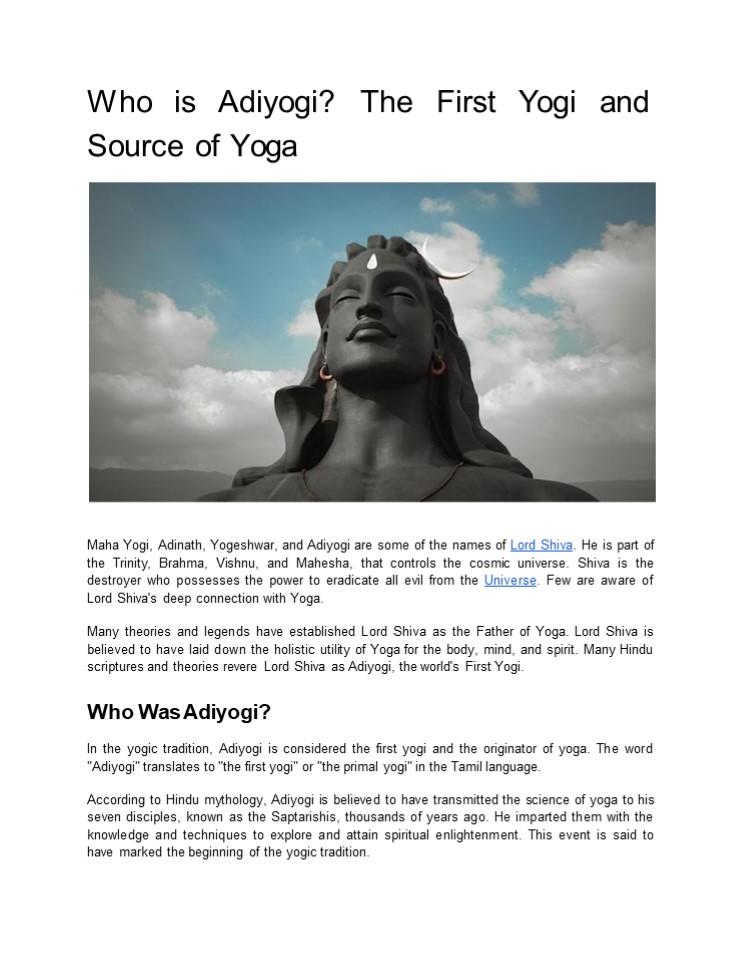
Rishi Agasthya. The Adiyogi Statue at the Isha
Yoga Center Adiyogi Shiva Statue in Coimbatore is
one of India's most enormous statues, dedicated
to the great Hindu god Lord Shiva. Located in
the Isha Foundation Complex in Coimbatore, the
statue is carved out of 500 steel stones and
stands tall at 112 feet. It is surrounded by
verdant green farms at the foothills of the
Velliangiri Mountains in the Western Ghats,
offering a relaxing environment for Yoga and
meditation.
6
- The Center foster inner transformation and
creates an established state of well-being in
individuals. The large residential facility has
an active international community of
brahmacharis, full-time volunteers and visitors.
Isha Yoga Center provides a supportive
environment to shift to healthier lifestyles,
seek higher self-fulfilment, and realise your
full potential. - Significance of the Adiyogi Statue
- Located at the Isha Yoga Center, with a height of
112 feet, Adiyogi symbolises the 112
possibilities to attain moksha, i.e. liberation
mentioned in yogic culture and the 112 chakras in
the human system. A linga known as Yogeshwar
Linga was consecrated and placed before the
statue. - Architectural and artistic features of the statue
- The Face of the Lord Shiva statue is made of
steel. - Lord Shiva's face is made of steel and is not
just for aesthetics but has the geometric
significance of crafting a metal statue. - Took 8 months to build the statue.
- Designing the face took about 2.5 years, but the
statue was built in 8 months. - It weighs 500 tonnes.
- The whole structure is estimated to weigh
approximately 500 tonnes.
7
4) Reason behind the statue being 112-foot
tall. 112 is significant because Adiyogi opened
112 possibilities for humans to reach their
ultimate potential. Also, there's a scientific
significance there are 112 chakras in the human
system to work to explore 112 life's
dimensions. 5) Face of Adiyogi will be the
enormous face of its kind on the planet. Shiva
isn't known as God but as Adiyogi or the first
yogi the Originator of Yoga. He first sowed
the seed into the human mind that one can evolve
if willing to strive.
Recommended

