

Hernia Symptoms – Dr. Valeria Simone MD PowerPoint PPT Presentation
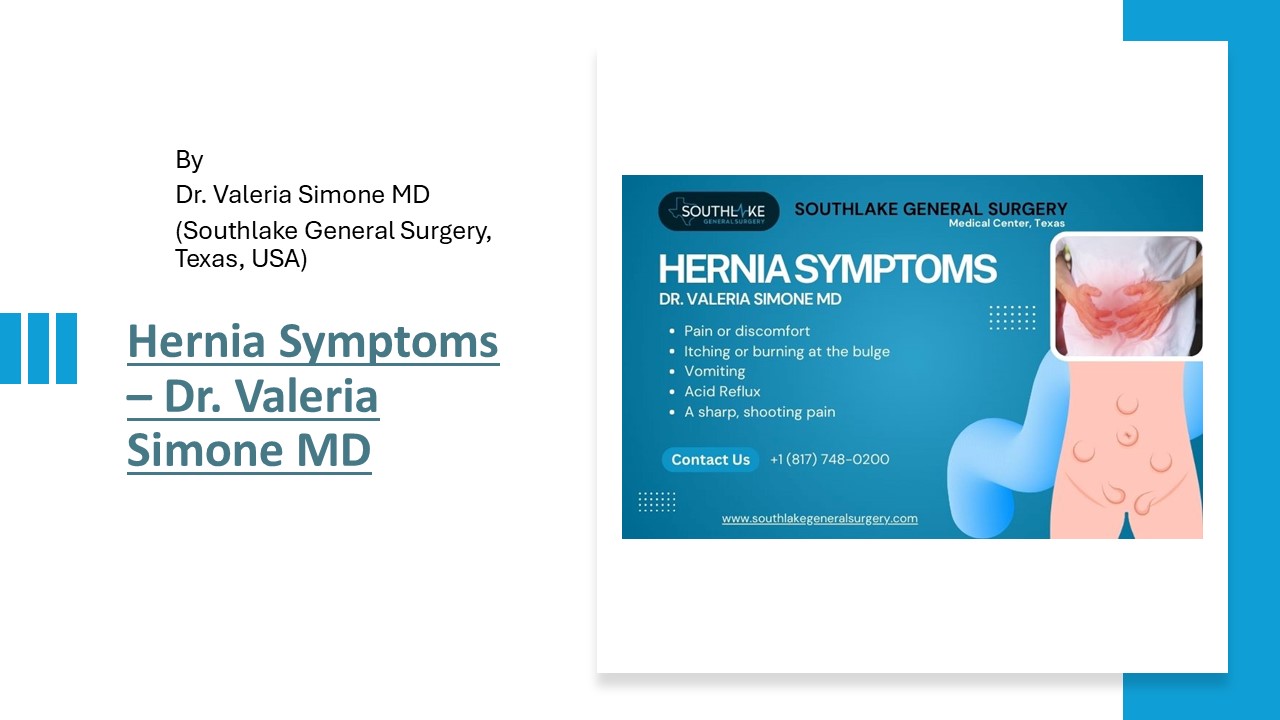
Title: Hernia Symptoms – Dr. Valeria Simone MD
1
Hernia Symptoms Dr. Valeria Simone MD
- By
- Dr. Valeria Simone MD
- (Southlake General Surgery, Texas, USA)
2
Overview
- Hernia symptoms typically appear out of nowhere
and can cause excruciating amounts of discomfort.
If you have a hernia, you may experience pain or
discomfort in your abdomen, groin, or belly area. - You may also notice a bulge or swelling in your
groin or belly area. It is common for people with
hernias to have difficulty sleeping or sitting,
or to feel faint or lightheaded.
3
What Are The Signs And Symptoms Of A Hernia?
- A hernia in the groin or abdomen can cause a
visible lump or protrusion, which, depending on
the persons position, may be able to be pushed
back in or may go away when they lie down. After
being pushed down, the lump may emerge after
certain activities, such as laughing, sobbing,
coughing, straining during a bowel movement, or
engaging in physical exercise.
4
Variability of Symptoms
- The signs and symptoms vary from one form of
hernia to another. Its possible that you wont
have any symptoms in some instances.
5
Common Symptoms of Hernias
- Inguinal, femoral, umbilical, and incisional
hernias can all present with symptoms that
include the following - Pain or discomfort in the lower back, groin, or
abdomen when carrying heavy objects or bending
over. - Swelling in the abdomen or groin that can be
clearly seen through the skin. The pain may be
excruciating, yet it may vanish as soon as you
fall asleep. - Itching or burning at the bulge
- Vomiting
- Acid Reflux
- A sense of fullness in the abdominal region,
which may accompany constipation or the presence
of blood in the stool. - A sharp, shooting pain
- Weakness or discomfort in the groin
- Difficulty in swallowing
- Discomfort and swelling in the area surrounding
the testicles - Constipation
- Acid reflux and pain in the upper abdomen are two
of the potential symptoms of a hiatal hernia.
6
What Are The Symptoms Of A Strangulated Hernia?
- Understanding Strangulated Hernia
- When a persons intestines become compressed
against other organs in the abdominal cavity, the
condition is known as a strangulated hernia. The
most common type of strangulated hernia occurs
when the intestine becomes twisted and pinched
between the abdominal wall and a nearby organ,
such as the bowel or the bladder. - If the blood supply to the trapped part is cut
off or strangulated, the condition is critical
and potentially life-threatening.
7
What Causes Variability in Symptoms?
- The symptoms of a strangulated hernia can vary,
depending on where the strangulation occurs in
the abdominal cavity and how severe it is. They
can also change over time, with the strangulation
gradually getting worse instead of better. - Recognizing the Warning Signs
- If you experience any of the following symptoms
of a strangulated hernia, you should make an
appointment with your doctor as soon as possible - Acute, sharp pain that rapidly worsens
- Fever
- Nausea and/or vomiting
- Having difficulty excreting gas or passing stools
- Inflammation around the hernia lump that changes
color from red to purple to black
8
What Are The Signs And Symptoms Of Hernia In
Children?
- Hernias are prevalent in children, particularly
in infants and young children. Abdominal wall
weakness at birth can lead to them. In most
cases, youll detect a bulge in the groin area or
around the belly button if your child has one.
You may also notice that your infant is crying a
lot and refusing to feed. The hernias in your
childs lower abdomen may protrude when they cry,
cough, or strain to urinate. In addition, you may
notice that their tummy is pliable to the touch.
9
How To Treat A Hernia?
10
When is Surgery Necessary?
- Typically, hernias do not heal on their own,
and hernia repair surgery may be the only option
to treat them. However, your physician will
suggest the most effective treatment for your
hernia and may refer you to a general surgeon. If
the surgeon determines that it is necessary to
fix your hernia, he or she will customize the
method of treatment to match your specific needs. - Treatment for Children
- Children with significant umbilical hernias or
those who have not recovered from their hernias
by the age of 4 to 5 may require surgery. Its
common for a youngster to avoid complications
from surgery at this age. - Treatment for Adults
- In case an adult develops an umbilical hernia,
hernia surgery is generally advised by the doctor
as the condition is unlikely to resolve on its
own and complications are more likely.
11
Types of Hernia Surgery
- Hernia surgery can be classified into one of the
following three categories - Open Hernia Surgery
- In this procedure, a hernia is cut out of the
body. The tissue that had protruded out of the
muscle wall has been sewn back in place. Extra
support can be provided by implanting a mesh in
the affected area. - Laparoscopic Hernia Repair Surgery
- In laparoscopic surgery, the surgeon fixes the
hernia by using laparoscopic and other special
surgical tools. Small incisions are used to
implant surgical instruments rather than making a
large incision on the outside of the abdomen or
groin. - Robotic Hernia Repair Surgery
- A laparoscope is utilized for robotic hernia
repair, just as it is during laparoscopic
surgery. Additionally, only minor incisions are
required for the procedure. During the surgery,
the surgeon is seated on a console and controls
the surgical instruments being used during the
procedure. In addition to smaller hernias, or
areas of weakness, robotic surgery can now also
be utilized to rebuild the abdominal wall. - There are benefits and drawbacks to any surgical
procedure. The patients surgeon will determine
the best course of action.
12
What Are The Potential Consequences If A Hernia
Is Not Treated On Time?
- Hernias will not go away on their own, except for
umbilical hernias in newborns. As it grows and
develops, a hernia can become larger and
uncomfortable. - An inguinal or femoral hernia that has not been
treated might lead to - Abdominal obstruction (incarceration) When a
portion of the intestine becomes lodged in the
inguinal canal. This condition can result in a
painful lump in the groin, as well as nausea,
vomiting, and pain in the stomach. - Strangulation This condition occurs when a
portion of the intestine is compressed in such a
way that its blood supply is disconnected. When
this occurs, immediate surgical intervention
(within a few hours of the incident) is required
to prevent the death of tissue. - Lets explore more Hernia Symptoms Dr. Valeria
Simone MD - Southlake General Surgery
13
Make An Appointment
- Dont allow a hernia to interfere with your daily
activities! For expert diagnosis and treatment,
consider consulting Dr. Valeria Simone MD at
Southlake General Surgery in Texas. Give us a
call at 1 (817) 748-0200 today to set up your
appointment and begin your journey toward relief!
You can also make an online appointment with us.
14
- Medically Reviewed By Dr. Valeria Simone MD
- Board-certified General Surgeon at Southlake
General Surgery, Texas, USA. - Follow us on Facebook and YouTube.
- Source Hernia Symptoms Dr. Valeria Simone MD -
Southlake General Surgery
15
THANK YOU!
SOUTHLAKE GENERAL SURGERY
1545 E. Southlake Blvd, Suite 270 Southlake, TX
EMAIL info_at_southlakegeneralsurgery.com
VISIT US AT www.southlakegeneralsurgery.com
Recommended

