

Chance and Probability in Each Roll: The Math of Ludo PowerPoint PPT Presentation
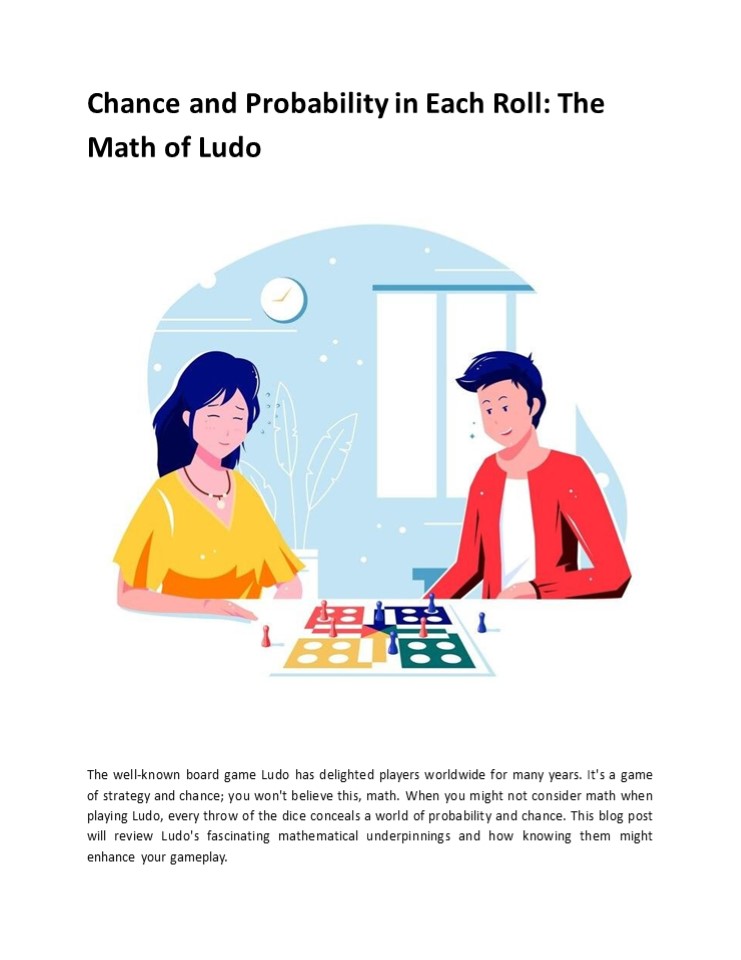
Title: Chance and Probability in Each Roll: The Math of Ludo
1
Chance and Probability in Each Roll The Math of
Ludo
The well-known board game Ludo has delighted
players worldwide for many years. It's a game of
strategy and chance you won't believe this,
math. When you might not consider math when
playing Ludo, every throw of the dice conceals a
world of probability and chance. This blog post
will review Ludo's fascinating mathematical
underpinnings and how knowing them might enhance
your gameplay.
2
- The Principles of Ludo
- Let's quickly go through the Ludo rules before we
begin the mathematics. Each player has four
tokens of their color, and the game is often
played on a square board with four colored
portions. Players take turns rolling a six-sided
die to move their tokens around the board to get
to their home base before their rivals. The
first player wins the game to take all of their
tokens home. - Let's now examine the integers that make up the
mathematical Ludo cube! Ludo game download from
BatBall11 to play and win real money games. - Ludo probability
- The probability is essential in Ludo, mainly when
using the online Ludo dice. Understanding the
likelihood associated with each roll in games
like win real money games from BatBall11 Ludo,
which uses a verified random and unpredictable
ludo roll dice, will help you make wise
judgments during the game. - The Chance of Rolling a Specific Number
- In Ludo, a typical six-sided die is used. There
is an equal chance that each die will land face
up. This indicates that the likelihood of
rolling any particular number on the dice, from 1
to 6, is 1/6 or roughly 16.67. - The Chance of Hitting the Token of Your Opponent
- There is a risk that if your token lands on an
opponent's token, it will be sent back to the
starting area. You must consider the number of
ways you can roll the required number to land on
your opponent's token to determine the
likelihood that this will occur. The possibility
of success increases with the number of options. - The 57-Move Challenge
- Fans of the BatBall11 frequently refer to the
57-move triumph as their most significant
accomplishment. In the BatBall11 Classic mode,
players must carefully plan their moves and rely
on a positive series of dice rolls because it
takes exactly 57 moves to move their token from
base to home and win. The mathematical formula is
as follows
3
- Chances of rolling a 1 or a 6
- It would be best if you rolled a 6 or a 1 to
relocate a token from the starting area. The
likelihood of rolling a 6 or a 1 on a fair
six-sided ludo dice is 1/6, or around 16.67 for
each. This phase is essential for every player
aiming for a 57-move victory. - Sixes in order
- Consecutive rolls of 6 are typically required to
win in 57 moves. Multiply the probabilities to
determine the likelihood of rolling two or more
6s in a row. It is (1/6) x (1/6) 1/36, or
around 2.78, for two consecutive 6s. If you
roll three consecutive 6s in the BatBall11 online
game, your mathematical ludo cube number will
become null, and you will lose a round. For three
consecutive 6s, it is (1/6) x (1/6) x (1/6)
1/216, or roughly 0.46. - Adding Dice Results
- Players must add up their dice results to get the
needed 57 moves. Numerous 6 and other number
combinations may be used in this. The probability
of making 57 moves must be calculated because it
depends on a series of dice rolls and the
player's Ludo strategy. - Planning and Making Decisions
- Your knowledge of the probability can influence
your tactical choices in Ludo. The following
crucial information - Leaving the Initial Location
- You can choose when to move a token out of the
beginning area by considering that you have a
1/6 chance of rolling a 6 or a 1, respectively.
Sometimes, waiting for a 6 or a 1 will improve
your chances of swiftly placing a token on the
board. - Blocking your adversaries
- Knowing the probabilities, you can carefully
position your tokens to obstruct your opponents.
A successful tactic can involve, for instance,
placing your tokens such that it is more
difficult for your opponents to access their
home base.
4
Risk and Reward You can make calculated choices
by knowing the odds of hitting an opponent's
token versus pushing your token nearer to your
home base. Taking a chance is worthwhile in some
situations, but staying safe is preferable in
others. Conclusion Ludo is both a game of
mathematics and a game of chance. You can gain an
advantage over your opponents by knowing the
probabilities and possibilities involved in each
dice roll. This will also help you play more
strategically. Ludo can be enjoyed more, and your
chances of winning increase if you have a basic
understanding of the mathematics involved,
whether you play leisurely with family and
friends or in more competitive situations.
Therefore, remember that there is more to Ludo
than meets the eye and that there is a world of
probability and chance just waiting to be
discovered the next time you roll the dice. Ludo
game download can make you win lakhs daily.
Recommended

