

Shoulder Fracture : Overview, Types and Implants PowerPoint PPT Presentation
Title: Shoulder Fracture : Overview, Types and Implants
1
Shoulder fractures occur when external force
fractures any of the three shoulder joint bones,
often due to accidents or sports injuries.
Recovery involves wearing a brace or sling for
weeks, possibly requiring surgery, with full
recovery taking a few months. What is a Shoulder
Fracture? A shoulder fracture is the result of
the three bones in the shoulder joint breaking,
commonly stemming from traumatic incidents such
as car accidents or sports injuries. This
breakage can necessitate the use of a brace or
sling for several weeks, and in more severe
cases, surgical intervention may be required for
bone repair. The recovery process is gradual,
spanning a few months, during which individuals
may experience limitations in shoulder mobility.
Rehabilitation efforts, including physiotherapy,
play a crucial role in restoring full
functionality to the shoulder and aiding in the
overall recovery from a shoulder fracture.
2
Types of Shoulder Fracture Shoulder fractures
manifest in various forms, each impacting
different components of the shoulder
complex Proximal Humerus Fracture A proximal
humerus fracture refers to a break in the upper
arm bone, specifically in the region close to the
shoulder joint. This type of fracture can occur
due to various traumatic events, such as falls or
direct impacts to the shoulder area. The proximal
humerus is a critical part of the shoulder, and
fractures in this area can affect shoulder
function and mobility. Clavicle (Collarbone)
Fracture A clavicle fracture involves a break
along the collarbone. The collarbone connects the
sternum (breastbone) to the shoulder blade,
providing structural support to the shoulder.
Fractures in the clavicle commonly result from
falls onto the shoulder, sports injuries, or
accidents. These fractures can cause pain,
swelling, and restricted shoulder
movement. Scapula Fracture A scapula fracture
occurs in the shoulder blade, which is the
triangular-shaped bone on the upper back.
Typically caused by high-impact injuries, such as
motor vehicle accidents or falls from a height,
scapula fractures can vary in severity. Fractures
in the scapula may impact the stability of the
shoulder joint and require careful evaluation for
proper management. Acromion Fracture An acromion
fracture affects the bony prominence at the top
of the shoulder known as the acromion process.
This type of fracture can result from direct
trauma or excessive force on the shoulder. The
acromion plays a crucial role in the functioning
of the shoulder, and fractures in this area may
influence shoulder movement and
stability. Glenoid Fracture A glenoid fracture
involves the socket part of the shoulder joint.
The glenoid is a shallow, concave surface where
the head of the humerus fits, forming the
shoulder joint. Fractures in the glenoid can
occur in association with other shoulder injuries
or as isolated incidents. These fractures may
impact the articulation and stability of the
shoulder joint, necessitating careful assessment
and appropriate treatment.
3
Symptoms of Shoulder Fractures Pain Persistent,
localized pain in the shoulder region,
intensified with movement or pressure on the
affected area. Swelling Swelling around the
injured shoulder, often accompanied by bruising
or discoloration. Limited Range of Motion
Difficulty or inability to move the shoulder
joint fully, experiencing stiffness or
resistance. Deformity Visible changes in the
shape or alignment of the shoulder, especially in
cases of severe fractures. Tenderness Increased
sensitivity and tenderness when touching or
applying pressure to the fractured
area. Weakness Weakened strength in the
affected arm, making it challenging to perform
routine activities. Instability A sense of
instability or looseness in the shoulder joint,
indicating potential ligament or socket
damage. Numbness or Tingling Numbness or
tingling sensations in the arm or hand,
suggesting nerve involvement. Di?culty with
Daily Activities Challenges in performing daily
tasks, such as reaching overhead or lifting
objects, due to pain and limited
mobility. Causes of Shoulder Fractures Falls
Accidental falls, especially onto an outstretched
arm or directly onto the shoulder, can lead to
shoulder fractures. Sports Injuries High-impact
sports or activities that involve forceful
collisions or falls increase the risk of shoulder
fractures. Motor Vehicle Accidents The impact
experienced during car accidents or motorcycle
crashes can cause significant trauma to the
shoulder, resulting in fractures.
4
Direct Trauma Sudden, forceful blows or impacts
to the shoulder region, whether from accidents,
collisions, or physical altercations, can lead to
fractures. Osteoporosis Weakening of bones due
to conditions like osteoporosis makes them more
susceptible to fractures, including those in the
shoulder. Repetitive Stress Overuse or
repetitive stress on the shoulder joint, common
in certain occupations or sports, can contribute
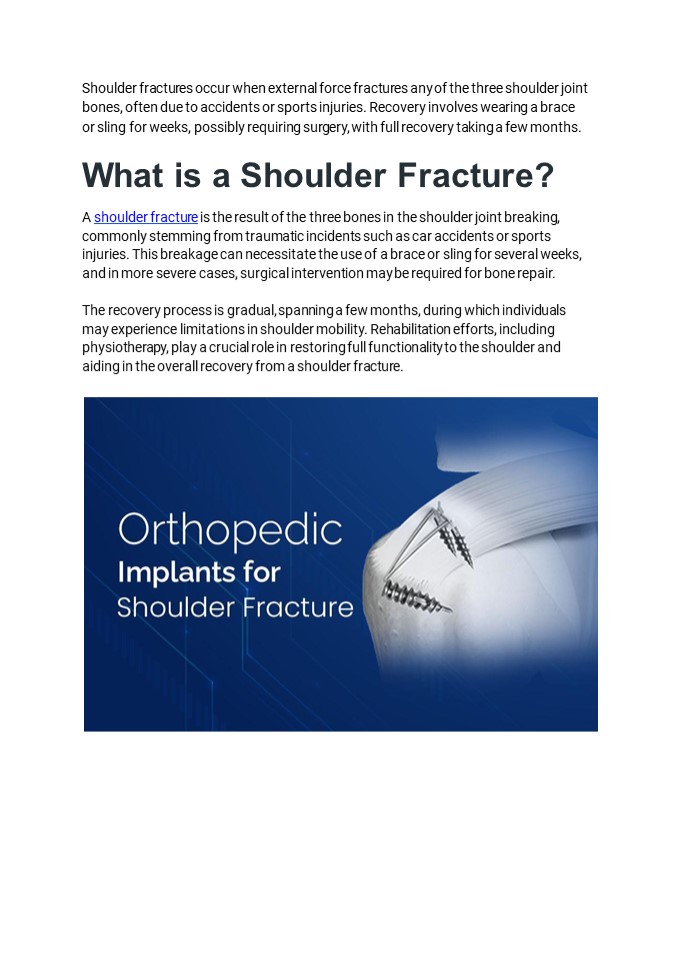
to stress fractures over time. Orthopedic
Implants Used In Shoulder Fractures Orthopedic
shoulder implants play a crucial role in
stabilizing and facilitating the healing of
shoulder fractures. Common types of shoulder
implants used in the treatment of fractures
include Plate and Screws Orthopedic plates
made of metal, often titanium or stainless steel,
are secured to the fractured bone with screws.
These provide stability during the healing
process. Intramedullary Rods Intramedullary
rods, inserted into the medullary canal of the
humerus, can provide internal support and
stability for certain types of shoulder fractures.
Suture Anchors Suture anchors are used to
repair soft tissues, such as tendons or
ligaments, to the bone. They are commonly
employed in cases where the shoulders supporting
structures are damaged. Prosthetic Implants In
severe cases, particularly if the shoulder joint
is affected, prosthetic implants may be used.
These can involve partial or total
shoulder replacement to restore joint
function. Locking Plates Locking plates have
screws that lock into the plate, providing added
stability. They are often used in cases where
conventional plates may not offer sufficient
support. Tension Bands Tension bands involve
the use of wires or cables to convert forces that
would normally cause a bone to separate into
compressive forces, aiding in fracture
stabilization.
5
Shoulder Fracture Implants by Zealmax Ortho
- Trauma Implants
- LCP Clavicle Hook Plate 3.5 mm Right
- The LCP Clavicle Hook Plate 3.5mm Right is
utilized for stabilizing lateral clavicle
fractures and acromioclavicular joint injuries,
ensuring optimal implant placement and surgical
efficacy. Its hook design features smooth edges,
a posterior hook offset, and three distinct
depths (12mm, 15mm, and 18mm). The rounded shaft - minimizes soft tissue irritation, enhancing
comfort. The plate, crafted from titanium and
stainless steel, includes holes for
intraoperative compression or angular stable
locking. With a shaft profile sporting a rounded
end and a 12 bend for simplified - implant placement, this plate prioritizes
precision and patient well-being in orthopedic
interventions. - LCP Superior Anterior Clavicle Plate
- The LCP Superior Anterior Clavicle Plate, an
anatomically precontoured implant, delivers
angular stability for lateral clavicle and
clavicle shaft fractures. Crafted in stainless
steel and titanium, it features a limited-contact
shaft profile, ideal for - fractures, malunions, nonunions, and osteotomies
of the clavicle. Recon plate segments allow
customizable contouring, while small diverging
locking screws enhance screw purchase. The
tapered plate tip enables percutaneous insertion,
minimizing soft tissue irritation. With a rounded
profile and flush-seated screw heads, its unique
twisted design combines superior and anterior
inferior plating - advantages. Directional availability for left and
right, offering versatility in orthopedic
applications. - Shoulder Arthroscopy
- 2.8mm Ligament Anchor, PEEK Knotless
- Zealmax Ortho currently offers the 2.8mm Ligament
Anchor, PEEK Knotless, - featuring a diameter of 2.8mm. This
non-absorbable suture anchor, crafted from PEEK
material, boasts a low coefficient of friction
and exceptional resistance to abrasion. The
anchor incorporates a built-in eyelet,
eliminating the necessity for - suture knots. This innovative technology not only
streamlines the surgical process, reducing time
requirements, but also mitigates potential tissue
irritation associated
6
with traditional knot stacks. Zealmax Orthos
advancement ensures efficiency and minimizes
postoperative complications, marking a
significant enhancement in ligament anchoring
procedures. 5.0mm Ligament Anchor, Titanium
Loaded with 2 PC Fiber The 5.0mm Ligament Anchor,
a titanium orthopedic implant, serves the purpose
of soft tissue fixation in orthopedic procedures.
Engineered with high-strength titanium, it
ensures durability and corrosion resistance.
Loaded with 2 PC Fiber, a polyethylene material,
this anchor provides enhanced strength and
stability. Its design features a low profile to
minimize tissue irritation, while self-drilling
and self-tapping capabilities facilitate easy
insertion. The anchor, with a diameter of 5.0mm,
is adaptable to various surgical techniques,
available in different lengths. Its applications
encompass ligament reconstruction, tendon repair,
fracture fixation, and joint stabilization,
making it a versatile solution in orthopedic
interventions. Conclusion As a prominent global
leader, Zealmax Ortho specializes in crafting
robust trauma fracture implants and shoulder
arthroscopy implants, renowned for their
strength. Our commitment lies in producing
top-tier, enduring, and minimally invasive
implants tailored for addressing shoulder
fractures. Zealmax Ortho strives for ongoing
innovation in soft tissue repair tools and
techniques, empowering surgeons with expanded
choices and enhanced versatility.
Recommended

