

Cleanroom Technology Market: Analyzing Efficacy in Key Sectors PowerPoint PPT Presentation
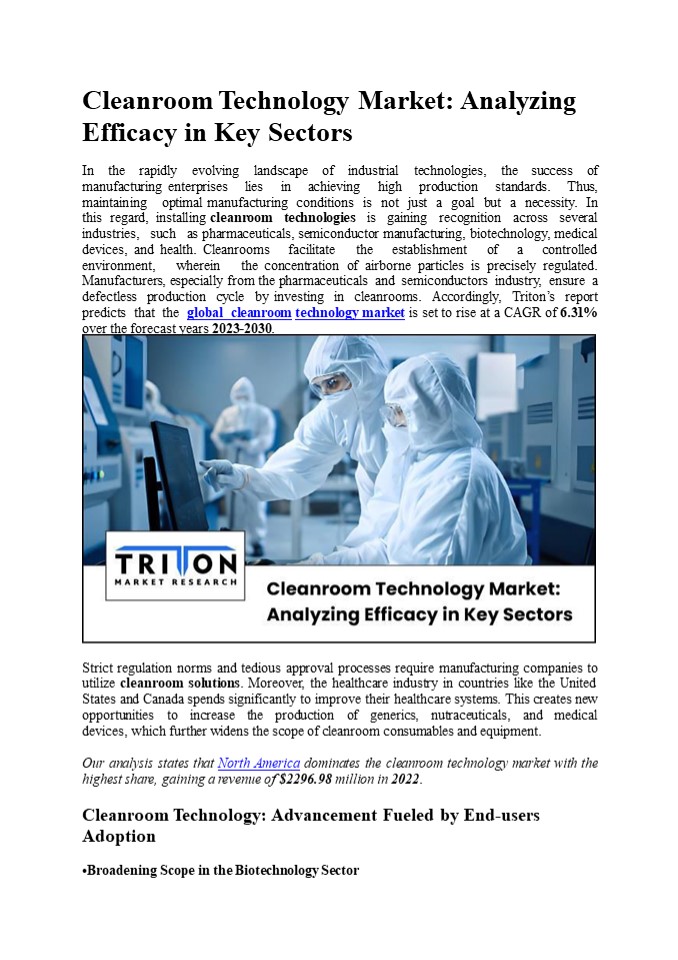
Title: Cleanroom Technology Market: Analyzing Efficacy in Key Sectors
1
Cleanroom Technology Market Analyzing Efficacy
in Key Sectors In the rapidly evolving
landscape of industrial technologies, the
success of manufacturing enterprises lies
in achieving high production standards.
Thus, maintaining optimal manufacturing
conditions is not just a goal but a
necessity. In this regard, installing
cleanroom technologies is gaining
recognition across several industries,
such as pharmaceuticals, semiconductor
manufacturing, biotechnology, medical devices,
and health. Cleanrooms facilitate the
establishment of a controlled
environment, wherein the concentration of
airborne particles is precisely regulated.
Manufacturers, especially from the
pharmaceuticals and semiconductors industry,
ensure a defectless production cycle by
investing in cleanrooms. Accordingly,
Tritons report predicts that the global
cleanroom technology market is set to rise at a
CAGR of 6.31 over the forecast years 2023-2030.
- Strict regulation norms and tedious approval
processes require manufacturing companies to
utilize cleanroom solutions. Moreover, the
healthcare industry in countries like the United
States and Canada spends significantly to improve
their healthcare systems. This creates new
opportunities to increase the production of
generics, nutraceuticals, and medical
devices, which further widens the scope of
cleanroom consumables and equipment. - Our analysis states that North America dominates
the cleanroom technology market with the highest
share, gaining a revenue of 2296.98 million in
2022. - Cleanroom Technology Advancement Fueled by
End-users Adoption - Broadening Scope in the Biotechnology Sector
2
- The biotechnology industry is witnessing
massive growth globally due to a rise in
demand for vaccines, gene therapies, and blood
products. While manufacturing these
biopharmaceuticals, it is critical to eliminate
the risk of contamination and maintain a required
level of cleanliness. Thus, deploying
cleanroom consumables like gloves,
disinfectants, and apparel, along with equipment
such as HVAC systems and fan filter units,
becomes imperative to avoid exposure to any
bacteria and foreign particles. - As per our research report, the growth in
the cleanroom technology market is expected
to be highest in the biotechnology sector
at a CAGR of 6.47 for the forecast period
2023-2030. - With further advancements in research, RD labs
and experimental units are keen on installing
cleanrooms. This creates avenues for the market
players to collaborate and bring new developments
within the industry. In March 2022, Biologics
Modular and MRC Cleanrooms formed an alliance
to offer advanced cleanroom wall system
technology to the United States. Our
analysis also states that North America
generated a revenue of 571.68 million in
2022 in the biotechnology sector. Thus,
cleanroom solutions within the biotech sector
will have a significant demand in the coming
years. - Evolving Utility in Semiconductor Manufacturing
- As the world moves ahead with digitization, the
demand for advanced electronics is surging. This
drives the need for semiconductors as a
foundational element in electronic devices.
Thus, in terms of end-users, semiconductor
manufacturing is anticipated to witness
substantial growth at a CAGR of 6.68
during 2023-2030. Since the process of
manufacturing involves building intricate
electric components at the nanoscale, any form of
contamination, even on a microscopic level,
disrupts the entire production process and
creates a defect in the functioning of the final
product. - Cleanroom technology, therefore, ensures the
reliability of semiconductors which are then
used across various applications within
automotive, consumer electronics, and medical
devices. Thus, the correlation between
semiconductor production and cleanroom
technologies becomes vital. - According to Intel, its semiconductor
factory has three levels that deploy
cleanroom technology - In the first level, the interstitial and fan
deck system keeps the air particle-free and
maintains precise temperature and humidity for
chip production. - The second level of cleanroom involves around
1200 factory tools that convert silicon wafers
into hundreds of computer chips. - The third level of clean sub-fabs consists of
transformers and large pipes that are used to
pump out waste and exhaust. - Additionally, countries like South Korea,
Taiwan, Japan, and China are the hubs of
semiconductor manufacturing with reputed
companies like Samsung Electronics, SK Hynix,
Sony, etc. Being dominant in producing
memory chips, South Korea is a major
semiconductor producer, with a global market
share of around 18.4 in 2020. This growth of
the semiconductor industry further leads to
the demand for cleanroom solutions within
3
South Korea and other Asian countries. Tritons
analysis estimates that Asia-Pacific is set to
emerge as the fastest-growing region, with
a CAGR of 7.65 during the forecast period
2023-2030. Novel Developments in Cleanroom
Environment With features like easy to
assemble, disassemble, and relocation,
customized cleanrooms have emerged as a flexible
alternative to conventional cleanrooms. Since the
benefits revolve around its rapid installation
and reconfiguration to cater to specific industry
needs, modular cleanrooms are now becoming
popular among new market players and
small-scale manufacturers. By installing
tailored cleanroom solutions, companies have
a competitive edge by maintaining
cleanliness standards. Besides,
international bodies such as the
International Confederation of Contamination
Control Societies are established to promote
contamination control efforts. This further
creates demand for innovative, cost-effective
cleanroom solutions, which further widens the
scope of the cleanroom technologies market.
FAQs Q1) What is the market share of cleanroom
technology globally? The market share of the
global cleanroom technology was 6691.30 in 2022
and is expected to reach 10956.39 by 2030. Q2)
What are the key equipment used inside a
cleanroom? The key equipment used are HVAC
systems, cleanroom air showers, desiccator
cabinets, high-efficiency filters, laminar
airflow systems, and vacuum systems.
Recommended

