

Solar Panel Recycling Market: The Sustainability Factor PowerPoint PPT Presentation
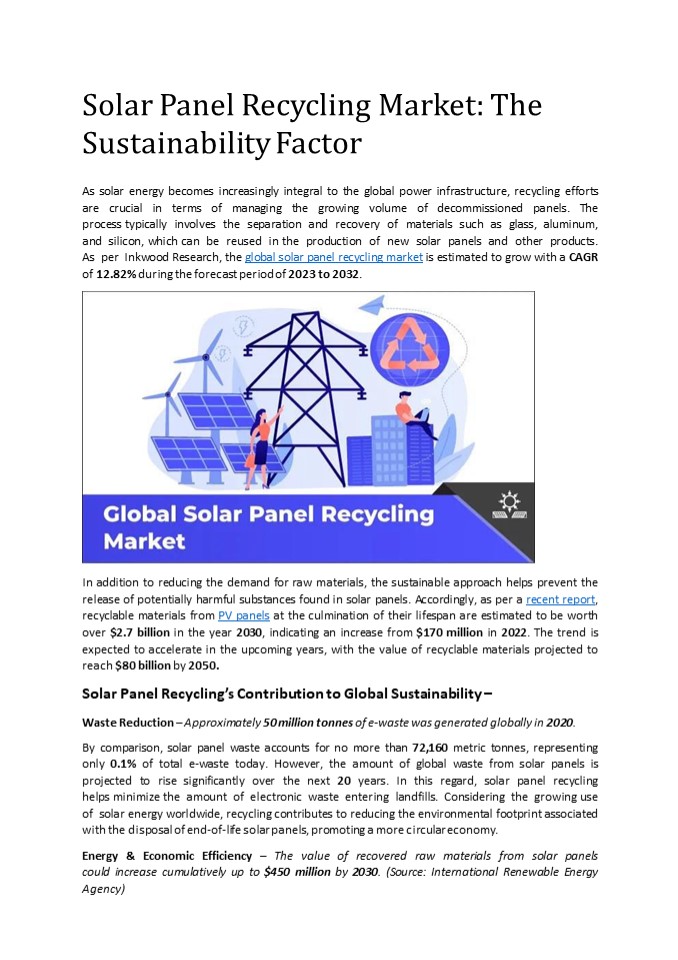
Title: Solar Panel Recycling Market: The Sustainability Factor
1
Solar Panel Recycling Market The Sustainability
Factor As solar energy becomes increasingly
integral to the global power infrastructure,
recycling efforts are crucial in terms of
managing the growing volume of
decommissioned panels. The process typically
involves the separation and recovery of
materials such as glass, aluminum, and
silicon, which can be reused in the
production of new solar panels and other
products. As per Inkwood Research, the global
solar panel recycling market is estimated to grow
with a CAGR of 12.82 during the forecast period
of 2023 to 2032.
In addition to reducing the demand for raw
materials, the sustainable approach helps prevent
the release of potentially harmful substances
found in solar panels. Accordingly, as per a
recent report, recyclable materials from PV
panels at the culmination of their lifespan are
estimated to be worth over 2.7 billion in the
year 2030, indicating an increase from 170
million in 2022. The trend is expected to
accelerate in the upcoming years, with the value
of recyclable materials projected to reach 80
billion by 2050. Solar Panel Recyclings
Contribution to Global Sustainability Waste
Reduction Approximately 50 million tonnes of
e-waste was generated globally in 2020. By
comparison, solar panel waste accounts for no
more than 72,160 metric tonnes, representing only
0.1 of total e-waste today. However, the
amount of global waste from solar panels
is projected to rise significantly over the
next 20 years. In this regard, solar panel
recycling helps minimize the amount of
electronic waste entering landfills.
Considering the growing use of solar energy
worldwide, recycling contributes to reducing the
environmental footprint associated with the
disposal of end-of-life solar panels, promoting a
more circular economy. Energy Economic
Efficiency The value of recovered raw
materials from solar panels could increase
cumulatively up to 450 million by 2030. (Source
International Renewable Energy Agency)
2
- Solar panel recycling embodies the principles of
a circular economy by closing the loop on the
life cycle of solar panels. Instead of following
a linear take-make-dispose model, recycling
encourages the reuse of materials, fostering
sustainability by extending the lifespan and
value of resources. - Moreover, as the use of solar energy continues to
grow, recycling ensures that the environmental
benefits of solar power are not compromised by
the negative impacts of improper disposal. This
contributes to the overall sustainability of the
renewable energy sector. - Environmental Protection Recycling prevents
potentially hazardous materials present in
solar panels, such as cadmium and lead, from
entering the environment - This protects ecosystems and human health,
aligning with global sustainability goals
related to environmental conservation and the
reduction of toxic substances. Accordingly,
research has consistently demonstrated the
importance of recycling cadmium telluride
(CdTe) thin-film solar panels, which contain
cadmium. Improper disposal of CdTe panels could
potentially contribute to cadmium pollution. In
addition to preventing the introduction of
cadmium into the environment, recycling these
panels also conserves valuable materials for
future use. - Solar Panel Recycling Market Looking Ahead
- Recycling is the most sustainable solution in
which solar panels can be handled at the end of
their useful life, not only from an
environmental and social impact perspective
but also in terms of resource and economic
efficiency. The recovered materials can serve in
the production of new solar panels or be sold
into global commodity markets, hence
increasing the security of future raw
material supply. Hence, this aspect is set to
play a pivotal role in boosting the growth of the
global solar panel recycling market in the
upcoming years. - Frequently Asked Questions (FAQs)
- How are solar panels recycled?
- A The recycling process typically involves
several steps, including the removal of the
panels frame, the separation of different
materials through mechanical or thermal
processes, and the recovery of valuable
components like silicon. The goal is to
maximize the reuse of materials and minimize
waste. - How often do solar panels need to be replaced?
- A Solar panels typically have a lifespan of
25-30 years. Recycling should be considered when
panels reach the end of their life cycle or if
they are damaged beyond repair.
Recommended

