

Choosing the Right Laboratory Glassware for Your Experiment PowerPoint PPT Presentation
Title: Choosing the Right Laboratory Glassware for Your Experiment
1
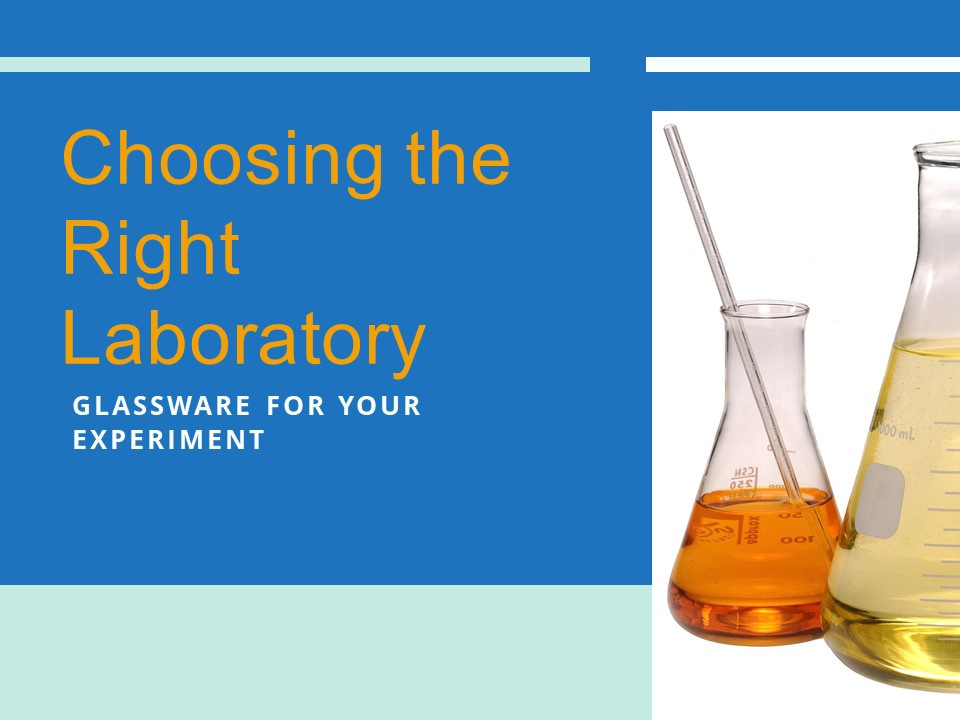
Choosing the Right Laboratory
GLASSWARE FOR YOUR EXPERIMENT
2
UNDERSTANDING THE EXPERIMENT REQUIREMENTS
Before delving into the vast array of laboratory
glassware options, its crucial to understand the
specific requirements of your experiment.
Consider the type of chemicals involved, the
temperature and pressure conditions, and the
reaction dynamics. This initial step ensures that
the chosen glassware aligns seamlessly with the
experiments demands.
3
THE DISTINCT TYPES OF LABORATORY GLASSWARE
1. Beakers Beakers are versatile vessels used
for mixing, stirring, and heating liquids. Their
cylindrical shape and flat bottom make them ideal
for a wide range of applications. When selecting
a beaker, consider the volume needed and the
material compatibility.
4
2. Flasks Flasks come in various shapes,
including round-bottom and flat-bottom.
Round-bottom flasks are suitable for reactions
involving gases, while flat-bottom flasks provide
stability during heating. Carefully match the
flask type with your experiments
requirements. 3. Test Tubes Test tubes are
essential for small-scale reactions and
observations. With a range of sizes available,
they are versatile tools for holding small
quantities of substances. Ensure the test tubes
chosen are heat-resistant and compatible with the
experiment.
5
4. Pipettes and Burettes Precision in liquid
measurement is crucial, and pipettes and burettes
play a vital role. Select the appropriate type
and size based on the volume accuracy required
for your experiment. 5. Petri Dishes For
cultivating microorganisms or observing small
samples, petri dishes are indispensable. Choose
sterile, high-quality dishes to maintain the
integrity of your experiments.
6
ENSURING SAFETY QUALITY ASSURANCE MATTERS
Laboratory safety is paramount, especially when
working with specialized experiments or research
projects. Always opt for laboratory glassware
that adheres to industry standards, with a focus
on customized glassware. Check for
certifications and ensure that the glassware can
withstand the specific conditions of your
experiment to prevent accidents and ensure
accurate results. This attention to detail in
selecting the appropriate customized glassware is
crucial for maintaining a secure and controlled
laboratory environment.
7
CLEANING AND MAINTENANCE TIPS
- To maximize the lifespan of your laboratory
glassware, proper cleaning and maintenance are
imperative. Follow these tips - Avoid Abrasive Cleaners Use non-abrasive
cleaners to prevent scratches and maintain the
glasswares transparency. - Regular Inspections Periodically inspect
glassware for any signs of wear, such as cracks
or chips, and replace damaged items immediately. - Proper Storage Store glassware in designated
areas to minimize the risk of breakage and
contamination.
8
Contact us
1 416-912-1530
usa_at_goelscientific.com
109 Boxcar Wy SE, Smyrna, GA 30080, United States
www.goelscientific.us
9
THANK YOU
www.goelscientific.us
Recommended

