

Biopesticides Market by Product: Latest Updates PowerPoint PPT Presentation
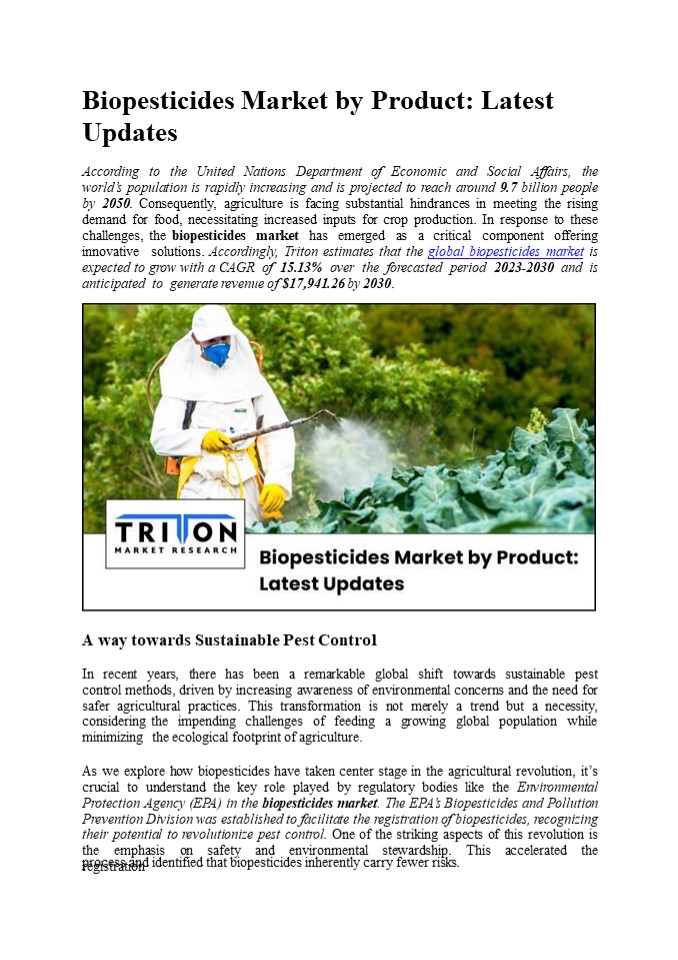
Title: Biopesticides Market by Product: Latest Updates
1
Biopesticides Market by Product Latest
Updates According to the United Nations
Department of Economic and Social Affairs,
the worlds population is rapidly increasing and
is projected to reach around 9.7 billion people
by 2050. Consequently, agriculture is facing
substantial hindrances in meeting the rising
demand for food, necessitating increased inputs
for crop production. In response to these
challenges, the biopesticides market has
emerged as a critical component offering
innovative solutions. Accordingly, Triton
estimates that the global biopesticides market is
expected to grow with a CAGR of 15.13 over
the forecasted period 2023-2030 and is
anticipated to generate revenue of 17,941.26
by 2030.
A way towards Sustainable Pest Control In
recent years, there has been a remarkable
global shift towards sustainable pest
control methods, driven by increasing awareness
of environmental concerns and the need for safer
agricultural practices. This transformation is
not merely a trend but a necessity, considering
the impending challenges of feeding a
growing global population while minimizing
the ecological footprint of agriculture. As we
explore how biopesticides have taken center stage
in the agricultural revolution, its crucial to
understand the key role played by
regulatory bodies like the Environmental
Protection Agency (EPA) in the biopesticides
market. The EPAs Biopesticides and Pollution
Prevention Division was established to facilitate
the registration of biopesticides, recognizing
their potential to revolutionize pest control.
One of the striking aspects of this revolution is
the emphasis on safety and environmental
stewardship. This accelerated the registration
process and identified that biopesticides
inherently carry fewer risks.
2
- Biopesticide Market by Product Overview
- Bioherbicide
- Extensive research and studies have linked
synthetic herbicides to various health
issues. For example, the International
Agency for Research on Cancer (IARC) has
classified some synthetic herbicides as
potentially carcinogenic to humans. This
classification has raised consumer concerns and
shifted towards safer alternatives. - Over the past few years, the sales of synthetic
herbicides have declined. In line with this, the
governments have introduced strict
regulations and awareness programs to
encourage organic farming. This has led to
a rise in the overall production of
bioherbicides globally. - For Instance, the United States Department
of Agriculture (USDA) established the
National Organic Program (NOP), which
regulates producing and labeling organic
agricultural products. The NOP prohibits
synthetic herbicides and other synthetic
substances in organic farming. - According to Tritons biopesticides market
report, the bioherbicide is expected to grow
with the fastest CAGR of 17.15 in the
product segment during the forecast period. - Bioinsecticide
- Biopesticides have been pivotal in
safeguarding crops, elevating their quality,
and enhancing productivity throughout
agricultural development. These formulations,
harnessed from naturally occurring compounds,
orchestrate pest management through non-toxic and
environmentally friendly mechanisms. - Within biopesticides, the bacterium Bacillus
thuringiensis reigns supreme as the most widely
utilized bioinsecticide. Its versatility
extends to organic and conventional farming.
Notably, Bt products have become the second
most widely employed insecticides globally,
with a staggering 32,000 tons sold in 2017. - In the product category, bioinsecticide holds the
dominant share in the biopesticides market.
the utilization of biopesticides. To
illustrate, the Indian Council of
Agricultural Research
3
(ICAR) has led by establishing the National
Bureau of Agriculturally Important Insects
(NBAII). This institution is dedicated to
developing eco-friendly pest management
strategies aligning with sustainable agriculture
principles. Similarly, the United States
Environmental Protection Agency (EPA) has
instituted the Biopesticides Registration Action
Document (BRAD) program, which plays a pivotal
role in fostering the adoption of biopesticides.
This program serves as a guiding force in
registering and utilizing biopesticides,
ensuring their safe and efficient
integration into agricultural practices. The
prospects for the biopesticides market are
exceptionally promising. Extensive research has
demonstrated its potential to deliver
agricultural productivity on par with
chemical pesticides. Also, with the growing
awareness of the adverse impacts of synthetic
pesticides, the studied market is poised to
experience sustained growth. FAQ Q1 How do
North America and Asia-Pacific influence the
global market dynamics? A In 2022, North
America held the top position worldwide in
the biopesticides market, boasting the
highest revenue share. Conversely, the
Asia-Pacific region is anticipated to exhibit
the fastest growth between 2023 and 2030. Q2
Which are the segments covered in the market
report? A Formulation, product, application,
mode of application, and ingredient. Q3 What
factors drive the biopesticides market? A The
rising population and consumer inclination
towards organic farming drive the
biopesticides market globally.
Recommended

