

The E-Learning Market: Shaping Education in the Digital Age PowerPoint PPT Presentation
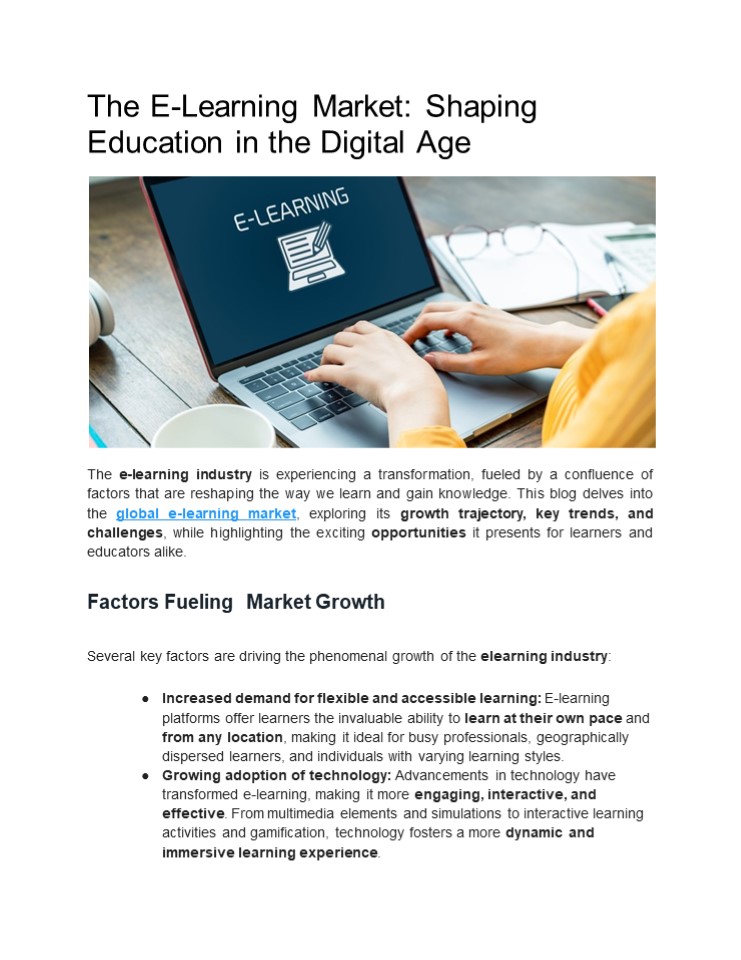
Title: The E-Learning Market: Shaping Education in the Digital Age
1
The E-Learning Market Shaping Education in the
Digital Age
- The e-learning industry is experiencing a
transformation, fueled by a confluence of
factors that are reshaping the way we learn and
gain knowledge. This blog delves into the global
e-learning market, exploring its growth
trajectory, key trends, and challenges, while
highlighting the exciting opportunities it
presents for learners and educators alike. - Factors Fueling Market Growth
- Several key factors are driving the phenomenal
growth of the elearning industry - Increased demand for flexible and accessible
learning E-learning platforms offer learners
the invaluable ability to learn at their own pace
and from any location, making it ideal for busy
professionals, geographically dispersed
learners, and individuals with varying learning
styles. - Growing adoption of technology Advancements in
technology have transformed e-learning, making
it more engaging, interactive, and effective.
From multimedia elements and simulations to
interactive learning activities and
gamification, technology fosters a more dynamic
and immersive learning experience.
2
- Shift towards remote work and learning The
COVID-19 pandemic has acted as a catalyst,
accelerating the adoption of online learning
solutions. As remote work and blended learning
models become - increasingly prevalent, e-learning platforms are
well-positioned to meet the evolving needs of
learners and educational institutions alike. - Market Size and Growth Trajectory
- The global e-learning market is projected to
reach a staggering USD 371.19 billion by 2025,
according to MarketsandMarkets, with a
significant CAGR of 12.7. This remarkable
growth trajectory underscores the immense
potential of this dynamic market to reshape the
future of the education market. - Segmentation and Models
- The market can be segmented by learning delivery
format and learning platform - By Learning Delivery Format
- Synchronous learning This format involves
real-time interaction between learners and
instructors, often through webinars or live
online classes. This allows for immediate
feedback and fosters a collaborative learning
environment. - Asynchronous learning This format enables
learners to progress at their own pace, offering
pre-recorded lectures, self-paced modules, and
downloadable materials. It provides flexibility
and caters to diverse - learning styles.
- Blended learning This approach combines online
and offline elements, offering a hybrid learning
experience. It leverages the interactive aspects
of in-person learning with the convenience and
accessibility of online resources. - By Learning Platform
3
- Learning Management Systems (LMS) These
platforms provide a central hub for managing and
delivering online courses, including features for
content management, learner progress tracking,
and communication tools. - Massive Open Online Courses (MOOCs) MOOCs offer
free or low-cost online courses from leading
universities and institutions, providing
widespread access to high-quality education for a
global audience. - Microlearning platforms These platforms deliver
bite-sized learning - modules that are concise, focused, and easily
digestible. They cater to short attention spans
and are ideal for quick knowledge acquisition and
skill development. - To Know More Visit E-Learning Market Insights
Global and Indian Scenario - Shaping the Future Emerging Trends
- Several key trends are shaping the future of the
e-learning market - Microlearning Breaking down learning content
into bite-sized modules has emerged as a popular
trend, promoting increased engagement and
knowledge retention. Microlearning caters to
short attention spans and allows learners to
acquire knowledge in manageable chunks. - Gamification The incorporation of game-like
elements, such as points, badges, and
leaderboards, is making learning more engaging
and interactive. This approach motivates
learners, enhances knowledge retention, and
fosters a sense of accomplishment. - Mobile learning The rise of smartphones and
tablets has facilitated the delivery of learning
content directly to learners pockets. Mobile
learning platforms enable accessible and
convenient learning, allowing individuals to
learn on the go and according to their schedules. - Focus on personalized learning E-learning
platforms are increasingly utilizing data and
analytics to personalize learning pathways and
content for individual learners. This ensures a
more relevant and effective learning experience
that caters to diverse needs and learning styles. - The rise of artificial intelligence (AI) AI is
transforming e-learning by enabling adaptive
learning, content creation, and personalized
learning recommendations. AI can adapt course
content and difficulty based on - individual learner progress, create personalized
learning paths, and recommend relevant learning
materials.
4
Challenges and Opportunities in E-Learning
- While e-learning offers tremendous potential, it
also faces significant challenges - Ensuring learner engagement and motivation
Maintaining attention and motivation in a
self-paced learning environment can be
challenging. - E-learning platforms need to be designed with
engaging content, interactive activities, and
progress-tracking mechanisms to keep learners
motivated. - Accessibility and digital equity Addressing the
digital divide and ensuring that all learners
have access to technology and internet resources
is crucial. This requires affordable learning
platforms, - mobile-friendly content, and initiatives to
bridge the digital gap, especially in
underserved communities. - Data privacy concerns Protecting the privacy and
security of learner data is paramount.
E-learning platforms need to implement robust
security measures and adhere to data privacy
regulations to build trust and ensure learner
data protection.
5
- Opportunities for Growth and Transformation
- Despite the challenges, the online learning
market presents exciting opportunities - Expanding into new markets Emerging economies
with growing internet penetration and increasing
demand for upskilling and reskilling
opportunities present significant potential for
growth. E-learning platforms can cater to these
markets by offering localized content and
addressing specific needs. - Developing niche e-learning solutions Tailoring
e-learning solutions to specific industries,
skill sets, and learning styles can create new
market opportunities. By catering to niche
audiences with focused and relevant - learning content, e-learning companies can
establish themselves as valuable resources
within specific sectors. - Integration of emerging technologies The
integration of virtual reality (VR), augmented
reality (AR), and AI into e-learning platforms
can create immersive and personalized learning
experiences. VR and AR can create simulated
environments for practical learning, while AI can
personalize learning paths and offer real-time
feedback. - Conclusion
- The e-learning industry is poised for continued
growth and transformation. By embracing
innovation, addressing challenges, and
capitalizing on emerging opportunities,
e-learning companies can play a vital role in
making education and training more accessible,
engaging, and effective for learners worldwide.
This, in turn, can empower individuals to
acquire new skills, stay competitive in the
workforce, and contribute to a more informed and
adaptable society.
Recommended

