

Exploring the Potential of Hydrogen Technologies: A Clean Energy Revolution PowerPoint PPT Presentation
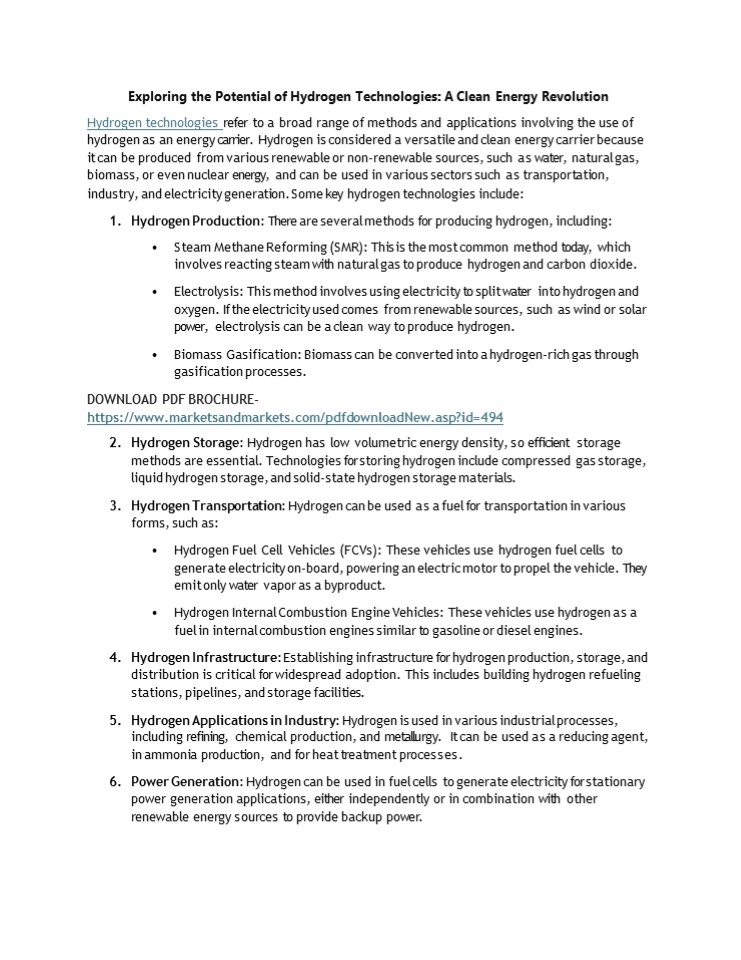
Title: Exploring the Potential of Hydrogen Technologies: A Clean Energy Revolution
1
- Exploring the Potential of Hydrogen Technologies
A Clean Energy Revolution - Hydrogen technologies refer to a broad range of
methods and applications involving the use of
hydrogen as an energy carrier. Hydrogen is
considered a versatile and clean energy carrier
because it can be produced from various
renewable or non-renewable sources, such as
water, natural gas, biomass, or even nuclear
energy, and can be used in various sectors such
as transportation, - industry, and electricity generation. Some key
hydrogen technologies include - Hydrogen Production There are several methods
for producing hydrogen, including - Steam Methane Reforming (SMR) This is the most
common method today, which involves reacting
steam with natural gas to produce hydrogen and
carbon dioxide. - Electrolysis This method involves using
electricity to split water into hydrogen and
oxygen. If the electricity used comes from
renewable sources, such as wind or solar power,
electrolysis can be a clean way to produce
hydrogen. - Biomass Gasification Biomass can be converted
into a hydrogen-rich gas through gasification
processes. - DOWNLOAD PDF BROCHURE-
- https//www.marketsandmarkets.com/pdfdownloadNew.a
sp?id494 - Hydrogen Storage Hydrogen has low volumetric
energy density, so efficient storage methods are
essential. Technologies for storing hydrogen
include compressed gas storage, liquid hydrogen
storage, and solid-state hydrogen storage
materials. - Hydrogen Transportation Hydrogen can be used as
a fuel for transportation in various forms, such
as - Hydrogen Fuel Cell Vehicles (FCVs) These
vehicles use hydrogen fuel cells to generate
electricity on-board, powering an electric motor
to propel the vehicle. They emit only water
vapor as a byproduct. - Hydrogen Internal Combustion Engine Vehicles
These vehicles use hydrogen as a fuel in
internal combustion engines similar to gasoline
or diesel engines. - Hydrogen Infrastructure Establishing
infrastructure for hydrogen production, storage,
and distribution is critical for widespread
adoption. This includes building hydrogen
refueling stations, pipelines, and storage
facilities. - Hydrogen Applications in Industry Hydrogen is
used in various industrial processes, - including refining, chemical production, and
metallurgy. It can be used as a reducing agent,
in ammonia production, and for heat treatment
processes. - Power Generation Hydrogen can be used in fuel
cells to generate electricity for stationary
power generation applications, either
independently or in combination with other
renewable energy sources to provide backup power.
2
7. Hydrogen for Energy Storage Hydrogen can also
be used for energy storage, where excess
electricity generated from renewable sources
during periods of low demand can be used to
produce hydrogen through electrolysis. The
hydrogen can then be stored and used to generate
electricity when demand is high. Overall,
hydrogen technologies have the potential to play
a significant role in the transition to a low-
carbon energy system by providing a clean and
versatile energy carrier that can help
decarbonize various sectors of the economy.
However, challenges such as cost, infrastructure
development, and scaling up production and
deployment remain to be addressed for widespread
adoption. READ MORE- https//www.marketsandmarkets
.com/industry-practice/hydrogen/hydrogen-
technologies-comparison
Recommended

