

AI in Epidemiology Market: Vaccine Development & Drug Discovery PowerPoint PPT Presentation
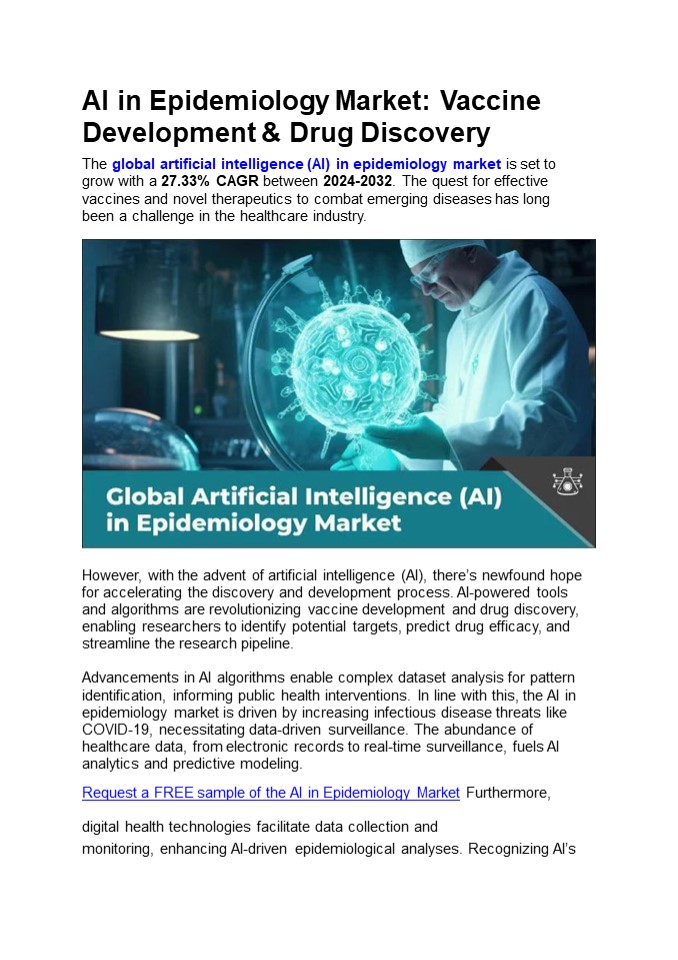
Title: AI in Epidemiology Market: Vaccine Development & Drug Discovery
1
AI in Epidemiology Market Vaccine Development
Drug Discovery The global artificial intelligence
(AI) in epidemiology market is set to grow with a
27.33 CAGR between 2024-2032. The quest for
effective vaccines and novel therapeutics to
combat emerging diseases has long been a
challenge in the healthcare industry.
However, with the advent of artificial
intelligence (AI), theres newfound hope for
accelerating the discovery and development
process. AI-powered tools and algorithms are
revolutionizing vaccine development and drug
discovery, enabling researchers to identify
potential targets, predict drug efficacy, and
streamline the research pipeline. Advancements
in AI algorithms enable complex dataset analysis
for pattern identification, informing public
health interventions. In line with this, the AI
in epidemiology market is driven by increasing
infectious disease threats like COVID-19,
necessitating data-driven surveillance. The
abundance of healthcare data, from electronic
records to real-time surveillance, fuels AI
analytics and predictive modeling. Request a FREE
sample of the AI in Epidemiology Market
Furthermore, digital health technologies
facilitate data collection and monitoring,
enhancing AI-driven epidemiological analyses.
Recognizing AIs
2
- potential, governments, healthcare organizations,
and research institutions are investing in AI
solutions, accelerating market growth. - In this blog, well explore how AI is
transforming the landscape - of vaccine development and drug discovery,
highlighting relevant ongoing projects and
breakthroughs shaping the future of healthcare - AI in Epidemiology Market The Role of AI in
Vaccine Development Vaccine development
traditionally involves a complex and
time-consuming process of identifying antigens,
designing vaccine candidates, and conducting
preclinical and clinical trials. However, AI is
revolutionizing this process by leveraging
data-driven approaches to identify potential
vaccine targets more rapidly and efficiently. - One key application of AI in vaccine development
is the prediction of antigenic epitopesspecific
regions of pathogens that trigger immune
responses. AI algorithms analyze vast amounts of
genomic data to predict and prioritize potential
epitopes, speeding up the identification of
vaccine candidates for emerging diseases such as
COVID-19, Ebola, and Zika. - Additionally, AI enables researchers to design
novel vaccine platforms, such as mRNA vaccines,
by optimizing antigen selection, delivery
systems, and adjuvants. This approach has been
instrumental in the rapid development of COVID-19
vaccines, demonstrating the potential of AI to
address global health challenges. - Breakthroughs Ongoing Projects in the AI in
Epidemiology Market Several groundbreaking
projects are harnessing the power of AI to
accelerate vaccine development and combat
infectious diseases - DeepMinds AlphaFold DeepMindsAlphaFold, an AI
system based on deep learning, made headlines
with its ability to predict protein structures
accurately. This breakthrough has significant
implications for vaccine design, as understanding
protein structures is crucial for identifying
potential vaccine targets and developing
effective therapeutics. - Vaccine Design by Insilico MedicineInsilico
Medicine, a biotechnology company, is using AI to
design vaccines and antiviral drugs for COVID-19
and other infectious diseases. Their AI-driven
drug discovery platform, based on generative
adversarial networks (GANs) and reinforcement
learning, accelerates the process of identifying
promising drug candidates. - EpiVaxs iVAX ToolkitEpiVax, a biotechnology
company specializing
in immunoinformatics, has developed the iVAX
toolkita suite of AI
3
- algorithms for vaccine design. The toolkit
utilizes machine learning and bioinformatics to
predict immunogenic epitopes and optimize vaccine
candidates for enhanced efficacy and safety. - Get CUSTOMIZED market insights delivered right to
your inbox! - A Closer Look at Artificial Intelligence in Drug
Discovery - In addition to vaccine development, AI is
revolutionizing the field of drug discovery by
accelerating the identification of novel
therapeutics for a wide range of diseases,
including cancer, neurodegenerative disorders,
and rare genetic conditions. - AI-driven drug discovery platforms leverage
machine learning, deep learning, and predictive
analytics to analyze large datasets and identify
potential drug targets, predict drug
interactions, and optimize drug candidates. By
combining data from genomics, proteomics, and
chemical libraries, AI algorithms can identify
promising drug candidates more efficiently than
traditional methods. - One of the key advantages of AI in drug discovery
is its ability to expedite the drug repurposing
process. By analyzing existing drug databases and
molecular structures, AI algorithms can identify
drugs that may be repurposed for new indications,
accelerating the time to market and reducing
development costs. - Several notable projects are leveraging AI to
drive innovation in drug discovery - Atomwises Drug Discovery PlatformAtomwise, a
biotechnology company, uses AI-driven virtual
screening to identify potential drug candidates
for a wide range of diseases. Their platform,
based on convolutional neural networks (CNNs) and
molecular docking simulations, accelerates the
drug discovery process by predicting the binding
affinity of small molecules to target proteins. - BenevolentAIs Knowledge GraphBenevolentAI, a
technology company, has developed a knowledge
graph. This AI-driven platform integrates
biomedical data from diverse sources to uncover
new insights and identify drug targets. Their
platform employs natural language processing
(NLP) and graph-based algorithms to extract
knowledge from scientific literature and
databases, enabling researchers to prioritize
drug candidates for further investigation. - Recursion Pharmaceuticals AI Drug Screening
Recursion Pharmaceuticalsutilizes AI-driven
phenotypic screening to identify potential drug
candidates for rare genetic diseases and other
disorders.
Their platform, powered by machine learning and
computer vision,
4
- analyses cellular images to identify compounds
with therapeutic potential, accelerating the drug
discovery process. - Stay up-to-date with whats trending in the
Global Artificial Intelligence (AI) in
Epidemiology Market - In conclusion, AI is revolutionizing vaccine
development and drug discovery, offering
unprecedented opportunities to address global
health challenges more rapidly and effectively
than ever before. By leveraging data-driven
approaches, advanced algorithms, and innovative
technologies, researchers and pharmaceutical
companies are poised to accelerate the pace of
innovation in healthcare and bring life-saving
treatments to patients worldwide. - As ongoing projects continue to yield
breakthroughs and advancements, the future of the
global artificial intelligence (AI) in
epidemiology market looks brighter than ever,
offering hope for a healthier and more resilient
world. - Cant find what youre looking for? Talk to an
expert NOW! FAQs - What role does AI play in epidemiology disease
treatment? - A AI technologies are revolutionizing disease
treatment in epidemiology by enabling
personalized medicine, drug discovery, and
treatment optimization. Machine learning
algorithms analyze patient data, genetic
information, and clinical outcomes to identify
effective treatment strategies and predict
disease progression, leading to improved patient
outcomes and tailored interventions. - How is AI used in epidemiology?
- A AI is used in epidemiology to analyze
large-scale datasets, identify disease patterns,
predict outbreaks, and assess intervention
strategies. Machine learning algorithms can
detect anomalies in health data, identify risk
factors, and model disease transmission dynamics,
enabling proactive public health measures and
targeted interventions.
Recommended

