

Global Surgical Robotics Market: Two Relevant AI Use Cases PowerPoint PPT Presentation
Title: Global Surgical Robotics Market: Two Relevant AI Use Cases
1
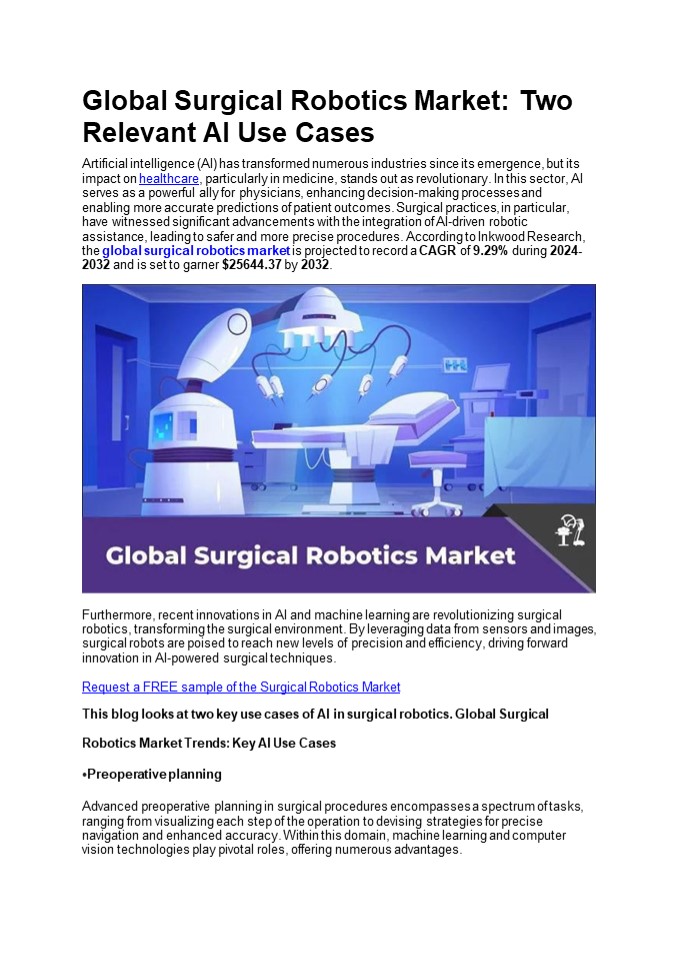
Global Surgical Robotics Market Two Relevant AI
Use Cases Artificial intelligence (AI) has
transformed numerous industries since its
emergence, but its impact on healthcare,
particularly in medicine, stands out as
revolutionary. In this sector, AI serves as a
powerful ally for physicians, enhancing
decision-making processes and enabling more
accurate predictions of patient outcomes.
Surgical practices, in particular, have witnessed
significant advancements with the integration of
AI-driven robotic assistance, leading to safer
and more precise procedures. According to Inkwood
Research, the global surgical robotics market is
projected to record a CAGR of 9.29 during
2024-2032 and is set to garner 25644.37 by 2032.
- Furthermore, recent innovations in AI and machine
learning are revolutionizing surgical robotics,
transforming the surgical environment. By
leveraging data from sensors and images, surgical
robots are poised to reach new levels of
precision and efficiency, driving forward
innovation in AI-powered surgical techniques. - Request a FREE sample of the Surgical Robotics
Market - This blog looks at two key use cases of AI in
surgical robotics. Global Surgical Robotics
Market Trends Key AI Use Cases - Preoperative planning
- Advanced preoperative planning in surgical
procedures encompasses a spectrum of tasks,
ranging from visualizing each step of the
operation to devising strategies for precise
navigation and enhanced accuracy. Within this
domain, machine learning and computer vision
technologies play pivotal roles, offering
numerous advantages.
2
- In contemporary surgical practices, machine
learning algorithms and computer vision systems
are increasingly utilized to swiftly analyze
diverse patient data, including medical records
and scans. These technologies facilitate the
creation of detailed 3D models of patients
anatomy by integrating information from various
imaging modalities such as CT scans, MRI scans,
and ultrasound scans. - Once generated, these 3D models serve as a
foundation for surgical planning. Through the
application of computer vision algorithms and
deep learning models, the visual data is
meticulously scrutinized to identify potential
risks and offer recommendations for each stage of
the surgery. Moreover, these algorithms enable
surgeons to precisely delineate and isolate
specific anatomical structures and regions of
interest within the 3D models, enhancing the
clarity of the surgical target area. - By segmenting crucial anatomical elements,
surgeons can explore different surgical
approaches and meticulously plan the trajectory
of instruments and incisions. This meticulous
planning process allows for the assessment of
potential risks by quantifying the proximity and
interaction between planned surgical paths and
adjacent structures. - In essence, the integration of machine learning
and computer vision technologies into
preoperative planning expedites the analysis of
patient data. At the same time, it empowers
surgeons with enhanced visualization and
strategic insights, ultimately contributing to
safer and more precise surgical outcomes. - Example Paradigm by Proprio Vision
- On 16th October 2023, Proprio announced the
first-in-human use of its groundbreaking surgical
technology platform, Paradigm. Dr. Richard J.
Bransford, MD, a renowned figure in the field of
spine surgery and education at the University of
Washington Harborview Medical Center,
successfully utilized Paradigm in its first human
application. - With a primary focus on addressing the 1.6
million spinal procedures conducted annually in
the United States, Paradigm represents a
pioneering solution. By integrating cutting-edge
light field imaging technology with artificial
intelligence (AI), the platform offers surgical
teams unparalleled 3D visualization of both
anatomical structures and the surgical field. - Utilizing an array of sophisticated sensors and
cameras, Paradigm captures high-definition
multimodal images in real-time during surgery.
These images are seamlessly integrated with
preoperative scans, providing surgeons with
dynamic, live mapping of the anatomy. This real-
time data empowers surgeons with invaluable
insights and advanced visualization tools,
revolutionizing the surgical experience. - Moreover, Paradigm significantly enhances
surgical navigation capabilities while minimizing
reliance on costly and potentially harmful
traditional scans that involve radiation
exposure. By collecting vast amounts of
preoperative and intraoperative data, Paradigm
contributes to informed decision-making,
ultimately enhancing surgical efficiency and
precision. - Says Dr. Bransford, The use of Paradigm in our
surgical environment is a game-changer
representing the future of spinal surgery. The
real-time 3D imagery allowed us to visualize the
patients anatomy in ways not previously
available to us. That will ultimately enable us
to drive better outcomes for patients. (Source)
3
- In precision-driven procedures, where even the
smallest error can have significant consequences,
the adoption of image-guided surgery has become
imperative for many healthcare facilities. This
cutting-edge technology relies on computer vision
to track instruments and recognize objects,
delivering real-time video data to AI systems.
These AI models play a crucial role in monitoring
surgeries and alerting medical professionals to
any irregularities, such as excessive bleeding or
tissue damage. - By harnessing AI assistance, surgical robots
enhance their capabilities to track and respond
to the movements of instruments with unparalleled
accuracy. Moreover, these systems excel in
identifying crucial anatomical structures and
abnormalities within the surgical field, offering
surgeons invaluable real-time guidance. - Example Medtronics Hugo Surgical Robot
- On 15th December 2022, Medtronic plc initiated a
significant milestone with the enrollment of the
first patient in the Expand URO U.S. clinical
trial for the Hugo robotic-assisted surgery
(RAS) system. The pioneering procedure, a
robotic-assisted prostatectomy, was skillfully
conducted by Dr. Michael R. Abern at Duke
University Hospital in Durham, N.C. - Urologic surgeries frequently benefit from the
precision and efficiency offered by surgical
robots, and the Hugo RAS system is poised to
elevate this standard. This innovative system is
specifically designed for urologic surgical
procedures, encompassing radical prostatectomy,
radical cystectomy, and nephrectomy (partial or
radical), with multiple sites across the U.S.
participating in the trial. - Moreover, the integration of the Hugo RAS system
with Touch Surgery - Enterprise presents a cutting-edge, digitally
enhanced surgical approach. This intelligent
system has already made waves internationally,
with successful utilization in hospitals spanning
three continents. Its versatility extends beyond
urology to encompass gynecology and general
surgery, demonstrating its broad applicability
and potential impact on surgical practices
worldwide. (Source) - Surgical Robotics Market Outlook Future of AI in
Robotic Surgeries - Surgical pathways, characterized by
evidence-based protocols and often bolstered by
technological advancements, offer concrete
measures for assessing performance, efficiency,
and patient outcomes. This foundation has
propelled the maturity of AI models and the
approval of software-as-medical devices by
regulators, positioning them at pivotal stages
within surgical processes. These innovations span
various stages of surgery, from screening and
diagnosis with radiomic devices to predictive
models leveraging comprehensive clinical data for
risk assessment. - Additionally, AI-assisted robotic surgical
systems, efficiency-optimizing models, and
decision support systems for postoperative care
contribute to the comprehensive evolution of
surgical workflows. The integration of AI is
poised to enhance efficiency and outcomes across
diverse surgical specialties, backed by evidence
of significant savings and improvements in
patient care. Such aspects will define the global
surgical robotics market growth trajectory in the
coming years.
Cant find what youre looking for? Talk to an
expert NOW!
4
- FAQs
- How does AI enhance the performance of surgical
robots? - A AI empowers surgical robots by enabling them
to analyze vast amounts of data collected from
sensors and images in real time. This analysis
enhances precision and decision-making during
procedures, leading to improved surgical outcomes
and reduced risk for patients. - What specific tasks can AI-powered surgical
robots perform? - A AI-equipped surgical robots can undertake a
wide range of tasks, including tissue
manipulation, suturing, and precise
incision-making. Additionally, they can assist
surgeons in complex procedures by providing
real-time feedback and enhancing surgical
dexterity.
Recommended

