

Exploring the Fundamentals of Medical Insurance Billing PowerPoint PPT Presentation
Title: Exploring the Fundamentals of Medical Insurance Billing
1
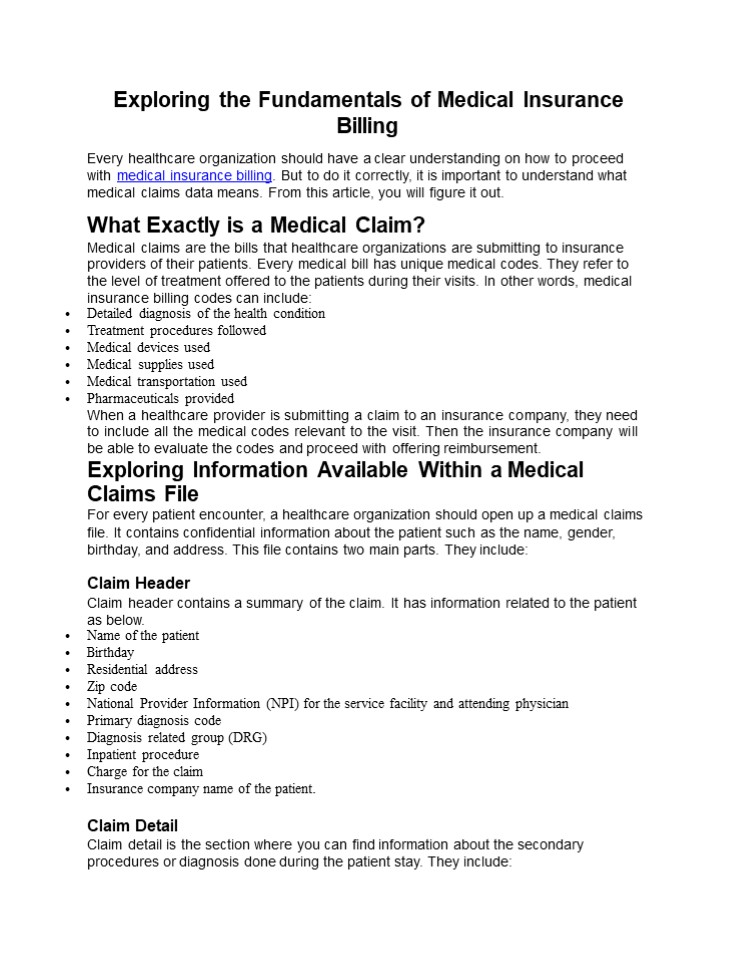
- Exploring the Fundamentals of Medical Insurance
Billing - Every healthcare organization should have a clear
understanding on how to proceed with medical
insurance billing. But to do it correctly, it is
important to understand what medical claims data
means. From this article, you will figure it out. - What Exactly is a Medical Claim?
- Medical claims are the bills that healthcare
organizations are submitting to insurance
providers of their patients. Every medical bill
has unique medical codes. They refer to the
level of treatment offered to the patients during
their visits. In other words, medical insurance
billing codes can include - Detailed diagnosis of the health condition
- Treatment procedures followed
- Medical devices used
- Medical supplies used
- Medical transportation used
- Pharmaceuticals provided
- When a healthcare provider is submitting a claim
to an insurance company, they need to include
all the medical codes relevant to the visit. Then
the insurance company will be able to evaluate
the codes and proceed with offering
reimbursement. - Exploring Information Available Within a Medical
Claims File - For every patient encounter, a healthcare
organization should open up a medical claims - file. It contains confidential information about
the patient such as the name, gender, birthday,
and address. This file contains two main parts.
They include - Claim Header
- Claim header contains a summary of the claim. It
has information related to the patient as below. - Name of the patient
- Birthday
2
- Procedure code
- Date of offering patient treatment
- National Drug Code (NDC)
- All corresponding diagnosis codes
- NPI number of the attending physician
- Overall charge for the service
- Learning About Medical Claims Clearinghouse
- Medical claims clearinghouse is the electronic
platform that facilitates payors and healthcare
providers. All the healthcare providers should go
ahead and submit medical insurance billing
information to a clearinghouse. Then the
clearinghouse will standardize and screen all
the medical claims. The payor will get
information only after that. - One of the main purposes of a clearinghouse is to
remove errors during medical coding. It can also
reduce the time that it will take for a patient
to receive reimbursement. - Moreover, it can be beneficial for the payors as
well. Thats because the payors can get - medical insurance billing records in a
standardized format. The payors will not have to
do any formatting on their end. They will be able
to go ahead with the reimbursements without an
issue. - Read Also-What Does a Medical Billing Expert Do?
- Understanding the Medical Insurance Billing
Process - The overall medical billing process is made out
of seven important steps. All these steps
capture the overall claims journey from the
moment a patient checks into a healthcare - facility, until they get their bill from the
insurance provider. Lets explore the steps in - detail.
3
- Medical coding is one of the most important
pieces of information you can find in a claims
request. All healthcare providers should
transcribe clinical documentation along with
their notes to standard medical codes. Below are
the most prominent medical coding systems
available as of now - Current Procedural Terminology (CPT)
- Diagnosis-related Group (DRG)
- International Classification of Diseases (ICD-10)
- Healthcare Common Procedure Coding System (HCPCS)
- National Drug Code (NDC)
- From these codes, it is possible to explain the
medical diagnosis, medical procedure, and even
prescriptions offered to the patient. In other
words, it clearly describes what the patients
overall condition is about. - Patient Charge Entry
- Charge entry refers to the final step before the
healthcare providers go ahead and submit their
claims. This is where they include all the
charges that they are expecting to receive. - Claims Transmission
- Claims transmission would happen once the claims
get transferred to the payor from the healthcare
provider. This is where the clearinghouse
involvement takes place as well. It will review
and reformat all information before submitting to
the payor. There are situations where the
healthcare providers submit their claims directly
to the payors as well. - Adjudication of Claims
- After the payor reviews the medical claim,
adjudication will happen. This is where the
payor can evaluate claim and decide whether it is
valid. The payor will also decide the amount to
reimburse during this stage. Once the claim is
accepted, the payor will go ahead and provide
reimbursement to the healthcare provider. - Along with that, the payor will also charge
remaining amount from the patient. In case the
patient doesnt have sufficient coverage, the
payor can deny the claim. This is where a
patient will have to go ahead and submit an
appeal.
Recommended

