

Speak Your Learner's Language: The Importance of Localization in eLearning PowerPoint PPT Presentation
Title: Speak Your Learner's Language: The Importance of Localization in eLearning
1
4/26/24, 302 PM
Localizing eLearning Key to Speaking Learner's
Language
Tina Jay Roy The practice of tailoring digital
learning content to fit the unique demands of
learners from various cultural and linguistic
backgrounds is known as localization in the
context of eLearning. It entails content
translation and adaptation to make it relevant to
the target audience's culture. It is essential
to take localization into account when developing
an eLearning program since it guarantees that
the learning material is efficient and
interesting for learners from around the globe.
Additionally, it aids in removing linguistic and
cultural obstacles to learning, opening
eLearning to a worldwide audience. Therefore, it
is emphasized in this study that localization is
essential for designing engaging eLearning
courses for learners from all over the world.
Localization enhances learning by tailoring
eLearning materials to the cultural and
linguistic requirements of learners.
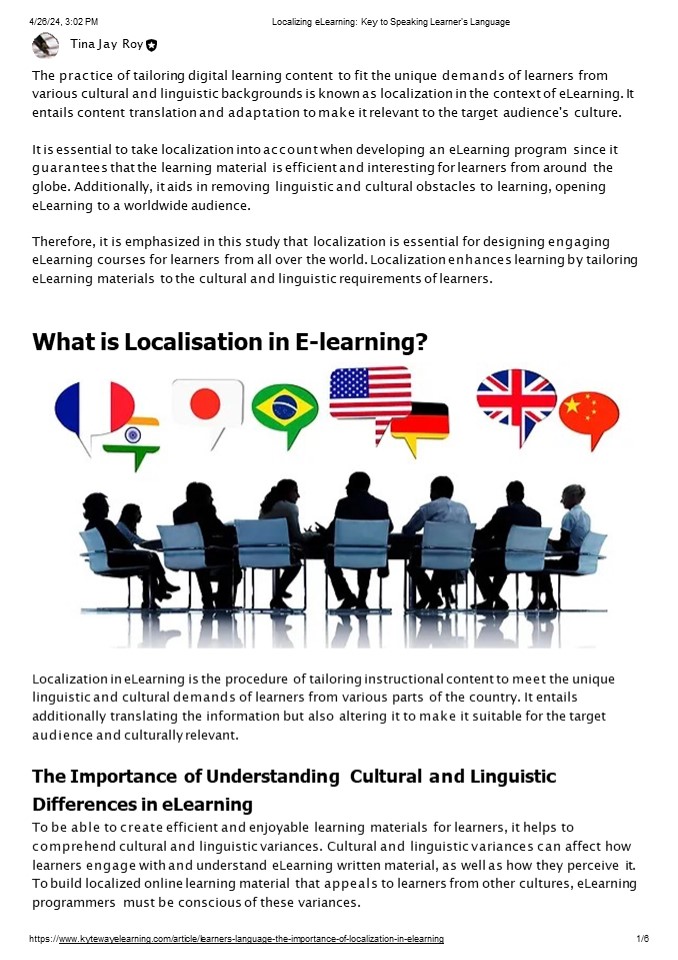
What is Localisation in E-learning?
Localization in eLearning is the procedure of
tailoring instructional content to meet the
unique linguistic and cultural demands of
learners from various parts of the country. It
entails additionally translating the information
but also altering it to make it suitable for the
target audience and culturally relevant. The
Importance of Understanding Cultural and
Linguistic Differences in eLearning To be able
to create efficient and enjoyable learning
materials for learners, it helps to comprehend
cultural and linguistic variances. Cultural and
linguistic variances can affect how learners
engage with and understand eLearning written
material, as well as how they perceive it. To
build localized online learning material that
appeals to learners from other cultures,
eLearning programmers must be conscious of these
variances.
https//www.kytewayelearning.com/article/learners-
language-the-importance-of-localization-in-elearni
ng
2
4/26/24, 302 PM
Localizing eLearning Key to Speaking Learner's
Language
How does Localization Go Beyond Translation in
eLearning? In eLearning, localization extends
beyond translation. Although translation is a
crucial component of localization, it is
insufficient to make eLearning content
entertaining and effective for learners from
other areas or nations. Additionally,
localization entails modifying the content to
make it culturally relevant. Examples of this
include the use of culturally suitable examples
and images, as well as the avoidance of cultural
prejudices that might not be appealing to
learners. Additionally, localization could
include modifying eLearning materials to conform
to regional or national cultural or legal
standards. Thus, localization is a thorough
process that entails tailoring eLearning content
to the unique linguistic and cultural
requirements of learners.
The Importance of Localisation in eLearning
Making eLearning Courses more Accessible to
Global Learners. In the context of eLearning,
localization means adjusting the course material
to meet the linguistic, cultural, and
technological demands of a particular area or
nation. Companies may reach a larger audience
and improve their courses' accessibility for
learners all through the world by localizing
their eLearning content. Additionally, it can
assist learners in overcoming language hurdles
and improving their comprehension of the
material. Offering translations of the course
enables learners to comprehend the material more
effectively, improving learning
outcomes. Enhancing Learner Engagement through
Personalized and Culturally Relevant
Content Organizations may develop individualized
and culturally appropriate content for their
learners thanks to localization in eLearning.
Learners are more able to connect with the
material. This may boost learner engagement and
enhance learning outcomes. Adding a personal
touch to the
https//www.kytewayelearning.com/article/learners-
language-the-importance-of-localization-in-elearni
ng
3
4/26/24, 302 PM Localizing eLearning Key to
Speaking Learner's Language learning process can
increase learners' motivation to learn by making
them feel important and linked to the course
material.
Addressing the Difficulties of Education in a
Global Setting
To overcome the difficulties of learning in a
global context, localization in eLearning is
essential. Regional differences in language
competency, technological access, and digital
literacy, for instance, may exist. Organizations
may guarantee that their eLearning programs are
usable and effective for learners from various
geographic and cultural backgrounds by localizing
their courses. Additionally, it can assist
businesses in adhering to local rules and
regulations, such as those governing data
protection and accessibility. Organizations may
increase their reach, engagement, and influence
in a global setting by tackling these
issues. Fostering Cultural Sensitivity and
Inclusion In an interconnected world, cultural
sensitivity and global awareness are essential
skills. Through the process of localization,
eLearning content can be made culturally
appropriate and sensitive, thereby promoting an
inclusive learning environment. This not only
enhances the learner's experience but also
fosters respect for diversity and encourages a
global outlook among learners. Ensuring Legal
and Regulatory Compliance Different regions have
specific legal and regulatory requirements that
eLearning content must comply with, especially
in fields like healthcare, finance, and law.
Localization ensures that the content not only
meets these local requirements but also aligns
with the professional practices
https//www.kytewayelearning.com/article/learners-
language-the-importance-of-localization-in-elearni
ng
4
4/26/24, 302 PM Localizing eLearning Key to
Speaking Learner's Language and standards of the
target audience. This is crucial for eLearning
programs that aim to provide certifications or
professional development opportunities.
Strategies for Effective Localisation in Elearning
Conducting a Needs Analysis and Identifying
Target Audiences A successful localization
process begins with a needs analysis to determine
the linguistic and cultural requirements of the
target audience. This entails investigating the
language and cultural variations that could
affect learners' understanding of and engagement
with the eLearning content. eLearning developers
may design content that is pertinent,
interesting, and useful for the learners by
having a clear grasp of the demands of the target
audience. Adapting Content to Cultural and
Linguistic Nuances Effective localization
depends on tailoring the eLearning material to
the target audience's cultural and linguistic
quirks. This entails not just translating the
text but also customizing it to make it relevant
to the learners' cultures. For instance,
eLearning creators can utilize examples that
reflect the target audience's culture, steer
clear of cultural prejudices, and use language
that appeals to them. Using Culturally Relevant
Examples and Visuals Another successful method
for localization in eLearning is the use of
examples and graphics that are culturally
appropriate. This makes the material more
relatable to the learners and makes it clear how
it relates to their background and culture. For
instance, eLearning creators can utilize
illustrations or graphics that are representative
of the learners' cultural norms and
practices. Creating Interactive and Engaging
Learning Experiences Effective localization in
eLearning requires the creation of interactive
and captivating learning experiences. Quizzes,
simulations, and games that are interactive in
nature can boost learner
https//www.kytewayelearning.com/article/learners-
language-the-importance-of-localization-in-elearni
ng
5
4/26/24, 302 PM Localizing eLearning Key to
Speaking Learner's Language motivation and
engagement. Including multimedia components like
videos and animations will also be
beneficial. Ensure Legal Compliance Understand
and comply with local laws and regulations
regarding data protection, accessibility
standards, and copyright laws. This is crucial to
avoid legal issues and ensure that your eLearning
content can be freely distributed and used
within the target region. Adjust for Local
Education Standards Be mindful of the educational
standards and requirements of the target region.
This might involve aligning the content with
local curricula, professional competencies, and
accreditation requirements to ensure the
eLearning course is both relevant and recognized.
Localization in E-learning Challenges
The Complexity of Translating Idiomatic
Expressions and Cultural Nuances The
translation of colloquial terms and cultural
flavors that might not have a straight equivalent
in the target language is one of the most
difficult aspects of localization in eLearning.
This calls for the experience of qualified
translators who can convey the desired meaning
and context, in addition, to accurately
translating the text. The Requirement for
Suitable and Accurate Translations Making sure
the translations are acceptable and accurate is
another difficulty with localization in
e-learning. Inaccurate translations can cause
misunderstandings and even offend the intended
audience. Working with qualified translators who
are acquainted with the cultural and linguistic
quirks of the intended audience is crucial to
ensure accurate translation.
https//www.kytewayelearning.com/article/learners-
language-the-importance-of-localization-in-elearni
ng
6
4/26/24, 302 PM
Localizing eLearning Key to Speaking Learner's
Language
The Cost and Time Required for Localization Parti
cularly when translating content into various
languages, localization may be a time- and
money-consuming process. Some eLearning
developers may find this to be a challenge since
they lack the funds or resources to devote to
localization. Summing Up Localization is crucial
for creating effective eLearning courses that
resonate globally. By customizing content for
specific cultural and linguistic audiences,
developers can improve accessibility,
engagement, and educational outcomes. This
strategy enhances inclusivity, making learning
materials relevant to a diverse range of learners
and expanding global reach. Prioritizing
localization and collaborating with experts can
significantly boost learner motivation and
success. Start integrating localization into
your eLearning projects now for better global
impact and subscribe to our newsletter for
further insights. Consider including
localization in your eLearning projects right
away! Collaboration with experienced translators
and cultural experts should be given top priority
to ensure that your target audience can
understand your material. You may raise learner
motivation, enhance learning outcomes, and
broaden your worldwide reach by investing in
localization. Utilise localization to your
advantage when developing effective online
courses for learners with varied cultural and
linguistic backgrounds. Act right away to improve
your eLearning materials through localization.
Go to Articles and sign up for our newsletter to
expand your understanding of the importance of
localization in eLearning courses.
https//www.kytewayelearning.com/article/learners-
language-the-importance-of-localization-in-elearni
ng
Recommended

