

The Market Trends and Segmentation Analysis of Indian Footwear Industry PowerPoint PPT Presentation
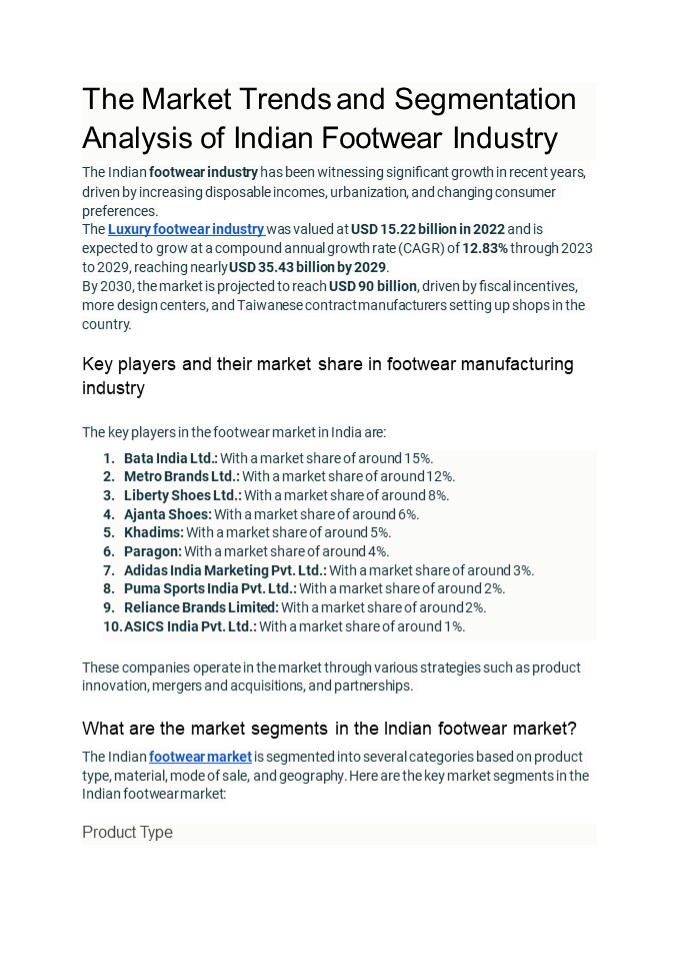
Title: The Market Trends and Segmentation Analysis of Indian Footwear Industry
1
The Market Trends and Segmentation Analysis of
Indian Footwear Industry
The Indian footwear industry has been witnessing
signi?cant growth in recent years,
driven by increasing disposable incomes,
urbanization, and changing consumer
preferences.
The Luxury footwear industry was valued at USD
15.22 billion in 2022 and is
expected to grow at a compound annual growth rate
(CAGR) of 12.83 through 2023
to 2029, reaching nearly USD 35.43 billion by
2029.
By 2030, the market is projected to reach USD 90
billion, driven by ?scal incentives,
more design centers, and Taiwanese contract
manufacturers setting up shops in the
country.
Key players and their market share in footwear
manufacturing industry
The key players in the footwear market in India
are
- Bata India Ltd. With a market share of around
15. - Metro Brands Ltd. With a market share of around
12. - Liberty Shoes Ltd. With a market share of around
8. - Ajanta Shoes With a market share of around 6.
- Khadims With a market share of around 5.
- Paragon With a market share of around 4.
- Adidas India Marketing Pvt. Ltd. With a market
share of around 3. - Puma Sports India Pvt. Ltd. With a market share
of around 2. - Reliance Brands Limited With a market share of
around 2. - ASICS India Pvt. Ltd. With a market share of
around 1.
These companies operate in the market through
various strategies such as product
innovation, mergers and acquisitions, and
partnerships.
What are the market segments in the Indian
footwear market?
The Indian footwear market is segmented into
several categories based on product
type, material, mode of sale, and geography. Here
are the key market segments in the
Indian footwear market
Product Type
2
- Casual Footwear This segment includes casual
shoes, sandals, and ?ip-?ops - that are designed for everyday wear.
- Mass Footwear This segment includes affordable
and mass-produced footwear that is widely
available in the market. - Active/Sport Footwear This segment includes
athletic shoes and sports footwear designed for
speci?c activities like running, basketball, or
tennis. - Leather Footwear This segment includes footwear
made from leather, which is considered a premium
material. - Non-Leather Footwear This segment includes
footwear made from materials other than leather,
such as synthetic materials or fabric.
Material
- Leather This segment includes footwear made from
leather, which is - considered a premium material.
- Non-Leather This segment includes footwear made
from materials other than leather, such as
synthetic materials or fabric.
Mode of Sale
- Retail Sales This segment includes footwear sold
through physical retail - stores.
- Online Sales This segment includes footwear sold
through e-commerce platforms and online
marketplaces.
Geography
- North America This segment includes footwear
sales in the United States - and Canada.
- Europe This segment includes footwear sales in
the European Union and - other European countries.
- Asia-Paci?c This segment includes footwear sales
in countries such as China, Japan, and South
Korea. - Latin America This segment includes footwear
sales in countries such as Brazil, Mexico, and
Argentina.
End User
- Women This segment includes footwear designed
for women, including high - heels, ?ats, and sandals.
- Men This segment includes footwear designed for
men, including dress shoes, casual shoes, and
athletic shoes. - Kids This segment includes footwear designed for
children, including character-licensed shoes and
casual shoes.
3
These market segments help to understand the
diverse preferences and needs of
consumers in the Indian footwear market.
How are the Indian Footwear market trends shaping
and Growth Opportunities?
Here are the key trends shaping the market and
growth opportunities Key Trends
- Sustainability The Indian footwear industry is
focusing on sustainability, with - brands using eco-friendly materials, reducing
waste, and implementing green manufacturing
processes. - E-commerce The rise of e-commerce has made
footwear more accessible, providing consumers
with a wide range of options to choose from. - Health and Fitness The growing focus on health
and ?tness has boosted the demand for athletic
and sports footwear. - Premium and Luxury The demand for premium and
luxury footwear is - increasing among a?uent consumers who seek
high-quality and fashionable products. - Ethnic and Traditional The demand for ethnic and
traditional footwear remains strong, re?ecting
India's rich cultural heritage.
Growth Opportunities
- Sports and Athleisure The sports and athleisure
segment is expanding - rapidly due to the rising popularity of ?tness
and wellness activities. - Children's Footwear The children's footwear
segment is growing, driven by increased
awareness of proper foot health and a wide range
of designs. - Online Sales The growth of e-commerce platforms
is making it easier for consumers to access a
diverse range of footwear, further driving market
expansion. - International Brands The entry of international
brands is contributing to market growth,
offering consumers a wider range of options. - Government Initiatives Government initiatives
like Make in India and the - Leather and Footwear Policy are expected to boost
production and exports, driving market growth.
Challenges
1. Competition from International Brands The
presence of international brands poses a
challenge to domestic players, as they offer
high-quality products at competitive prices.
4
- Counterfeit Products Counterfeit and low-quality
products ?ooding the - market pose a challenge to the growth of genuine
brands. - Infrastructure Limitations Inadequate logistics
and distribution networks, particularly in rural
areas, can impede the reach of footwear brands.
Conclusion Conclusion Conclusion
The Indian footwear market is experiencing rapid growth, driven by rising disposable The Indian footwear market is experiencing rapid growth, driven by rising disposable The Indian footwear market is experiencing rapid growth, driven by rising disposable
incomes, urbanization, and e-commerce. Key trends include sustainability, health and incomes, urbanization, and e-commerce. Key trends include sustainability, health and incomes, urbanization, and e-commerce. Key trends include sustainability, health and
?tness, and the demand for premium and ethnic footwear. To stay competitive,
brands should adapt to these trends and leverage growth opportunities in sports, brands should adapt to these trends and leverage growth opportunities in sports,
children's, and online footwear. For more detailed insights, readers are encouraged to children's, and online footwear. For more detailed insights, readers are encouraged to children's, and online footwear. For more detailed insights, readers are encouraged to
refer to comprehensive market research reports on the Indian footwear industry. refer to comprehensive market research reports on the Indian footwear industry.
Some FAQs Which segment is expected to grow the
fastest in the Indian footwear market?
Based on the sources provided, the sports and athleisure segment is expected to Based on the sources provided, the sports and athleisure segment is expected to Based on the sources provided, the sports and athleisure segment is expected to
grow the fastest in the Indian footwear market. This segment is expanding rapidly grow the fastest in the Indian footwear market. This segment is expanding rapidly grow the fastest in the Indian footwear market. This segment is expanding rapidly
due to the rising popularity of ?tness and wellness activities, with consumers due to the rising popularity of ?tness and wellness activities, with consumers
seeking comfortable yet stylish footwear that can be worn for exercise and casual seeking comfortable yet stylish footwear that can be worn for exercise and casual seeking comfortable yet stylish footwear that can be worn for exercise and casual
outings.
What factors are driving the popularity of
leather footwear in India?
The popularity of leather footwear in India is
driven by
- Increasing leather production.
- Bene?ts of leather footwear.
- Growing demand for fashionable footwear.
- Government initiatives.
- Growing demand for premium footwear.
- Increased focus on sustainability.
These factors contribute to the growth of the
leather footwear segment in India.
Recommended

