

Tech-Driven Solutions in the Global Workplace Wellness Market PowerPoint PPT Presentation
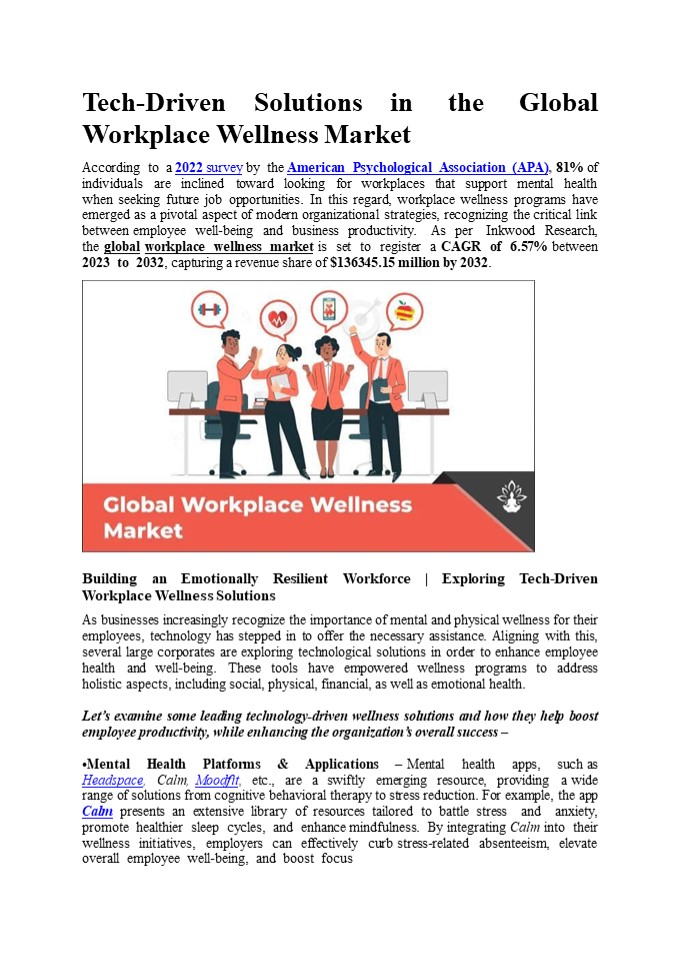
Title: Tech-Driven Solutions in the Global Workplace Wellness Market
1
Tech-Driven Solutions in the Global
Workplace Wellness Market According to a 2022
survey by the American Psychological
Association (APA), 81 of individuals are
inclined toward looking for workplaces that
support mental health when seeking future job
opportunities. In this regard, workplace wellness
programs have emerged as a pivotal aspect of
modern organizational strategies, recognizing the
critical link between employee well-being and
business productivity. As per Inkwood
Research, the global workplace wellness market
is set to register a CAGR of 6.57 between
2023 to 2032, capturing a revenue share of
136345.15 million by 2032.
- Building an Emotionally Resilient
Workforce Exploring Tech-Driven Workplace
Wellness Solutions - As businesses increasingly recognize the
importance of mental and physical wellness for
their employees, technology has stepped in to
offer the necessary assistance. Aligning with
this, several large corporates are exploring
technological solutions in order to enhance
employee health and well-being. These tools
have empowered wellness programs to address
holistic aspects, including social, physical,
financial, as well as emotional health. - Lets examine some leading technology-driven
wellness solutions and how they help boost
employee productivity, while enhancing the
organizations overall success - Mental Health Platforms
Applications Mental health apps,
such as Headspace, Calm, Moodfit, etc., are a
swiftly emerging resource, providing a wide
range of solutions from cognitive behavioral
therapy to stress reduction. For example, the app
Calm presents an extensive library of resources
tailored to battle stress and anxiety, promote
healthier sleep cycles, and enhance
mindfulness. By integrating Calm into their
wellness initiatives, employers can
effectively curb stress-related absenteeism,
elevate overall employee well-being, and
boost focus
2
- and productivity, leading to a happier and
more satisfied workforce.Several leading
players in the global workplace wellness
market are also contributing to the
development and further implementation of
mental health and mindfulness apps. For
instance, the Virgin Pulse (United States)
platform interfaces with a variety of
third-party health as well as fitness
gadgets and apps, allowing employees to
effortlessly sync their data. - Virtual Reality (VR) Over the years,
virtual Reality (VR) has become
increasingly popular, mainly owing to the
availability of affordable headsets that deliver
immersive, high quality experiences. In the
workplace setting, VR has demonstrated
significant promise in minimizing stress and
promoting relaxation. According to a study
published in 2022, Virtual Reality as a
Tool to Promote Wellbeing in the Workplace,
participants reported significantly increased
feelings of happiness and relaxation, and
decreased feelings of sadness, anger and anxiety
following a VR experience.A study by employee
communication and engagement technology company
Dynamic Signal found that around 80 of
workers in the United States were stressed and
prepared to quit because of ineffective workplace
communication. Accordingly, the incorporation
of virtual reality into employee wellness and
training programs can result in several benefits,
including improved engagement and
communication, a more inclusive work
environment, better mental and physical
well-being, and effective collaboration. - Artificial Intelligence (AI) Machine
Learning (ML) The World Health Organization
(WHO) reports that lost productivity due to
anxiety and depression equates to 1 trillion in
revenues, globally. Meanwhile, 94 of HR
professionals agree that providing mental
health resources can enhance the overall
health of employees. Tech innovations, in
this regard, have the potential to
revolutionize workplace wellness programs to
effectively address these problems while
AI- powered chatbots answer employee queries,
offer personalized recommendations, and provide
247 support, ML algorithms can help analyze
employee data. This, in turn, helps identify
patterns and make proactive suggestions for
enhancing well- being on the basis of individual
requirements.As per a 2022 study that examined
the impact of AI on manufacturing workers in
China, AI can significantly boost mental health
by improving the workplace. Improving the work
environment is a powerful way to increase the
positive effects of AI on workers mental
health, the study concluded. - Likewise, machine learning can also help
curate customized plans for each employee,
considering elements such as gender, health
conditions, age, and lifestyle. This
personalized approach ensures that the workforce
is more engaged with the program, moving closer
to achieving the organizations wellness goals. - Workplace Wellness Market The Synergy
Between Mental Health Technology - As demonstrated above, technology-driven
solutions such as AI and machine learning,
virtual reality (VR), mental health and wellness
applications, etc., can significantly boost
employee wellness initiatives. Moreover, they can
also help facilitate seamless collaboration
between
3
- well-being platforms and healthcare
providers. This effective integration allows
for better coordination of care, sharing of
health data, and personalized support for
employees. - Furthermore, collaborations with healthcare
providers can facilitate targeted
interventions, specialized resources, and
preventive care programs that aim to address
employees specific health requirements. With
corporate well-being needs anticipated to
grow worldwide, the demand for
technology-driven wellness solutions is set to
further increase, thus boosting the global
workplace wellness market growth during the
upcoming years. - FAQs
- What is the role of
technology in workplace wellness? A
Technology has transformed the organizational
wellness sphere by offering online platforms,
mobile apps, and wearables that enable easy
access to resources, track progress,
and provide personalized health
insights. - How can small organizations implement
workplace wellness initiatives? A Small
businesses can begin implementation by assessing
employee needs, setting realistic goals,
offering simple wellness activities,
leveraging technology, and seeking
partnerships with local health providers.
Moreover, the small organizations segment, under
the end-user category, is set to grow with the
fastest CAGR of 7.45 between 2023 to 2032.
Recommended

