

Navigating the Complex GMO Space: Agricultural Biotechnology Market PowerPoint PPT Presentation
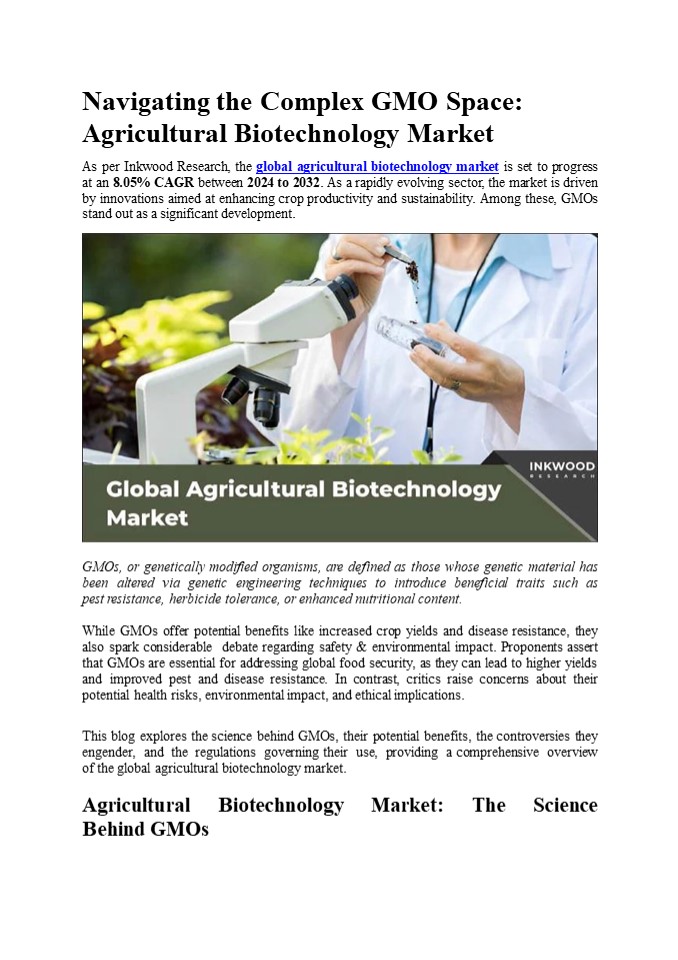
Title: Navigating the Complex GMO Space: Agricultural Biotechnology Market
1
Navigating the Complex GMO Space Agricultural
Biotechnology Market As per Inkwood Research, the
global agricultural biotechnology market is set
to progress at an 8.05 CAGR between 2024 to
2032. As a rapidly evolving sector, the market is
driven by innovations aimed at enhancing crop
productivity and sustainability. Among these,
GMOs stand out as a significant development.
GMOs, or genetically modified organisms, are
defined as those whose genetic material has been
altered via genetic engineering techniques
to introduce beneficial traits such as pest
resistance, herbicide tolerance, or enhanced
nutritional content. While GMOs offer potential
benefits like increased crop yields and disease
resistance, they also spark considerable debate
regarding safety environmental impact.
Proponents assert that GMOs are essential for
addressing global food security, as they can lead
to higher yields and improved pest and
disease resistance. In contrast, critics
raise concerns about their potential health
risks, environmental impact, and ethical
implications. This blog explores the science
behind GMOs, their potential benefits, the
controversies they engender, and the
regulations governing their use, providing a
comprehensive overview of the global
agricultural biotechnology market. Agricultural
Biotechnology Market The Science Behind GMOs
2
- At the core of GMOs is the science of
genetic engineering, which allows for the
precise modification of an organisms DNA.
This technology enables scientists to
introduce new traits that can help crops
withstand adverse conditions, such as drought,
pests, and diseases. - For instance, Bt corn, a genetically
modified crop, produces a protein
derived from the bacterium Bacillus
thuringiensis, which is toxic to specific
insects but harmless to humans. This
innovation has significantly reduced the need for
chemical pesticides, thereby lowering production
costs and potentially reducing environmental
pollution. - The process of creating GMOs involves isolating a
specific gene that encodes a desired trait,
inserting it into the DNA of the target organism,
and ensuring that the new gene functions
correctly within the organisms genetic
framework. This precise manipulation allows for
the development of crops with enhanced
characteristics, such as improved resistance
to pests, diseases, and environmental stresses,
as well as increased nutritional value. - Exploring the Intricate Agri-Biotech Industry
Potential Benefits of GMOs One of the primary
arguments in favor of GMOs is their
ability to increase agricultural productivity.
By enhancing crop yields, GMOs can help
meet the growing global food demand,
especially in regions facing food security
challenges. For example, a study conducted
by scientists at Arkansas State
University and their partners revealed
that genetically modified (GM) white maize
exhibited a greater increase in yields in South
Africa compared to GM yellow maize and
conventional hybrid maize. - Results showed that GM white maize had the
highest yield increase of 0.60 Mt ha-1.
Additionally, GMOs can be engineered to improve
nutritional content, such as Golden Rice, which
is enriched with vitamin A and aims to
combat vitamin A deficiency in developing
countries, potentially saving millions of lives.
Here are some specific benefits of GMOs - Increased Crop Yields Higher crop yields
are crucial for feeding a growing global
population. GMOs such as Bt corn and Bt
cotton have been engineered to produce their
own insecticides, which reduce crop losses due to
pests. In India, the adoption of Bt cotton
has led to a significant decrease in
pesticide use and an increase in crop
productivity, benefiting both farmers and
the environment. A study published in the
Proceedings of the National Academy of
Sciences (PNAS) found that Bt cotton
adoption in India resulted in yield
increases of up to 24 due to reduced pest damag
e. - Improved Nutritional Content GMOs can also
be tailored to address specific nutritional
deficiencies. Golden Rice, for example, is
engineered to produce beta- carotene, a precursor
of vitamin A. This biofortified crop aims to
combat vitamin A deficiency, which is a leading
cause of blindness and mortality among children
in developing countries. By enhancing the
nutritional profile of staple crops, GMOs
have the potential to improve public
health on a large scale. - Environmental Benefits Another significant
benefit is the potential for GMOs to contribute
to sustainable agriculture. GMOs can reduce
the reliance on chemical inputs like
fertilizers and pesticides, which can
have harmful environmental effects. Crops
engineered for herbicide tolerance, such
as Roundup Ready soybeans, allow for more
efficient weed control, which can lead to
conservation tillage practices that enhance
soil health and reduce erosion. This
approach not
3
- only promotes environmental sustainability
but also reduces the labor and fuel costs
associated with traditional farming methods. - GMOs in the Agricultural Biotechnology Market
Concerns Controversies Despite the potential
benefits, GMOs remain a contentious topic. One of
the main concerns is the safety of GMOs for
human consumption. Critics argue that GMOs
could introduce allergens or have unforeseen
health effects, although scientific consensus
generally holds that GMOs currently on the
market are safe to eat. For instance,
studies have shown that GM soybeans are
nutritionally equivalent to their non-GM
counterparts. - Health Concerns The introduction of new genes
into crops raises questions about potential
allergenicity and long-term health impacts.
While regulatory agencies such as the
USDA (United States Department of
Agriculture) and EPA (Environmental Protection
Agency) rigorously assess GMOs for safety,
public skepticism remains. Critics point to the
need for long-term studies to ensure that GMOs do
not pose health risks that only become apparent
over extended periods. - Environmental Impact Another major concern
is the environmental impact of GMOs. There is
a fear that GMOs could lead to a reduction in
biodiversity, as well as the unintended transfer
of modified genes to wild relatives of crops,
potentially creating superweeds resistant to
herbicides. The potential for gene flow between
GM and non-GM crops can complicate efforts to
maintain agricultural biodiversity
and ecosystem health. - Ethical and Socioeconomic Issues Ethical and
socioeconomic concerns also play a significant
role in the GMO debate. The control of GMO
technology by a few large corporations raises
questions about the monopolization of the
food supply and the impact on small-scale
farmers. There are concerns that dependence
on proprietary GMO seeds could undermine
traditional farming practices and local food
sovereignty. - Stay up-to-date with whats trending in the
Global Agricultural Biotechnology Market - Agricultural Biotechnology Market Regulatory
Landscape - United States GMOs are regulated by three main
agencies the USDA, the FDA (Food and Drug
Administration), and the EPA. These agencies
ensure that GMOs are safe for
cultivation, consumption, and
the environment. - European Union (EU) The EU has stricter
regulations and requires rigorous safety
assessments before GMOs can be approved. This
regulatory disparity often fuels the debate
about the global agricultural biotechnology
market, as different regions adopt
varying stances on the acceptance
and use of GMOs. - Other Regions Countries like Australia and
New Zealand have mandatory labeling laws
for GMOs, allowing consumers to make informed
choices about the products they purchase.
4
- The debate over GMOs is multifaceted,
encompassing scientific, economic, ethical,
and environmental dimensions. Proponents argue
that GMOs are essential for achieving food
security and sustainable agriculture. They
highlight the scientific consensus on the safety
of GMOs, supported by organizations like
the World Health Organization (WHO) and
the National Academy of Sciences (NAS).
Opponents, however, call for more rigorous
testing and caution, pointing to the
potential long-term risks and the need for
transparent labeling to allow consumers to make
informed choices. - The global agricultural biotechnology market
continues to evolve, with GMOs playing a
pivotal role. The ongoing discourse around
GMOs underscores the need for balanced,
evidence-based discussions to navigate the
complex landscape of agricultural innovation.
Moving forward, it is crucial to consider both
the potential benefits and risks of GMOs to
ensure their integration into agriculture
contributes positively to global food
security and environmental sustainability. The
global agricultural biotechnology market must
continue to advance with a focus on safety,
transparency, and sustainability, ensuring that
the benefits of GMOs are realized while
addressing the valid concerns raised by critics. - Kindly click here to view the LinkedIn post
related to this market. Explore the market
insights in this YouTube video by clicking here. - Cant find what youre looking for? Talk to an
expert NOW! - FAQs
- What are the primary applications of Agricultural
Biotechnology? - A The primary applications of agricultural
biotechnology include genetic engineering,
molecular markers, molecular diagnostics,
vaccines, and tissue culture. These technologies
are applied to develop high-yield, pest and
disease-resistant crops, enhance the nutritional
content of food, and create environmentally
sustainable - farming practices.
- What products are developed through Agricultural
Biotechnology? - A Products developed through agricultural
biotechnology include genetically modified seeds,
biopesticides, and transgenic crops, such as
those resistant to insects - and herbicides. Biotechnological advancements
also yield innovations like microbial pesticides,
enriched biofortified food products, and
synthetic biology products.
Recommended

